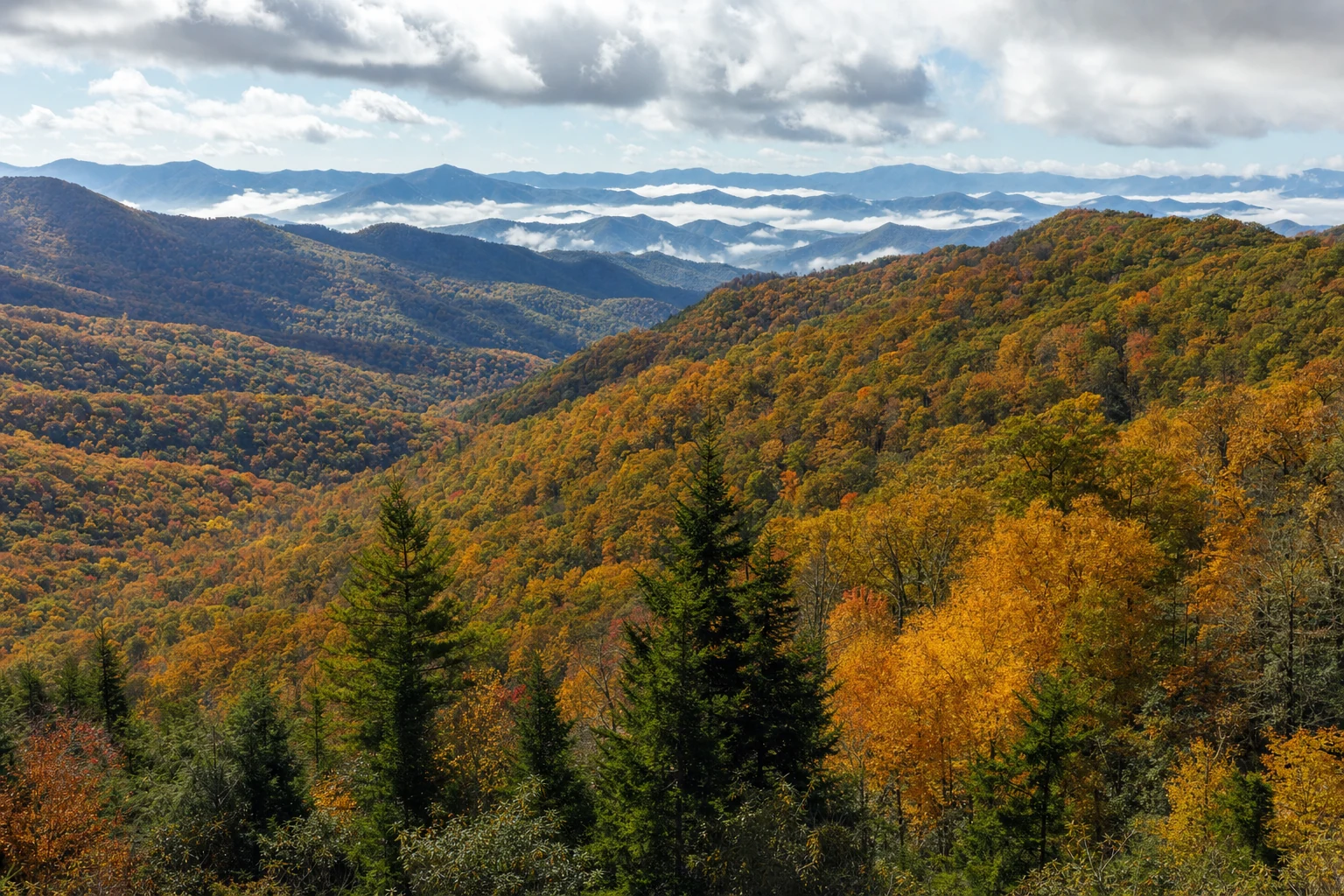

Asheville sits 60 miles east of Cherokee and about 90 minutes from the south entrance of Great Smoky Mountains National Park — far enough to feel like a different world, close enough to make a day trip genuinely workable. For visitors already immersed in the park, a day in Asheville offers a deliberate shift: historic mansion architecture, a dense downtown walkable on foot, a river-arts district built out of former industrial buildings, the densest concentration of craft breweries in the Southeast, and a nationally ranked food scene. This guide covers how to get there, what to prioritize, and when the trip is worth making — and when it isn't.
Getting to Asheville from the Smokies
Two primary routes serve the Smokies-to-Asheville corridor, and they are very different experiences.
From Cherokee, NC — the standard route is I-40 East, roughly 60 miles, about 90 minutes. Highway driving through mountainous terrain, generally reliable in most weather. For a slower, more scenic alternative, the Blue Ridge Parkway picks up at the Oconaluftee Visitor Center (milepost 469.1) and runs north and east toward Asheville. The BRP is stunning — a winding two-lane road with a 45 mph limit and frequent overlooks — but it adds real time. Budget 2.5 to 3 hours for the Parkway route, depending on stops, and check the NPS Blue Ridge Parkway road-status page before committing. Sections above 5,000 feet close regularly in winter and shoulder seasons, fog can be dense, and the Parkway is not the route for a tight schedule or marginal weather.
From Gatlinburg or Pigeon Forge, TN — the drive runs about 2.5 hours, via US-441 south through the national park (past Newfound Gap and the turnoff for Kuwohi, formerly Clingmans Dome), continuing to Cherokee, then east on I-40. Through-traffic on US-441 does not require a Park-It-Forward parking tag, but any stops at overlooks or short hikes within GSMNP boundaries do. Tags are $5 daily, purchasable online at recreation.gov.
Regardless of route, build the drive into the day's budget. A "half-day in Asheville" from Gatlinburg means leaving at 7 AM, arriving by 9:30, and starting home by 3 if the schedule is tight.
Biltmore Estate: America's largest home
The Biltmore Estate is the single biggest draw in Asheville and can easily consume a full day by itself. George Vanderbilt's 8,000-acre estate, completed in 1895, houses America's largest private home, Frederick Law Olmsted-designed gardens, a working winery, and a full village of shops and dining at Antler Hill.
- The house — A self-guided tour of Biltmore House takes 2-3 hours at a normal pace. Original furnishings, period art, and the scale of the rooms (including a 70-foot-tall banquet hall and a two-story library) are the draw. The estate operates on a timed-entry system for the house to manage crowds.
- The gardens — Extensive Olmsted-designed gardens surround the house, with a Conservatory open year-round. Spring bloom and fall foliage are the two prime windows.
- Antler Hill Village & Winery — A short drive from the house, the village includes the Biltmore Winery (complimentary tastings are included with admission), the Biltmore Legacy exhibit, farm animals, additional shops, and a cluster of restaurants.
Tickets are required in advance, especially during peak seasons and weekends. Pricing varies significantly by day, season, and purchase lead time — 2025-2026 rates run from roughly $79 to $109+ per person, with holiday programming (especially Christmas at Biltmore, with candlelight evening tours) at the top end. Parking is included with admission, and shuttle service runs from outlying lots to the house.
Planning realism: a minimum of 4-6 hours for a substantive visit; a full day if walking the gardens thoroughly or dining on-site. First thing in the morning is the best time to tour the house — crowds thicken by mid-morning, and the gardens and Antler Hill read more comfortably later in the day.
Downtown Asheville: architecture, art, and compact walking
Downtown Asheville is compact, dense with Art Deco and neoclassical architecture, and one of the more walkable small-city cores in the Southeast. It rewards unstructured exploration as much as scheduled stops.
- Pack Square Park — The civic heart, a natural starting point. Often hosts free events and concerts.
- Grove Arcade — An architectural landmark and indoor-outdoor marketplace housing independent shops, restaurants, and a food hall. The intricate stone detailing and public-market feel make it a productive stop for browsing, a snack, or a full meal.
- Asheville Art Museum — On Pack Square, focused on 20th and 21st-century American art with a strong Southeastern emphasis. Budget 1-2 hours. Admission charged; hours generally Wednesday-Sunday.
- Thomas Wolfe Memorial — The preserved boyhood home of novelist Thomas Wolfe, author of "Look Homeward, Angel." Guided tours provide a detailed window into early-20th-century Asheville. Admission charged; hours typically Tuesday-Saturday.
- Wandering — Beyond the named stops, downtown repays two or three unhurried hours of walking. Murals, independent bookstores, outdoor gear shops, and boutique retailers fill the blocks between Pack Square and the South Slope.
Parking: public garages are the reliable option. Buncombe County Parking Garage (164 College St), Civic Center Garage (68 Rankin Ave), and Rankin Avenue Garage (60 Rankin Ave) all charge hourly. On-street metered parking exists but is limited and competitive.
River Arts District: working studios and industrial conversion
West of downtown, the River Arts District (RAD) occupies a cluster of former industrial buildings along the French Broad River, converted into working studios, galleries, and small eateries. It is the most distinctive creative-neighborhood experience in the city.
Artists often work on-site in their studios, and most are willing to talk about the work — watching a ceramicist at the wheel or a printmaker pulling a block is part of the draw. Murals cover many of the building exteriors, adding to the bohemian, slightly scruffy aesthetic. The district is vast, and a complete tour is not realistic in a day trip — pick a few studios or galleries of interest, or simply park and wander a few blocks.
The RAD also houses several breweries, most notably Wedge Brewing Company at both the Foundation and Grove Arcade locations, plus Hi-Wire Brewing's Big Top production facility. They make a logical beer-and-food break between studio visits.
Logistics: Weekends see more studios open and artists present. The first Friday of each month features gallery walks and special events. Parking can be challenging — some studios have small private lots, and free street parking fills quickly on weekends. Arriving prepared to walk a few blocks is the path of least resistance.
South Slope: the brewery district
Adjacent to downtown on its southern edge, the South Slope is Asheville's densest concentration of craft breweries — and the practical reason the city earned the "Beer City USA" moniker. The district is walkable, which is the point: visitors move between tasting rooms on foot rather than driving.
Anchor stops include:
- Wicked Weed Brewing — The original brewpub at 91 Biltmore Ave, with a full kitchen.
- Burial Beer Co. — Known for heavy, boundary-pushing styles.
- Hi-Wire Brewing — The original taproom (distinct from the production facility in the RAD).
- Green Man Brewery — One of the city's older operations, with a large outdoor deck.
Most breweries open by late morning or early afternoon and run well into the evening. Food trucks rotate through the patios, and several locations have full kitchens. Designated drivers or ride-share are the only responsible option if tasting across multiple stops — the South Slope is a sampling district, not a drink-and-drive district. Public parking garages serving downtown also cover the South Slope; Buncombe County and Civic Center Garages are both within walking distance.
The food scene
Asheville's culinary reputation has been earned. The range runs from whole-hog barbecue to upscale Spanish tapas, with a deep bench of farm-to-table restaurants in between.
- Buxton Hall BBQ — 32 Banks Ave (South Slope). Whole-hog, Eastern Carolina-style barbecue. Casual, reliably excellent. One of the local consensus favorites.
- Cúrate — Authentic Spanish tapas downtown, widely considered one of the best restaurants in the region. Reservations are essential, often weeks or months in advance for dinner.
- 12 Bones Smokehouse — Famous for distinctive sauces and tender ribs. Two locations (River Arts District and South Asheville). Popular for lunch; expect a line.
- Biscuit Head — Creative biscuit sandwiches and a multi-gravy "gravy bar." Long waits on weekends; arrive early. Multiple locations.
- Other options — A deep bench of farm-to-table, international, and coffee-focused spots fills in the gaps. Local food publications maintain current recommendation lists worth scanning before a trip.
Planning reality: for Cúrate, reservations must be made well in advance — often before the trip is even booked. For Biscuit Head, walk in early. For everything else, a short wait is the default, especially on weekends.
Half-day vs. full-day itinerary
Half-day (4-6 hours in Asheville). A half-day trip requires ruthless prioritization. Two realistic options:
- Biltmore focus — Dedicate the entire window to Biltmore. Arrive early, tour the house, and walk a portion of the gardens or visit the winery at Antler Hill. This is the best choice for first-time visitors whose primary interest is the estate.
- Downtown + South Slope — Two to three hours downtown (Pack Square, Grove Arcade, a museum or shopping), then two to three hours in the South Slope for a brewery stop or two and a casual meal. Skips Biltmore but captures the urban character of the city.
Full day (8-10+ hours in Asheville). The full day allows combining districts:
- Morning (9 AM-2 PM): Biltmore Estate. Arrive at opening, tour the house, explore a significant portion of the gardens, lunch on the estate.
- Afternoon (2:30-5:30 PM): Drive to downtown, park in a public garage, walk Pack Square and Grove Arcade. Optional museum stop.
- Evening (5:30 PM onwards): Choose one of the following — the River Arts District with Wedge Brewing and dinner at 12 Bones; the South Slope with a Wicked Weed or Burial stop and dinner at Buxton Hall; or a reserved evening at Cúrate or another downtown fine-dining room.
When it's worth the trip — and when to skip
Go when:
- Shoulder seasons — April-May and September-October offer pleasant weather, spring bloom or fall color, and more manageable crowds. The ideal window.
- Weekdays — Tuesday through Thursday are dramatically easier than weekends at Biltmore and downtown parking.
- Strong interests — If art, craft beer, architecture, or the specific food experiences matter to the trip, Asheville rewards the drive.
- Craving a change of pace — When several consecutive days in the national park have built up a taste for urban exploration, culture, and varied dining, Asheville supplies all of it within a reasonable drive.
Reconsider when:
- Major holidays and peak summer weekends — Memorial Day, Fourth of July, Labor Day, and July-August Saturdays bring heavy traffic, crowded house tours, difficult parking, and long waits. Book everything in advance or shift the day.
- Winter (January-February) — Biltmore is open year-round and is genuinely magical during Christmas at Biltmore. But many outdoor activities and gardens are reduced, and the Blue Ridge Parkway is frequently closed.
- Marginal weather — Heavy rain or snow significantly degrades walking tours, outdoor brewery patios, and scenic drives.
- Very limited time or budget — If the window is under four hours or Biltmore tickets don't fit the budget, a focused half-day with only free downtown exploration may feel more rewarding than trying to compress too much.