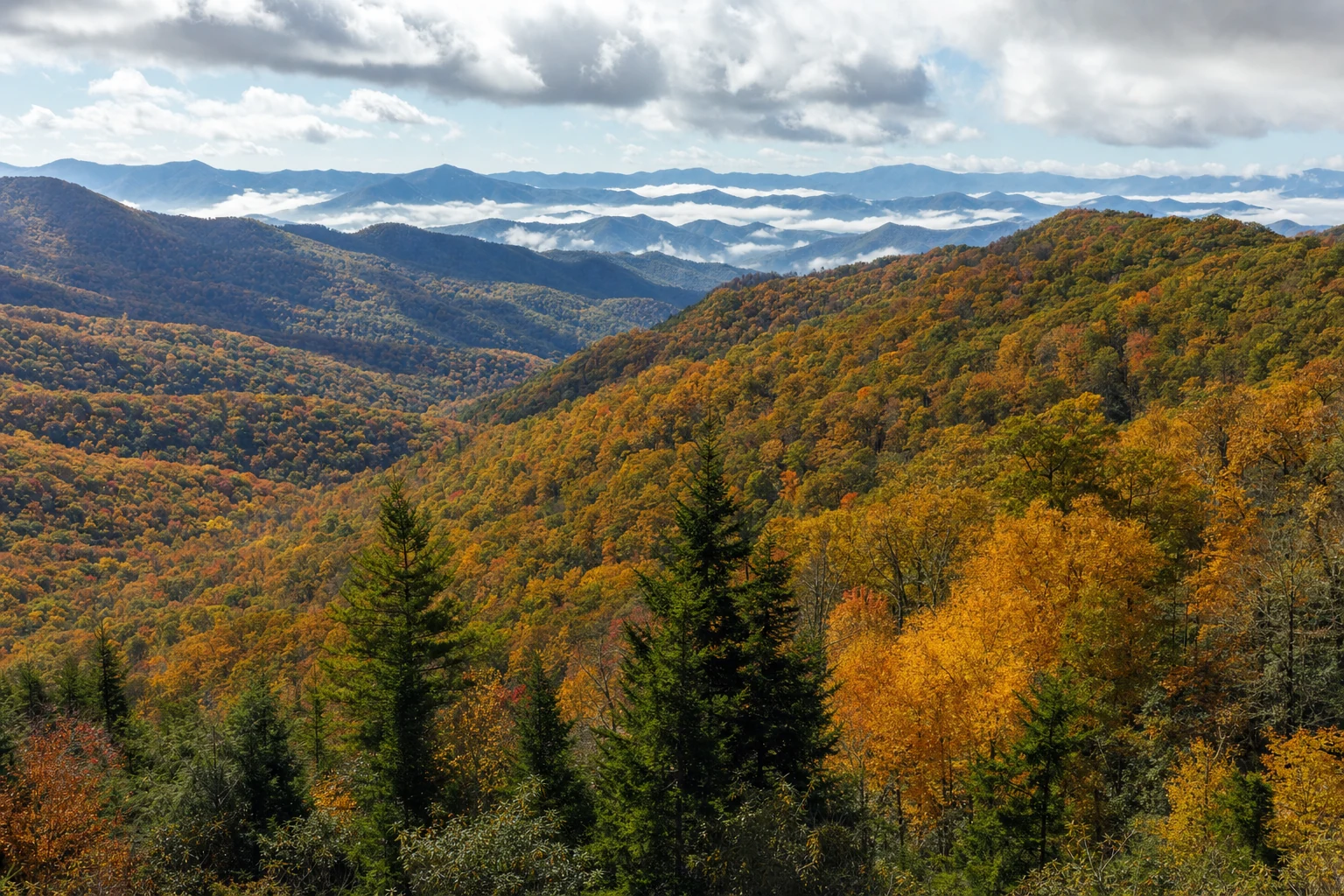

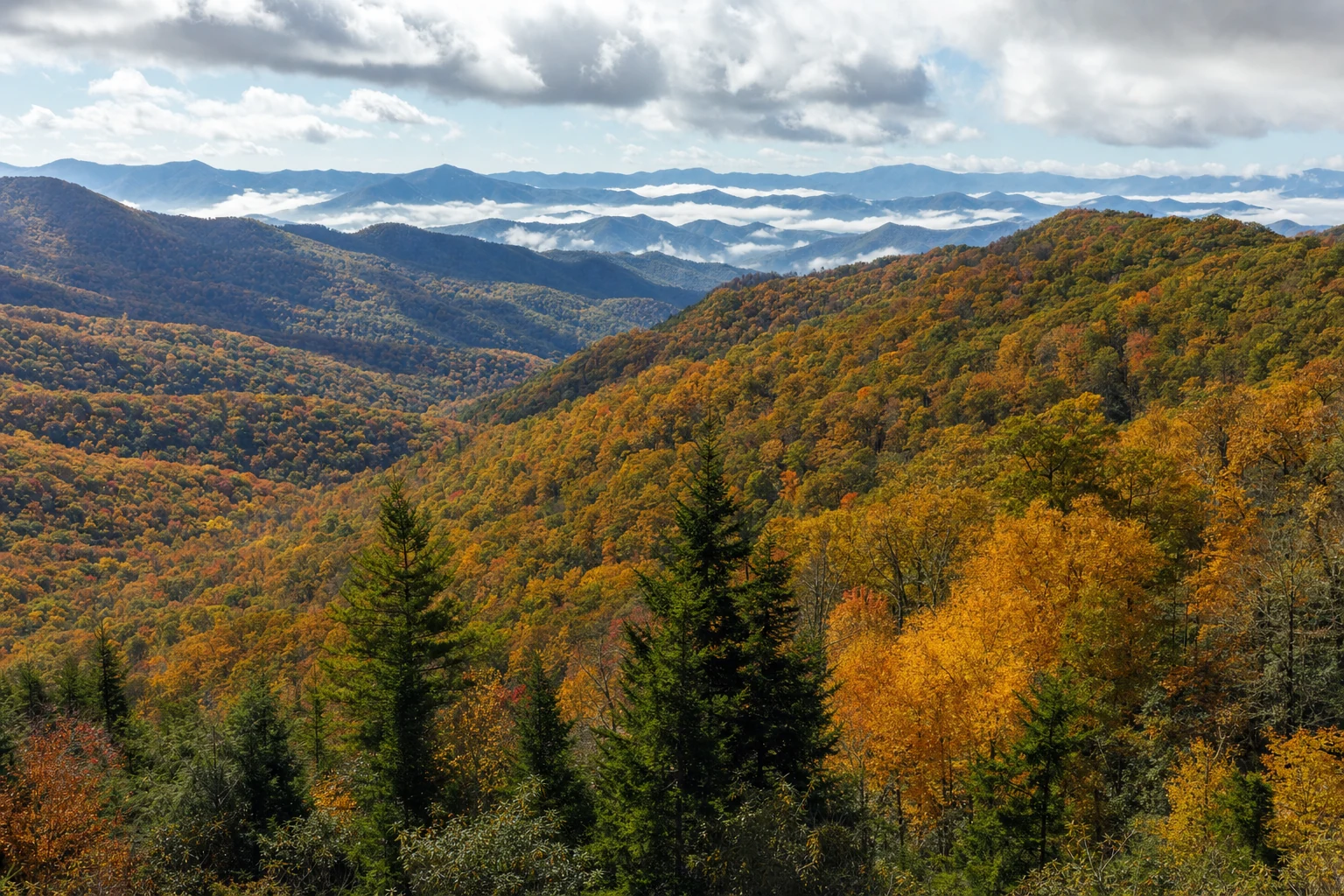
The Great Smoky Mountains stage one of North America's most spectacular fall foliage displays — a six-week progression of color driven by the park's 5,000-foot elevation range. Color starts at the highest peaks in late September and descends into the valleys by early November. Understanding how elevation drives the show is the single most useful piece of planning intelligence you can have.
Peak color timing by elevation
The park's 5,000+ foot elevation range means color arrives in waves, not all at once.
- Above 4,500 feet (late September to early October) — Kuwohi (formerly Clingmans Dome), Andrews Bald, and the high sections of the Appalachian Trail around Charlies Bunion. American beech, yellow birch, and mountain maple glow yellow and orange; mountain ash and pin cherry add deep reds. Prepare for cold — expect 38–50°F temperatures and possible early-season frost or snow flurries.
- 2,500–4,500 feet (mid to late October) — Newfound Gap Road (US-441), Chimney Tops overlook, and the higher Foothills Parkway sections. Sugar maple, scarlet oak, and hickory create a rich tapestry of red, orange, and gold. This is the most widely-anticipated viewing window and by far the busiest for vehicle traffic.
- Below 2,500 feet (late October to early November) — Cades Cove, the Gatlinburg and Pigeon Forge valleys, and the lower Foothills Parkway. Red maple, sourwood, and dogwood deliver brilliant reds; tulip poplar and birch bring yellow. By week one of November, the high peaks have shed their leaves but the valleys are still on fire.
Week by week
Late September: First splashes of yellow and scattered red appear above 5,000 feet. Kuwohi, Andrews Bald. Overall landscape still green.
Week one of October: High elevations (4,500+ ft) hit peak. Kuwohi and Charlies Bunion are stunning. Mid-elevations start to yellow.
Week two of October: Color progresses rapidly into mid-elevations. Newfound Gap Road becomes vibrant. High elevations may start to fade.
Week three of October (usually the prime week): Spectacular mid-elevation color everywhere. Newfound Gap, Foothills Parkway sections at peak. Lower elevations begin to show early reds.
Week four of October: Mid-elevation color declines slightly. Lower elevations — Cades Cove, the gateway town valleys — approach peak. Excellent color in town.
Week one of November: Lower elevations at or just past peak. Cades Cove and river valleys still beautiful. Upper ridges largely bare.
Best drives for color
Newfound Gap Road (US-441) climbs from 1,400 ft at Sugarlands to 5,046 ft at Newfound Gap, crossing every color zone in 33 miles. Reliable choice for reliable color through October. Heavy traffic on weekends — start before 8 AM.
Blue Ridge Parkway MP 411–469, from Soco Gap near Cherokee north to Balsam Gap, includes Waterrock Knob (the highest visitor center on the 469-mile Parkway) and delivers the earliest high-elevation color. Weather closes the BRP above 5,000 ft regularly in shoulder seasons — check status before you drive up.
Foothills Parkway (east and west segments) runs lower-elevation with less traffic than Newfound Gap. Mid-October is prime. The completed West segment between Wears Valley and Walland has stunning southwest-facing overlooks.
Cades Cove Loop Road peaks late October to early November. The 11-mile one-way loop fills with traffic by 9 AM on weekends. Arrive at dawn or go Wednesday (pedal-and-paddle, vehicle-free in summer; reverts to normal in fall) for smooth passage.
Best hikes for color
Andrews Bald (1.8 miles one-way from Kuwohi parking, 890 ft descent then climb on return, moderate): high-elevation grassy bald with panoramic views, peak late September to early October.
Charlies Bunion (4 miles one-way from Newfound Gap, strenuous): along the Appalachian Trail with incredible high-elevation views and unique rock formations. Peak color late September.
Mt. Cammerer (11.1 miles round-trip via Low Gap Trail from Cosby, strenuous): historic stone fire tower with 360° views over the Pigeon River gorge. Mid-October peak color along the trail.
Alum Cave to Mt. LeConte (11 miles RT, strenuous): the mixed-elevation classic. Color en route rotates through the zones as you climb.
Crowd-avoidance strategies
- Weekdays beat weekends. Mondays through Thursdays see far lighter traffic on Newfound Gap Road and at popular trailheads.
- Arrive before 8 AM at Cades Cove, Kuwohi, Newfound Gap, and Laurel Falls. Parking fills by 9.
- Use Cosby and Wears Valley entrances on the TN side, or Cataloochee on the NC side. All see a fraction of Gatlinburg or Cherokee traffic.
- Late afternoon for sunsets. By 3 PM, tour buses are heading home. Golden-hour light on the Parkway after 4 PM is the best of the day.
- Park It Forward tag: required for any vehicle parked more than 15 minutes in GSMNP. Buy online ahead at recreation.gov — $5 daily, $15 weekly, $40 annual. No in-person exceptions; ranger enforcement is active in fall.
What affects the color
- Cool nights, warm days: the ideal recipe for deep reds and oranges. Sugar maples especially respond to cool temps.
- Rainfall through summer: a wet summer produces more vivid color; a severe drought can cause early leaf drop or dull colors.
- Early frost: speeds progression. Late frost delays it.
- Wind and storm: severe October windstorms (which do happen) can strip leaves before peak — check forecasts in the week leading up to your visit.
Fall events worth planning around
- Dollywood Harvest Festival (late September through late October): Parton-scale pumpkin displays, corn mazes, craft demonstrations, special shows. Separate ticket.
- Gatlinburg Craftsmen's Fair (late October, overlapping peak color): the largest juried craft fair in the region, 180+ booths in the Convention Center.
- Pigeon Forge Fall Rod Run (mid-September): classic cars take over the Parkway for a weekend.
- Cherokee fall cultural programming (all season): Museum of the Cherokee People, Oconaluftee Indian Village, Unto These Hills runs through October.
Photography notes
Overcast or foggy mornings yield the richest color saturation — harsh midday sun washes leaves to pale versions of themselves. Newfound Gap at dawn during a cloud inversion (common late-fall morning, after a cool clear night) is the classic shot. Wide-angle for landscape; telephoto compresses ridge lines for the layered-ridges look the Smokies are famous for. Bring a tripod for low-light forest shots along Roaring Fork.