
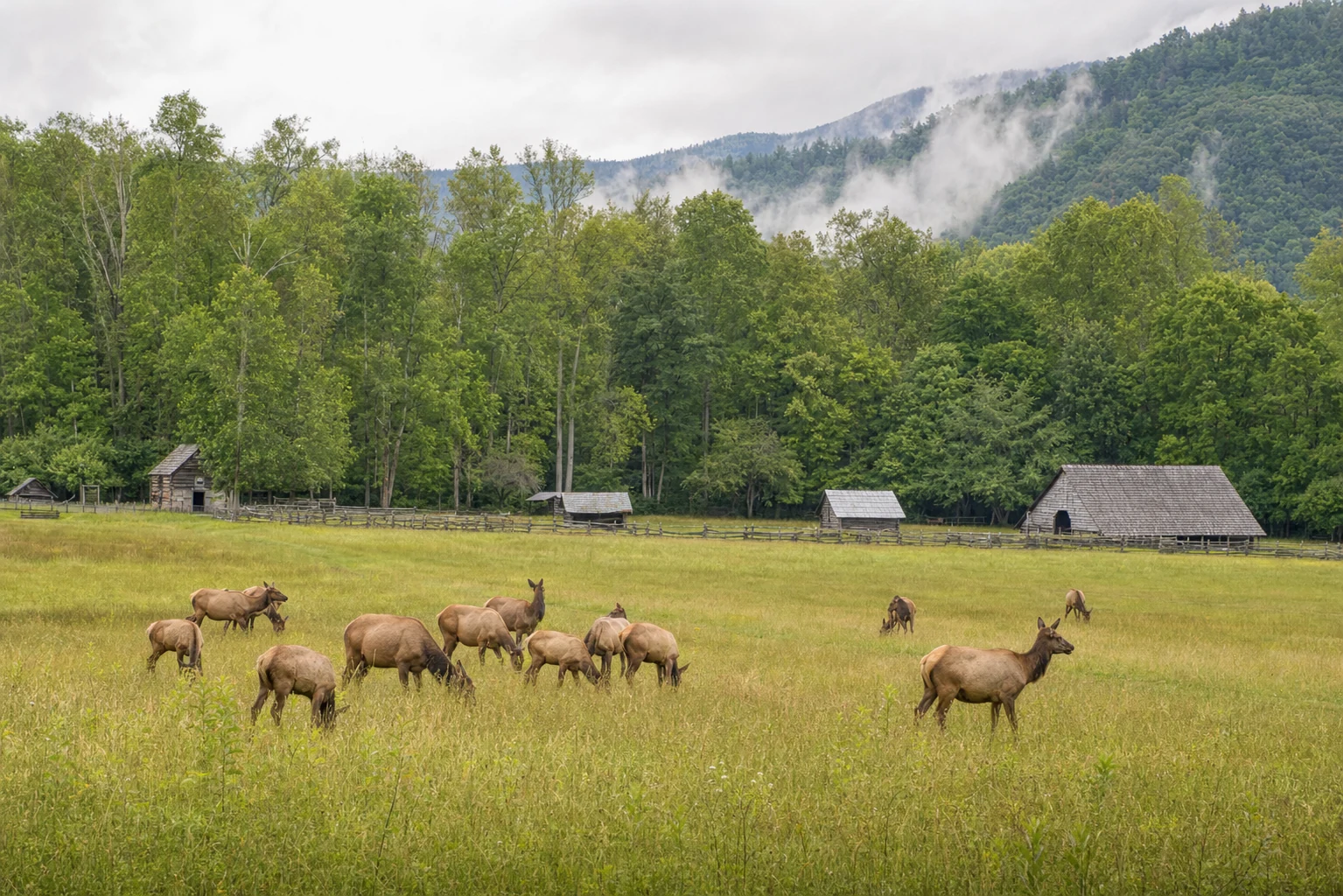
Elk (Cervus canadensis) were reintroduced to Great Smoky Mountains National Park starting in 2001, after an absence of about 150 years. The herd today numbers about 200 animals across two primary ranges — Cataloochee Valley on the east side and the Oconaluftee Valley at the park's North Carolina entrance — and the annual September rut (breeding season) is one of the great wildlife spectacles in the eastern United States.
Where to see elk
Cataloochee Valley (northeast NC side): the larger of the two herds, typically 100+ elk. Reached via a winding gravel road (Cove Creek Road) from Maggie Valley or from Cherokee via Heintooga Ridge Road. Most visitors arrive in the early morning or late afternoon and park along the valley-floor field edges. Calved cows and bulls use the broad open fields here; bull-territory fights during rut are most dramatic.
Oconaluftee Valley (near Cherokee, NC): a smaller but more accessible herd, typically 40–60 elk. The Oconaluftee Visitor Center is just north of Cherokee; elk graze the fields on both sides of the road between Cherokee and the visitor center. Best viewing windows overlap with Cataloochee.
When to see them
Dawn and dusk, year-round. Elk are crepuscular grazers — they feed most heavily in the first hour after sunrise and the last hour before sunset. Mid-day elk are usually bedded in the tree line, invisible or barely visible.
The rut: mid-September through mid-October. Bulls (adult males) gather harems of 10-20 cows (adult females), bugle constantly to claim territory, and fight other bulls for dominance. The bugling — a rising whistle that ends with a grunting cough — echoes across Cataloochee at dawn and dusk during peak rut. Easily heard from the road.
Calving: late May through June. Cows hide newborn calves in the grass and return to nurse. Do not approach any cow with a young calf — they are more defensive in this window than bulls are during rut.
Antler drop: late October through early December. Bulls shed their antlers; shed antlers on the valley floor are a common sight in November. Do not remove — they are park property.
Winter: elk remain in both valleys year-round. Cataloochee can see the entire herd bedded in a field at dawn in January, when the tree cover doesn't matter as much.
The viewing rules
50-yard minimum. Elk are large (bulls 700–1,100 lbs), fast (30+ mph), and powerful. Federal law requires 50 yards of distance from elk, same as bears. During rut, give bulls much wider berth — 100+ yards is safer. They have been known to charge vehicles that got too close.
Do not approach on foot. Stay by your vehicle or on designated road corridors. Never walk into the open fields toward the herd. Never try to get between a bull and his harem, or a cow and her calf.
Keep dogs leashed and out of sight. Dogs trigger elk defensive response more aggressively than humans alone.
Quiet voices. Conversation at normal volume is fine. Shouting, whistling, or any attempt to call elk closer is both illegal and harmful to them.
Photography. Use a telephoto lens — 300mm minimum, 500+ mm preferred. Do not use flash. Shutter pressed calmly; the click is fine. Never use bugle calls, antler rattles, or any sound recording to attract animals.
Rut viewing specifics
September rut draws the biggest crowd of the year at Cataloochee. Plan:
- Arrive at Cataloochee before dawn (6 AM on a September morning)
- Park along the valley-floor road; viewing is from the road edge, not the fields
- Dress warm — valley temperatures run 20°F cooler than Maggie Valley
- Bring binoculars; a spotting scope if you have one
- Bugling peaks at dawn and sunset; mid-day is quieter
- Plan to stay 2+ hours; the behavior unfolds in waves
At Oconaluftee, fall weekend crowds are large but the experience is significant. Rangers often staff the viewing area to enforce distance rules and answer questions.
Cataloochee access
The 15-mile gravel road from Maggie Valley (Cove Creek Road) is twisting and narrow — not suitable for RVs or trailers. Allow 45 minutes one-way for the drive. From Cherokee, the Heintooga Ridge Road is an alternate but closes seasonally. Alternatively, enter the park via Big Creek and take the backcountry Mt. Sterling Road (4WD recommended).
Cataloochee Campground (26 sites) is the overnight option in the valley; reservations via recreation.gov. Summer weekends and October fill 6+ months ahead.
The broader context
Elk historically roamed the eastern U.S. from Maine to the Gulf but were extirpated by the early 1800s due to over-hunting and habitat loss. The GSMNP reintroduction used animals from Kentucky and North Dakota; the herd has grown slowly and is considered a success story. Park biologists monitor health, disease (chronic wasting disease is a concern for elk populations; GSMNP remains uninfected), and expansion into new ranges.
The Eastern Band of Cherokee Indians, on whose ancestral land much of this range lies, have been central partners in the reintroduction and management of the elk. The animals hold deep cultural significance.