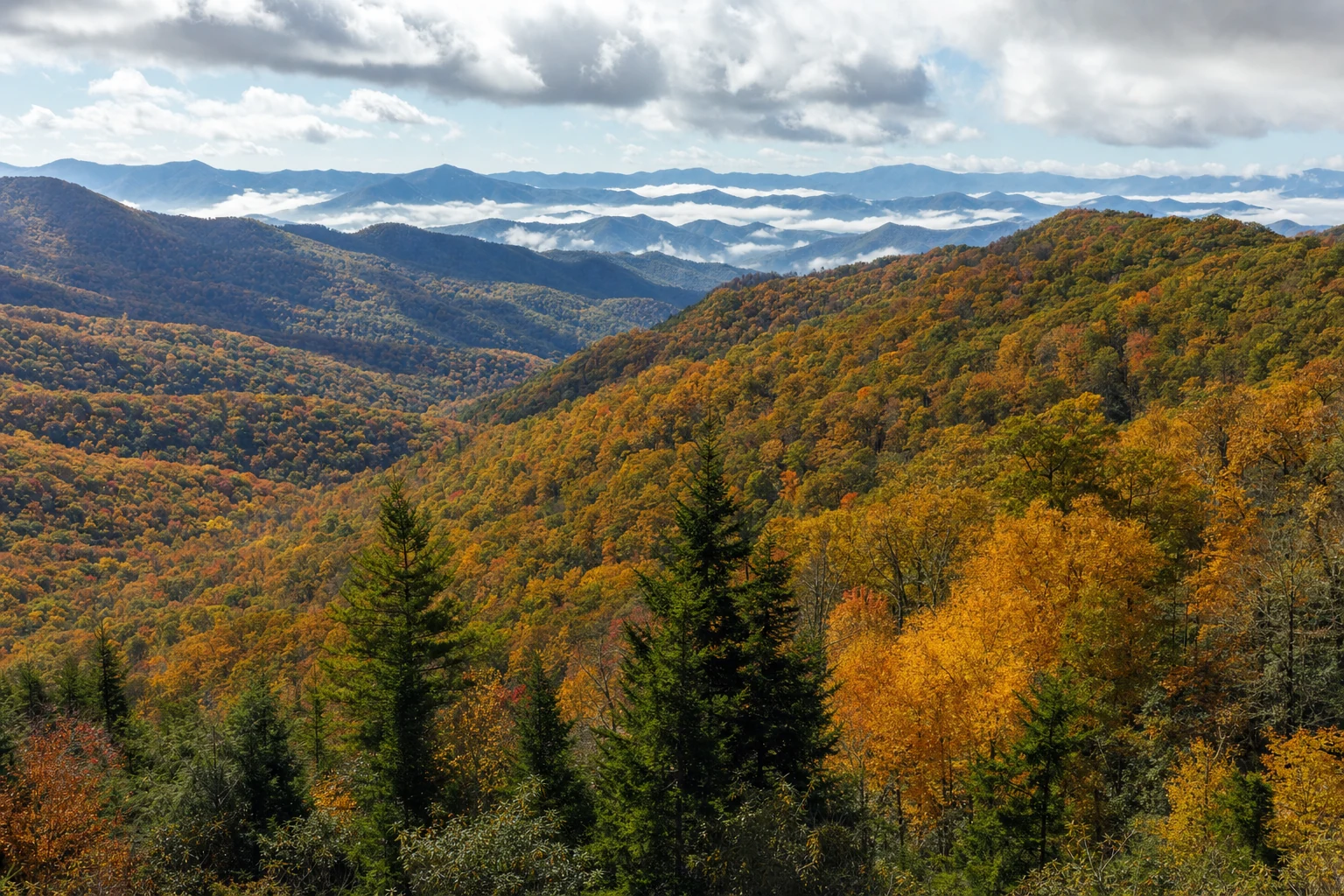

The Great Smoky Mountains National Park is one of the youngest major U.S. national parks, dedicated in 1940 and fully developed over the following decades — but the human history of these mountains spans at least 11,000 years. The story of the park is the story of the people who were here before the park, the movement to create it, the hundreds of families displaced, and the ongoing work to honor all that history.
The ancient past
The southern Appalachians are among the oldest mountain systems on earth, predating even the Atlantic Ocean. The rocks of Clingmans Dome (Kuwohi) are over a billion years old; these were once higher than the current Himalayas, worn down over 300 million years into today's rounded summits.
Human habitation dates to at least 9,000 BCE — stone-age hunting groups who followed megafauna through the valleys. By 1000 BCE, agricultural communities had developed. By 1000 CE, the Mississippian culture (mound builders) was active in the lower river valleys. The Cherokee — who emerged from this broader Mississippian heritage — established towns throughout the region by 1500 CE.
European contact
Spanish expeditions under Hernando de Soto (1540) and Juan Pardo (1567) made the first European contact with the Cherokee in what's now western North Carolina. The Spaniards were searching for gold and silver; they moved on, but introduced diseases that decimated Native populations.
British traders from coastal Carolina established commerce with the Cherokee by the mid-1700s. By the American Revolution, the Cherokee held treaties with Britain; after the war, U.S. relations were unstable and often violent. Cherokee territory steadily shrank through forced cession treaties.
The Trail of Tears
In 1838-39, the U.S. government forcibly removed approximately 16,000 Cherokee people from their southeastern homelands to Oklahoma (then "Indian Territory"). Roughly 4,000 died. A small number of Cherokee — perhaps 400 — hid in the high mountains and eventually became the core of today's Eastern Band of Cherokee Indians. The Qualla Boundary, the EBCI's sovereign lands, sits just outside the park.
See [Cherokee culture](/cherokee-culture/) for full context.
Settler communities
Following removal, European-American settlers moved into the mountain hollows: primarily Scots-Irish, German, and English families who built small subsistence farms. By 1850, thousands of families lived in what's now the park — in Cades Cove, Cataloochee, Greenbrier, Sugarlands, Elkmont, and dozens of smaller settlements.
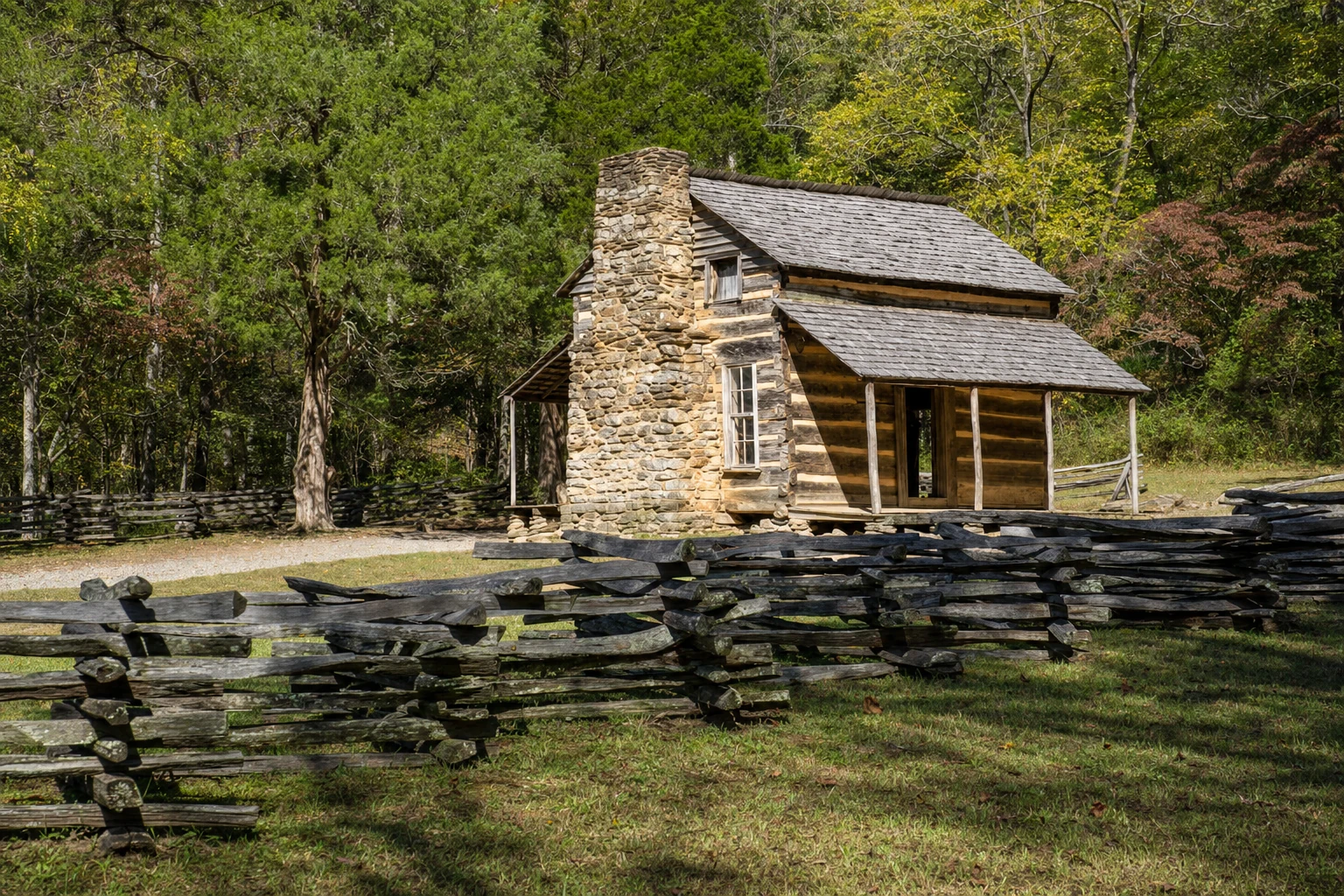
These communities were largely self-sufficient: corn, beans, squash, livestock, hunting, and logging. They built churches (often Baptist), one-room schools, and water-powered corn and sawmills. Many of the preserved buildings you'll see in the park date to this era.
The logging era
In the early 1900s, large-scale logging swept the southern Appalachians. Companies like Little River Lumber Company (operating out of Townsend) and Champion Fibre Company (based at Sunburst) stripped enormous tracts of old-growth forest. The logging railroads ran up every major drainage; by the 1920s, much of the Smokies had been cut. What remained was some of the last old-growth hardwood forest east of the Mississippi — which became a central rationale for preservation.
The push for a national park
By the 1910s, Americans had seen the destruction of the western wilderness and were organizing to protect eastern forests. The Appalachian National Park movement identified the Smokies as a prime candidate. Key figures:
- Horace Kephart (author of "Our Southern Highlanders," 1913): wrote extensively about the southern mountains and the need for preservation
- Gatlinburg pastor David Chapman and others lobbied state and federal authorities
- Laura Thornborough, a Chattanooga-based outdoor writer, campaigned tirelessly
- Anne Davis and the Knoxville-based Great Smoky Mountains Conservation Association organized private fund-raising
Funding was the obstacle. Unlike western parks created from federal land, a Smokies park required buying private land. The Tennessee and North Carolina legislatures pledged $2 million each in 1927. John D. Rockefeller Jr. donated $5 million in 1928 in honor of his mother. Private fundraising added more. By 1930, enough land had been acquired that the park was formally authorized.
The displacement
Creating the park required removing 6,600 people from their homes. The removals were orderly (unlike the Trail of Tears) — families were offered fair-market compensation, or lifetime leases (some people remained in place until the 1980s) — but the displacement was still traumatic. Entire communities were dismantled. Family graveyards, churches, and homesteads were abandoned or partially preserved.
The park has since worked to tell these stories with more honesty — the Mountain Farm Museum, Cades Cove preserved buildings, Cataloochee Valley, and interpretive signage across the park.
CCC era
The Civilian Conservation Corps, Roosevelt's Depression-era work program, built much of the park's foundational infrastructure between 1933 and 1942:
- Newfound Gap Road
- Many of the bridges and stone walls
- Trails and visitor centers
- Cades Cove Loop Road
- The Clingmans Dome (Kuwohi) tower
- Fire lookouts (most since removed, Mt. Cammerer preserved)
CCC workers were young men, many from Appalachian families, put to work building the park. Their labor shaped the structure you experience today.
Dedication
The park was formally dedicated on September 2, 1940, by President Franklin D. Roosevelt at Newfound Gap. The dedication ceremony drew over 10,000 people. The park had technically been authorized since 1934, but 1940 marked the official public opening.
Post-dedication history
- 1966: The park becomes one of the first International Biosphere Reserves
- 1983: UNESCO designates it a World Heritage Site
- 1996: Kituwah returned to EBCI ownership
- 2001: Elk reintroduction begins in Cataloochee
- 2016: Chimney Tops 2 wildfire — devastating fire burns through Gatlinburg, damages park facilities and forests; rebuilding ongoing
- 2023: Park It Forward parking tag program begins
- 2024: Clingmans Dome officially renamed Kuwohi, honoring Cherokee heritage
The museum buildings
The park preserves over 80 historic structures across several districts:
- Cades Cove: ~60 preserved buildings — John Oliver Cabin (oldest, ~1820s), Primitive Baptist Church, Methodist Church, Missionary Baptist Church, Elijah Oliver Place, John Cable Mill, Gregg-Cable House, Tipton Place, Carter Shields Cabin
- Cataloochee: Palmer Chapel, Beech Grove School, Caldwell House, Hiram Caldwell House, Woody House, Steve Woody House
- Roaring Fork: Ephraim Bales Cabin, Alfred Reagan Cabin, Place of a Thousand Drips
- Mountain Farm Museum: John Davis Cabin, Enloe Barn, springhouse, various outbuildings — recreated 1850s-era subsistence farm
- Elkmont: Wonderland Hotel ruins, Appalachian Clubhouse (preserved), historic summer cottages (some restoration in progress)
Most are freely enterable but come with rules — no climbing, no removal of artifacts, respect fragile woodwork. The Walker Sisters cabin in the Greenbrier area is particularly worth visiting for its story: five sisters lived in the cabin until the 1960s, famously declining to leave even after the park was established.
What to read
- "Our Southern Highlanders" by Horace Kephart (1913) — foundational
- "Strangers in High Places" by Michael Frome — classic history
- "Gatlinburg: Window to the Park" by J.L. Martin
- "Cades Cove: The Life and Death of a Southern Appalachian Community" by Durwood Dunn
- "The Great Smoky Mountains National Park" (National Geographic) — photographic survey
Timeline quick reference
| Year | Event | |------|-------| | 9000 BCE | First human habitation | | 1540 | De Soto contact with Cherokee | | 1838 | Trail of Tears (Cherokee removal) | | 1850s | Peak European settlement | | 1900s-1920s | Logging era peaks | | 1923 | Campaign for national park begins | | 1926 | Park authorized | | 1928 | Rockefeller donation | | 1934 | Park officially established | | 1940 | FDR dedicates the park | | 1966 | Biosphere Reserve designation | | 1983 | UNESCO World Heritage Site | | 2001 | Elk reintroduction begins | | 2016 | Chimney Tops 2 wildfire | | 2023 | Park-It-Forward begins | | 2024 | Clingmans Dome renamed Kuwohi |