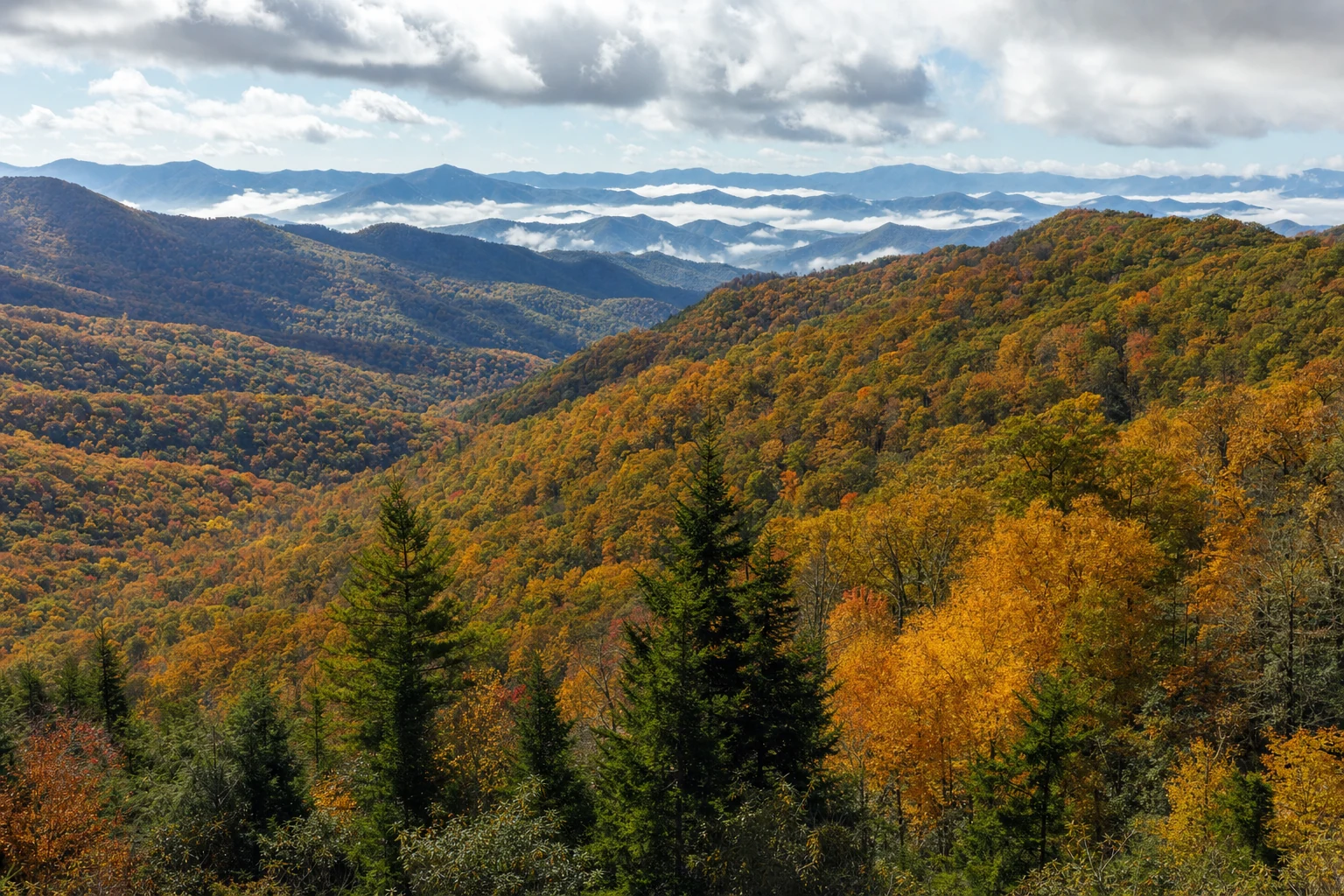

Great Smoky Mountains National Park has approximately 1,500 black bears across 522,000 acres — one of the densest populations of American black bear (Ursus americanus) anywhere in the lower 48. Almost every visitor who spends multiple days in the park will see one, and the large majority of sightings are positive. But food-conditioned bears are a growing problem, bear-human conflicts happen every year, and a handful of people have been injured or killed by bears in the park's history. This page is about staying safe — for you and for the bears.
The biology briefly
Black bears in the Smokies:
- Weigh 150–400 lbs typically; large males can exceed 500 lbs
- Live 15–30 years in the wild
- Are most active March–November; enter a torpor state in winter (not true hibernation)
- Eat primarily plants, berries, nuts, insects, and occasional carrion — they are not predators in the dangerous sense
- Are excellent climbers (all of them), strong swimmers, and capable of 30+ mph sprints
- Have extraordinary senses of smell — 2,100 times more sensitive than humans — which is why food management matters so much
The 50-yard rule
Federal law requires that you stay at least 50 yards (half a football field) from a black bear at all times. Violating the rule is a federal misdemeanor and can result in a $150+ fine. More importantly, it protects both you and the bear — close proximity stresses the animal and normalizes human presence in ways that reduce bear survival.
If you cannot maintain 50 yards, either back away or wait quietly where you are.
Encounter protocol
If you see a bear from a safe distance (50+ yards): 1. Stop. Assess. Is the bear aware of you? 2. If aware, stand still and observe calmly. Bears usually move on 3. If unaware, quietly back away and choose a different path 4. Do not approach for a photo. Use telephoto or crop later
If a bear approaches you or gets within 50 yards: 1. Make yourself look as large as possible. Raise arms, open jacket, stand tall 2. Make noise. Shout firmly. Clap your hands 3. Back away slowly. Do not run 4. Keep the bear in view. Do not turn your back 5. If you're with children or pets, keep them close and behind you 6. If you have bear spray, unholster it
If a bear charges: 1. Stand your ground. Most charges are bluffs — the bear will stop or veer off 2. If it continues, fight back aggressively with anything you have (rocks, sticks, poles, hands) 3. Do not play dead with black bears. That's grizzly advice and it's wrong for black bears — playing dead increases your risk. Fight back 4. Aim strikes at the bear's face and eyes
If you're attacked:
- A predatory attack (rare — more common with food-conditioned bears) requires active defense
- Black bear bites and claw strikes are serious but survivable if you fight back — the animals are opportunistic and retreat when meeting resistance
- After any contact, seek medical attention immediately, regardless of wound severity — rabies and infection risk is real
Bear spray
Bear spray is a highly effective, long-range pepper-based deterrent. The research is clear: in the rare event of a bear attack, bear spray outperforms firearms in preventing injury. You can purchase bear spray in Gatlinburg outfitters and at REI.
- Carry it on a holster at hip, not buried in the pack
- Know how to use it before you need to — practice the draw
- Don't carry expired spray; it loses effectiveness
- Never apply preventively to tents, gear, or your body — that would actually attract bears
- Federal TSA rules: bear spray cannot fly in carry-on or checked luggage. Buy locally
Food storage is everything
The number one cause of bear-human conflict is humans feeding bears, intentionally or accidentally. A bear that associates humans with food:
- Loses its natural fear of humans
- Becomes persistent in approaching campsites, picnickers, and vehicles
- Eventually becomes dangerous
- Eventually requires lethal removal by park rangers
In a campground or cabin:
- Every GSMNP frontcountry campsite has a bear-proof food box — use it
- Never leave food, coolers, trash, pet food, or scented items (toothpaste, sunscreen, deodorant) outside your vehicle or bear box
- Store trash in the provided dumpsters — they are bear-resistant
- Never cook or eat inside your tent
- Clean your campsite thoroughly at the end of meals and overnight
In the backcountry:
- Park-provided bear cable at most backcountry sites — hang food properly
- Alternative: approved bear canister (required for solo overnight trips)
- Never sleep with food, deodorant, or toothpaste in or near your tent
- Cook at least 100 yards from your sleeping area
In your vehicle:
- Windows up, food in trunk when possible
- A bear can break a window for a scented snack; this is not hypothetical
Backcountry specifics
- All overnight backcountry stays require a permit via recreation.gov
- Food must be hung on provided cables or in a canister
- Campfire policy varies by site — check current rules
- Report any close encounters to park staff
- Bring a whistle; carry bear spray
Incidents worth knowing
The park has averaged 1-2 documented bear injuries per year over the past decade. Causes are overwhelmingly: 1. Bears food-conditioned through visitor feeding 2. Bear-human encounters at close range (inside 50 yards) 3. Sleeping with food or scented items in the tent
Fatal black bear attacks in GSMNP are rare historically but have happened. In each case, food-conditioning and proximity were contributing factors.
When to call the park
Call park dispatch at 865-436-1230 (or 911 for true emergencies) to report:
- Any bear that charges or contacts a person
- Any bear showing persistent habituation (approaching people, entering buildings, damaging property)
- Any bear with a visible injury
- Any cub separated from its mother
The bottom line
Respect the distance, manage your food, don't run, carry spray if you're in the backcountry, and you will almost certainly have only positive bear sightings during your trip. Food-conditioned bears are the dangerous ones, and the way to keep bears wild is to keep human food unavailable.