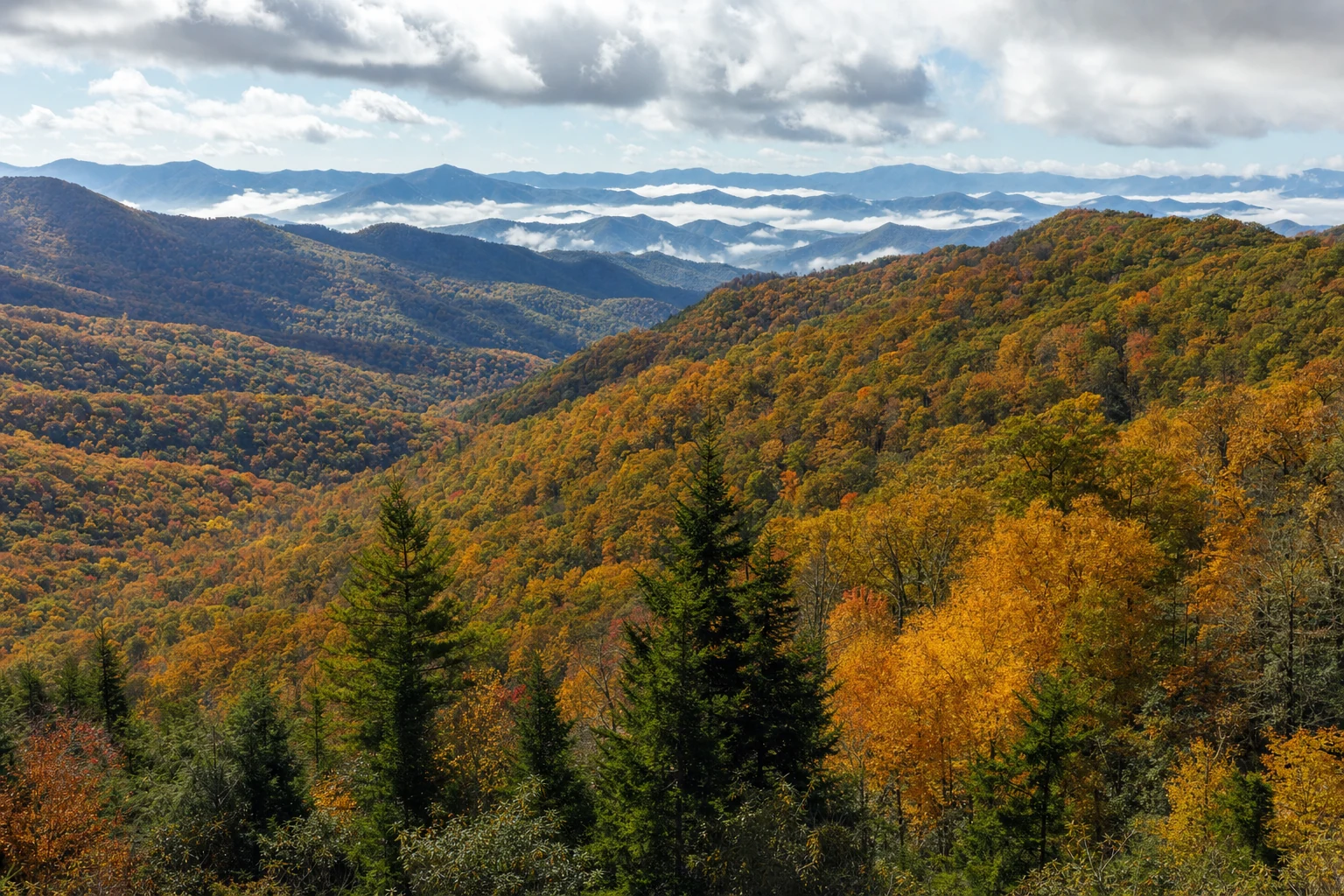

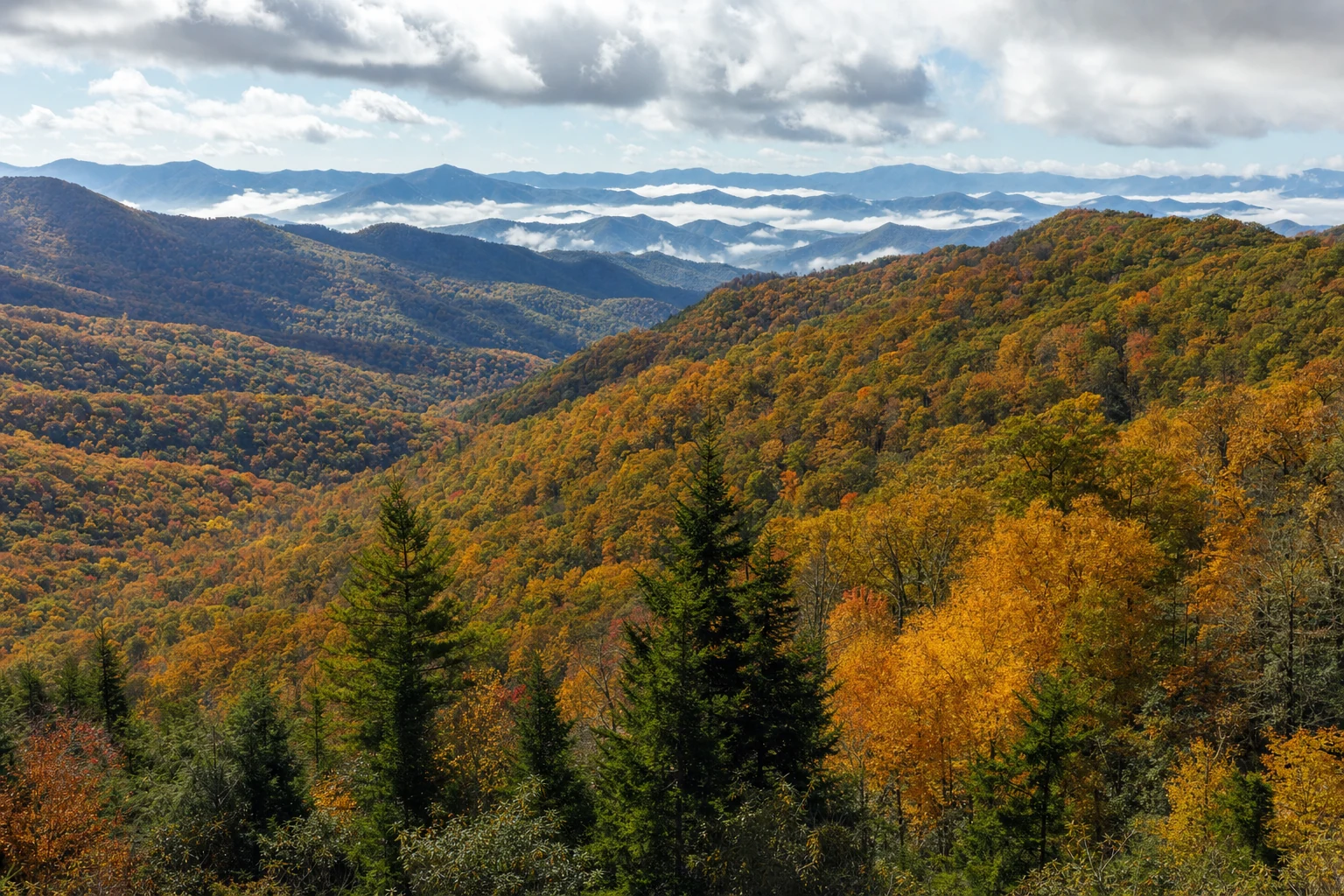
Fall color in the Smokies isn't a single event — it's a six-week cascade that moves downhill from late September through early November, giving road-trippers a choice of elevation depending on when they arrive. This five-day itinerary sequences the drives and hikes by elevation zone, from high-country balds to cove bottoms, so the color is always near peak regardless of which day you're out. Bring a Park-It-Forward hang tag or plan to reach every trailhead before 9 a.m. on weekdays — the park's most popular lots fill fast on October weekends.
Day 1: Cades Cove and the Foothills Parkway
Cades Cove sits at roughly 1,700 feet, putting its hardwood bottomlands near peak in late October through the first days of November. An 11-mile one-way loop circles the cove, and the first half-hour of light is best for both color and wildlife. Park at the Cable Mill area and walk the short path to the millhouse; the surrounding maples turn before the oaks and create a layered canopy effect worth slowing down for. The Carter Shields Cabin pullout and Cades Cove Overlook near the loop entrance are quick stops with open sight lines across the meadow. Wednesday and Saturday mornings the loop is closed to vehicles until 10 a.m. for cyclists and pedestrians — a far quieter experience if the timing works.
In the afternoon, drive out to the Foothills Parkway Look Rock section for a ridgeline perspective on the color spread across the valley below. The one-mile trail to the Look Rock tower takes about 30 minutes round-trip and rewards with unobstructed southern views. End the day in Townsend, the quietest of the gateway towns. If you're based in Gatlinburg, Calhoun's Gatlinburg on the river is a reliable sit-down option after the drive.
Day 2: Newfound Gap Road — The Central Drive
Newfound Gap Road (US-441) climbs from 1,400 feet at Sugarlands to 5,046 feet at the gap itself, crossing multiple color zones in a single 30-mile stretch. Mid-to-late October is the road's best window. Leave Gatlinburg by 7:30 a.m. to claim a spot at the Chimney Tops Overlook on the Tennessee side, which faces east and catches morning light directly on the ridge. Campbell Overlook, a few miles further up, gives a wide-angle view across the ridge system with minimal foreground obstruction.
At Newfound Gap, cross into North Carolina and continue to the Forney Ridge trailhead for the Andrews Bald hike — 1.8 miles each way over moderate terrain. The bald itself is an open grassy summit above 5,800 feet edged by red spruce, and in late September the blueberry bushes covering it turn deep burgundy before the surrounding trees go gold. The hike finishes before most day-trippers arrive at the lot. On the way back down through North Carolina, stop at the Oconaluftee area to walk through the Mountain Farm Museum's log structures. It's free, takes about 20 minutes, and grounds the landscape in its agricultural history.
Day 3: Cataloochee Valley — Fewer Crowds, More Payoff
Cataloochee Valley requires a reservation for vehicle access during peak fall season — check recreation.gov in advance. The payoff is a remote valley that most October weekend visitors never reach, with a resident elk herd that grazes openly at dusk and dawn. The Beech Grove School and Caldwell House are two of the best-preserved historic structures in the park and sit right along the main valley road. The Caldwell Fork Trail (5.7 miles, moderate) follows the creek upstream through dense hardwood coves where tulip poplars and maples close in overhead.
Leave by early afternoon to reach Cherokee and visit the Museum of the Cherokee People before closing. The museum covers Cherokee history in this region — including the removal period — with rotating exhibits that change seasonally. From there, Mingo Falls is a ten-minute detour off Big Cove Road: a 120-foot cascade reached by a 0.15-mile stair trail, steep but short. Stay in Cherokee to position for the next morning.
Day 4: High-Elevation Color and the Cosby Corner
The highest peaks — Kuwohi (formerly Clingmans Dome), the LeConte ridgeline, and the spruce-fir zone above 5,500 feet — hit peak color in late September, two to three weeks ahead of the cove bottoms. If your trip falls in that window, prioritize this day. The Kuwohi observation tower sits at 6,643 feet, the park's highest point, reached by a steep half-mile paved walk from the parking area. From the tower, color extends across the entire high-country horizon. The lot fills before 9 a.m. on fall weekends without fail.
Cosby, on the northeast end of the park, draws a fraction of the Gatlinburg-side crowds and offers strong mid-elevation fall color on the Tennessee side. The Hen Wallow Falls Trail (4.4 miles round-trip, moderate) follows a creek corridor lined with birch and maple before arriving at a 90-foot waterfall. On the return drive, stop at the Cosby Entrance Overlook for a final ridge view. Because Cosby sees far less traffic than the Gatlinburg entrances, it's worth building into any October weekend itinerary simply to avoid the corridor backup.
Day 5: Waterfall Loop and Departure
Fall color at lower elevations improves waterfall hikes — the surrounds are in full color rather than summer green. Ramsey Cascades, a four-mile round-trip to a 100-foot falls in the Greenbrier area, is one of the most visually rewarding hikes in the park when the maples are at peak, typically the third week of October at that elevation. Start before 8 a.m. The lot can be full by mid-morning on weekends.
For a shorter option before the drive home, the Grotto Falls Trail (2.6 miles, moderate) off Roaring Fork is a reliable choice — the trail passes behind the falls through old-growth forest. Grab breakfast at Crockett's Breakfast Camp in Gatlinburg before leaving; the camp-style interior and Tennessee country ham biscuits make it a fitting last meal. If time permits, the Gatlinburg Trail (3.8 miles, easy) runs flat along the river and is consistently uncrowded compared to anything in the commercial district — a quiet close to a trip built around getting ahead of the crowds.