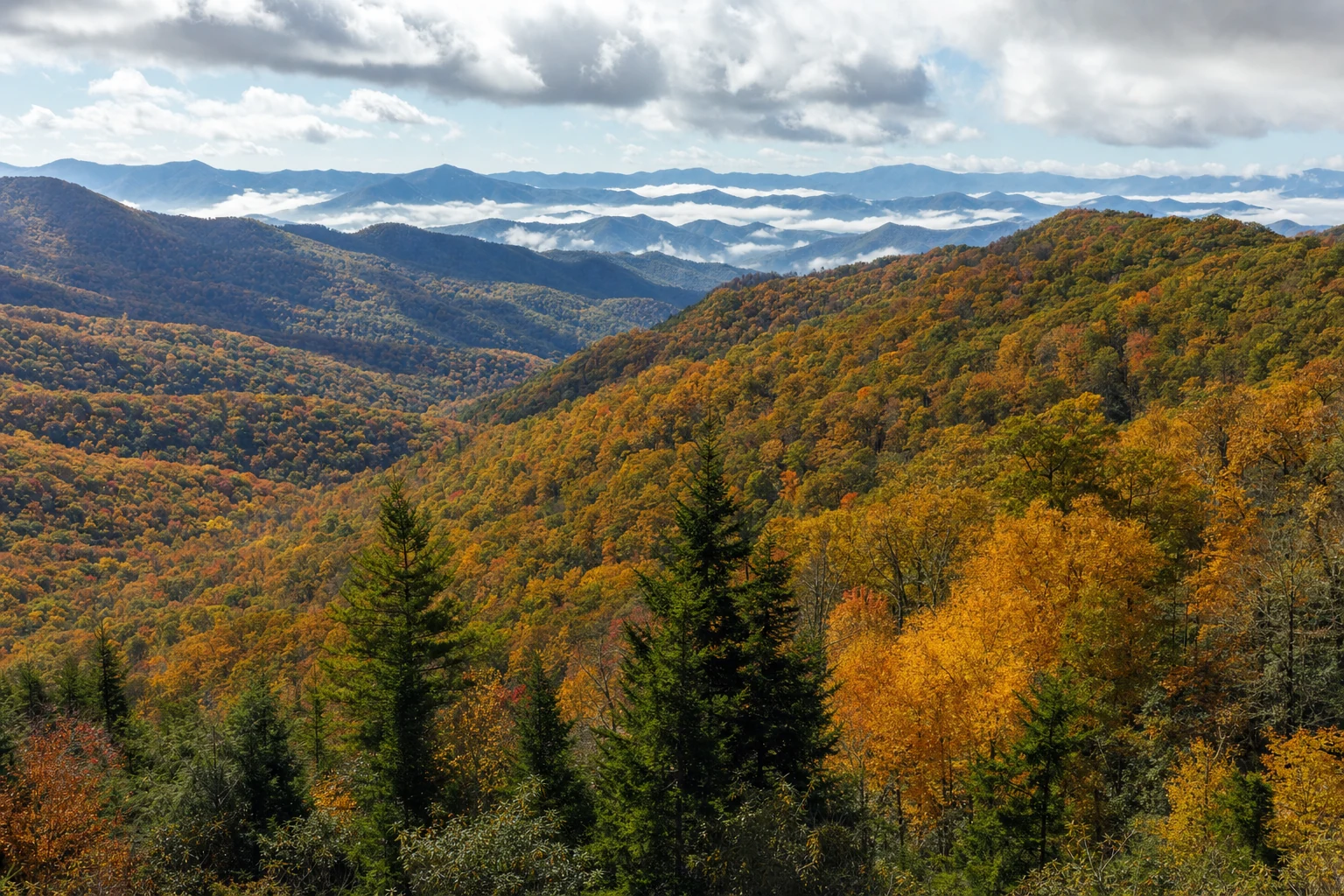

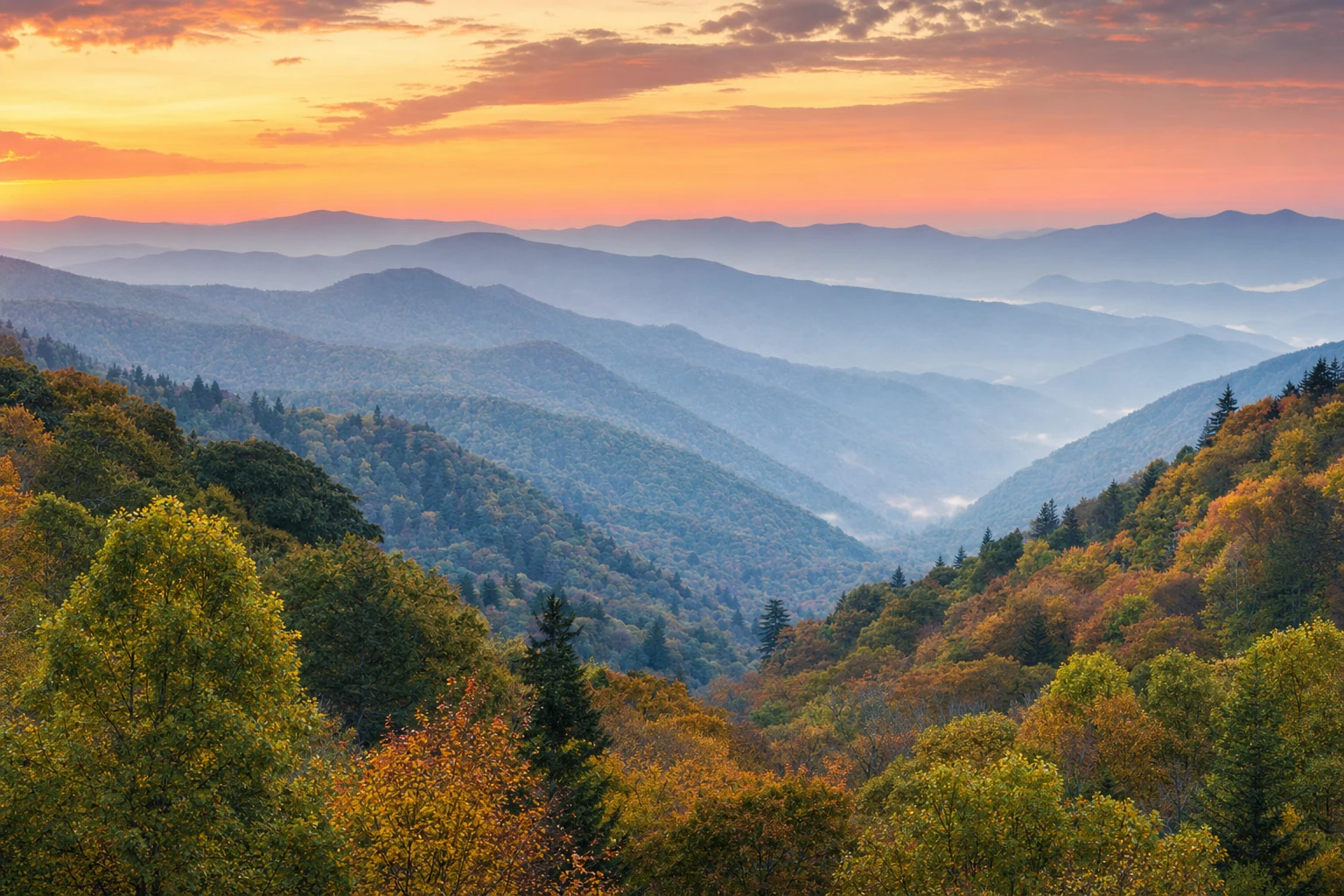
Serious photographers return to the Smokies for one reason: the fog. From April through October, valley mist pools in Cades Cove and drifts through the lower sections of Newfound Gap Road before burning off, usually between 9 and 10 a.m., sometimes later after a cool night. This five-day itinerary is built around catching that light first, with waterfalls and wildlife sessions filling the rest of each day.
Day 1: Foothills Parkway + Cades Cove
Start on Foothills Parkway West before sunrise. The Look Rock section gives clear westward views with ridgelines stacking into the Tennessee valleys below; a long telephoto in the 200–400mm range compresses that layering into something usable. Arrive 45 minutes before civil twilight. The parking area rarely fills before 7 a.m., even in peak October.
From there, drive to Cades Cove. On Wednesday and Saturday mornings, the one-way loop road stays closed to cars until 10 a.m. (bicycles and pedestrians only), so plan those mornings as walking sessions or arrive on a Thursday or Sunday instead. Fog in the cove burns off from the edges inward, and the Carter Shields Cabin (MP 9.5 pullout) and the Cades Cove Methodist Church photograph well against soft overcast after the fog clears. Deer are nearly certain before 8 a.m.
Abrams Falls Trail (5 miles roundtrip) ends at a waterfall 20 feet wide at its base. Overcast skies matter here: direct sun creates contrast the white water can't hold. Aim for a 2–4 second exposure at f/11 with a neutral density filter. The trailhead sits at the far end of the cove loop.
For dinner, Bennett's Pit Bar-B-Que in Gatlinburg is straightforward and worth the stop after a day on your feet. Pick up your Park-It-Forward parking tag at any park entrance — you'll need it for every in-park stop the rest of the week.
Day 2: Newfound Gap Road + Waterfalls
Newfound Gap (5,046 ft) is the target for Day 2's pre-dawn session. If the overnight low dropped below 55°F in the valleys, expect fog below the 3,000-foot line and clear skies above; that temperature boundary produces the most dramatic light on this road. The Chimney Tops Overlook, about 4 miles up from Gatlinburg, catches early-morning fog wrapping around the twin summits.
After sunrise, drive to Kuwohi (formerly Clingmans Dome) if visibility holds. At 6,643 feet, you're above the cloud layer on heavy fog mornings, shooting a cloud sea with ridge tops breaking through. The road to the parking area opens one hour after sunrise; check nps.gov for the current seasonal schedule. Come down before 10 a.m.
Afternoon waterfall options: Rainbow Falls (2.7 miles roundtrip, 80 feet) is one of the largest single-drop falls in the park, accessible from Gatlinburg. Grotto Falls on the Trillium Gap Trail (2.6 miles) lets you stand behind the curtain, which most waterfalls don't allow. Both photograph far better under overcast than in direct sun. Neither trail requires more than moderate fitness, though Rainbow Falls climbs about 1,400 feet in elevation.
Crockett's Breakfast Camp opens at 8 a.m. and works well as the morning meal before the summit drive if you want a real sit-down start.
Day 3: Cataloochee Valley
Cataloochee requires advance planning. The valley road from Cove Creek is unpaved and narrow for roughly 6 miles, and the NPS may require timed-entry reservations during peak fall weeks; check recreation.gov the week before your trip. The drive from Gatlinburg takes about 90 minutes.
Arrive before first light, around 6 a.m. in summer. The park's elk herd, reintroduced in 2001, now numbers around 200 animals. Bulls with antlers are present August through October; calves appear in May and June. Most animals graze along the open meadow beside the main valley road at dawn and dusk. A 400mm or longer lens keeps you at the NPS-required 150-foot minimum distance from elk; bulls in rut have charged visitors who closed that gap.
The Boogerman Trail (7.1 miles, strenuous) runs through old-growth sections of the valley. The photography skews toward forest floor work — root systems, moss-covered logs, fern beds — rather than open vistas, and it pairs well with a morning meadow session followed by an afternoon under heavy cloud cover.
Return to the meadow from 5 to 7 p.m. for the dusk elk session. Some photographers base out of Cataloochee Campground for two nights and skip other days entirely. Chesapeake's Seafood in Gatlinburg is a reasonable dinner choice after the long return drive.
Day 4: Alum Cave Trail + Ramsey Cascades + Cosby
Alum Cave Trail (5 miles to LeConte) is the park's most photographed subalpine corridor. The bluff itself, a concave overhanging rock face at roughly mile 1.5, catches best light in early morning when eastern sun hits the textured stone. Wildflower windows vary by elevation: trillium in late March through April at the lower sections, fire pink and bee balm in June, asters in September higher up. A macro lens or extension tubes pay off if wildflowers are the priority for the day.
Ramsey Cascades (100 feet, 4 miles roundtrip) is the tallest waterfall accessible by trail in the park. The hike follows Ramsey Prong through old-growth tulip poplar and eastern hemlock; hemlock woolly adelgid losses over the past two decades have opened some sections that appear more closed in older photography. A cloudy morning is ideal, though the gorge stays shaded enough that direct afternoon sun is rarely a serious problem.
Hen Wallow Falls in Cosby (90 feet, 2.1 miles) is worth the drive for quieter conditions. The Cosby area draws far fewer visitors than the Gatlinburg-side trailheads, largely because it adds 40–50 minutes from Pigeon Forge. Coffee & Company in Gatlinburg is an early-morning option before heading out.
Day 5: Andrews Bald + Mingo Falls
Andrews Bald via the Forney Ridge Trail (1.8 miles from the Kuwohi parking area) is one of two natural grass balds in the park accessible by trail. Mid-June brings Catawba rhododendron bloom, with magenta flowers covering the open ground against the ridge backdrop. The bald faces southwest, so arrive no later than 10 a.m. on clear days before overhead light flattens the scene.
Mingo Falls near Cherokee stands 120 feet and requires only a 0.15-mile walkup from the parking area. Spring snowmelt boosts flow considerably; a 2-second exposure under overcast gives you the smoothest water and the most balanced exposure between the dark rock face and the white cascade. It's one of the few falls where the walk-to-impact ratio is impossible to argue with.
Use the remaining afternoon for a second pass at any location where light or weather didn't cooperate earlier in the week. The Campbell Overlook on the Tennessee side of Newfound Gap Road reliably catches late-afternoon fog building from the valleys below. By 4 or 5 p.m. on humid days, mist starts rising from the lower elevations again — the same conditions that opened Day 1.