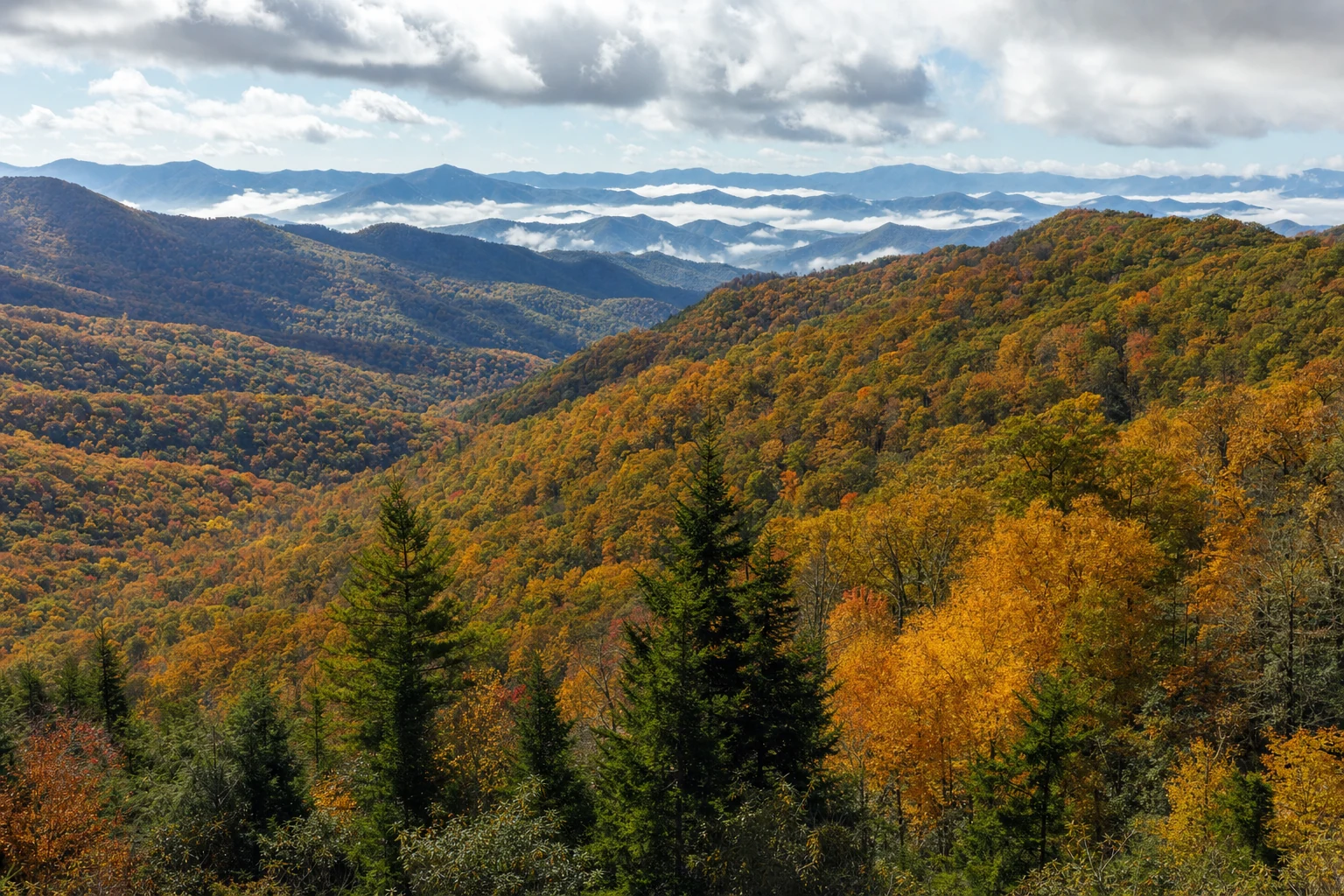

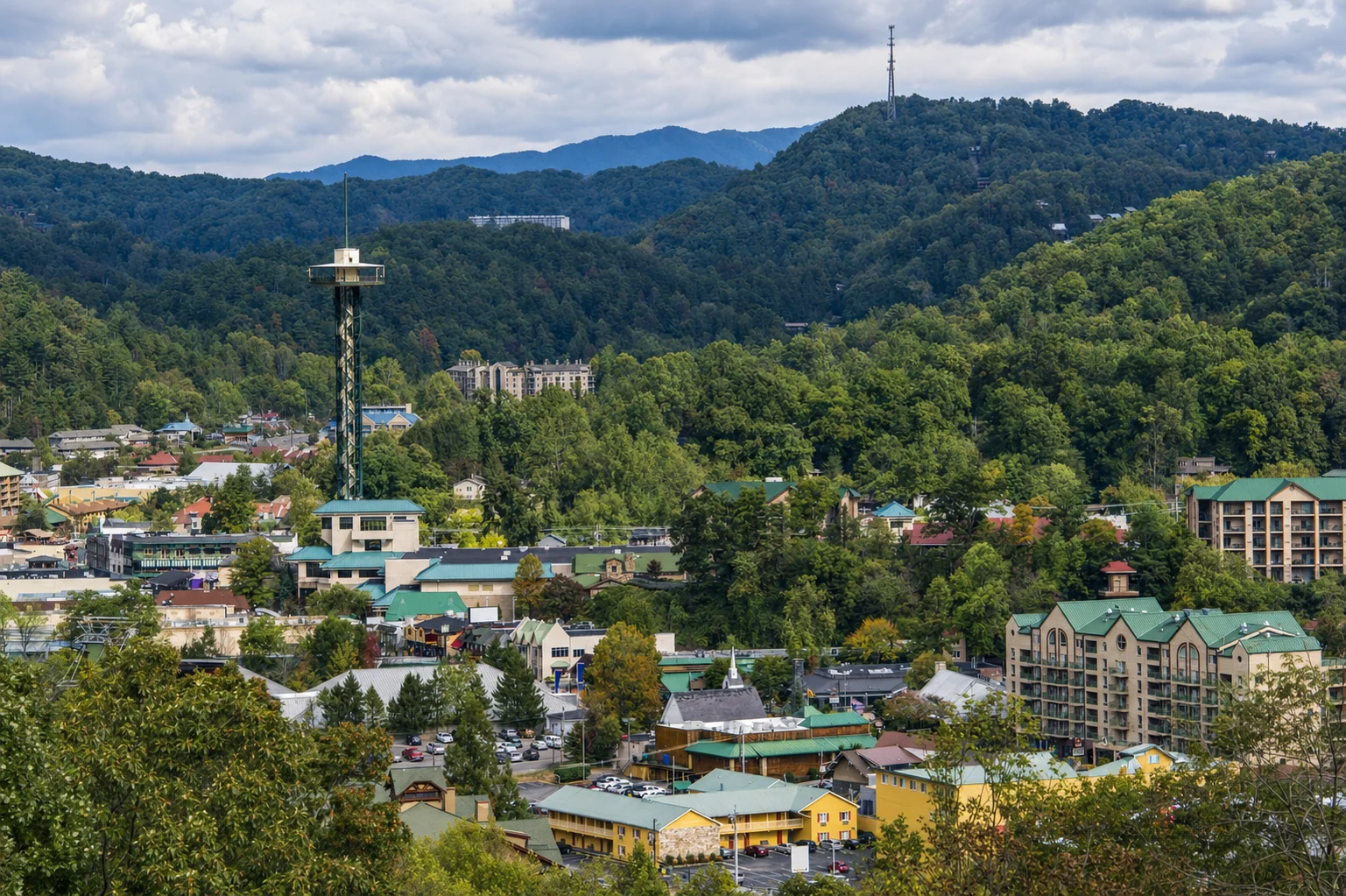
Seven days in the Smokies is enough time to do it right: the park's main corridors, the Cherokee cultural district, a genuine day trip out of the mountains, and at least one morning where the only pressure is deciding which waterfall to walk to. Base yourself in Gatlinburg for access to the Tennessee trailheads, Cades Cove, and Newfound Gap Road without adding unnecessary drive time.
Day 1: Arrival and the Lay of the Land
Start at Crockett's Breakfast Camp on the Parkway before the town wakes up, then walk to the Gatlinburg SkyLift Park and take the SkyBridge across. The crossing is the longest pedestrian suspension bridge in North America, and from the center of it you can see exactly which ridgelines you'll be on for the rest of the week. That context matters.
Afternoon: Laurel Falls, 1.3 miles each way on a paved trail to an 80-foot two-tier waterfall. Pick up a Park-It-Forward hang tag at the kiosk if you don't have one; you'll use it at every in-park parking area this week. Calhoun's on the river handles ribs and local draft well and is reliably good without requiring a reservation.
Day 2: Cades Cove
Leave at 7 a.m. — not 8, not "early." The 11-mile one-way loop at Cades Cove fills before 9, and everything worth seeing (deer and turkey in the open meadow, the occasional black bear) is harder to appreciate once cars are stacked three deep. Stop at Cable Mill, the Becky Cable House, the Methodist Church, and Carter Shields Cabin; the interpretive signage is understated and genuinely informative.
After the loop, park at the Abrams Falls trailhead and hike the 5-mile round trip. The falls are only about 20 feet tall, but the wide plunge pool and the creek crossings make it feel like more of a destination than the elevation profile suggests. Pack lunch rather than rushing back. Bennett's Pit Bar-B-Que in Gatlinburg handles dinner when you return tired.
Day 3: Newfound Gap Road and the High Country
Drive Newfound Gap Road from the Tennessee side, stopping at Campbell Overlook and the Chimney Tops Overlook before reaching the gap. From Newfound Gap, drive up to Kuwohi (formerly Clingmans Dome) at 6,643 feet; the Andrews Bald Trail via Forney Ridge begins at the same parking area and covers 3.6 miles round trip to one of the park's open grass balds, with an unobstructed view that's earned rather than driven to.
On the return leg, the Chimney Tops Trail (3.6 miles round trip, strenuous) is the single best summit experience in the Tennessee half of the park: rocky, exposed, and worth every step. If energy is short after Kuwohi, the Alum Cave Trail is 5 miles round trip and moderate, with the bluff shelter at mile 2 as a strong turnaround point. Cherokee Grill handles dinner.
Day 4: Cherokee and Cataloochee Valley
Cross into North Carolina at Newfound Gap and drive down to Cherokee. The Museum of the Cherokee People is a serious institution with a permanent collection covering Cherokee history from pre-contact through the 1838 removal and into the present; it takes two hours to move through properly. Oconaluftee Indian Village adds a living-history layer worth seeing alongside the museum. Mingo Falls is 0.15 miles from the parking area: 120 feet of waterfall, one of the tallest near a road in the entire Southern Appalachians.
From Cherokee, take the winding road into Cataloochee Valley. It's narrow, passable for standard vehicles, and worth the commitment. The elk herd congregates at dawn and dusk; midday, walk the Caldwell Fork Trail (5.7 miles, moderate) through old-growth forest past the Caldwell House and remnants of the community displaced when the park was established in the 1930s. Return via the Balsam Mountain Overlook at sunset.
Day 5: Pigeon Forge or a Rest Day
Dollywood earns a full day. It's consistently ranked among the better regional theme parks in the country, and the craft demonstrations and the food justify the price alongside the rides rather than in spite of them. If you're skipping it, spend the morning on the Grotto Falls Trail (2.6 miles, 60-foot falls, you walk directly behind the curtain), then the afternoon on the Gatlinburg Arts & Crafts Community loop — 8 miles of working studios along Glades Road and Buckhorn Road. The Ober Mountain Aerial Tramway from downtown is a good low-effort late-afternoon addition either way. Dinner at Alamo Steakhouse if you went to Pigeon Forge; Chesapeake's Seafood and Raw Bar if you stayed closer to Gatlinburg.
Day 6: Asheville or the Nantahala
Asheville is 1.5 hours from Gatlinburg on I-40. The River Arts District and downtown's restaurant scene make the drive worth it, and the Biltmore Estate handles a half-day on its own if it's on the list. Drive the Blue Ridge Parkway on the return; the Devil's Courthouse Overlook at Milepost 422.4 is 30 minutes from the car and looks directly into four states on a clear afternoon.
For the rafting alternative, Cherokee Rapids Whitewater Rafting puts you on Class III–IV water in a gorge that's worth seeing whether or not you get in a raft. If you go that route, add Joyce Kilmer Memorial Forest on the way back: 2.2 miles through old-growth hemlock and tulip poplar, including trees over 400 years old, with no meaningful elevation gain and rarely a crowd. Whitewater Falls at 411 feet — the tallest cascade east of the Rockies — is 0.25 miles from its parking area and fits into the drive without costing more than 45 minutes.
Day 7: Cosby and a Slow Exit
Cosby is the smallest and least crowded of the Tennessee entrances, which is reason enough to save it for last. Hen Wallow Falls Trail (4.4 miles, 90-foot waterfall) runs through second-growth forest and takes about three hours at a reasonable pace; you'll likely have the falls largely to yourself. Alternatively, Ramsey Cascades from the Greenbrier area (4 miles round trip, 100-foot falls, the tallest in the park) handles a late-season crowd better than the paved trails closer to Gatlinburg. Donut Friar for coffee and something warm before the drive out.