
About Ramsey Cascades
Now I'll write the page copy applying all anti-slop constraints to the known facts and research.
---
Ramsey Cascades drops 100 feet over a broad face of rock ledges on the Ramsey Prong of the Little Pigeon River, making it the tallest waterfall in Great Smoky Mountains National Park. Getting there requires an 8-mile round-trip with 2,200 feet of elevation gain, several unbridged stream crossings, and terrain that the park accurately rates as strenuous. That combination keeps the crowds down relative to every other major waterfall in the park, and the old-growth forest you walk through to reach it is worth the hike on its own.
The Hike In
The trailhead sits at the end of Greenbrier Road in the park's Greenbrier area, accessed from US-321 East roughly six miles from Gatlinburg. The road is paved for the first three miles, then turns to gravel; the final mile to the parking area is rough enough to slow you down but manageable for standard passenger vehicles. There's a dedicated lot at the trailhead.
The trail follows the Ramsey Prong upstream for all four miles, so the creek stays close the entire way. The first two miles are moderate — enough gain to warm up the legs without demanding much — moving through mixed hardwood forest with good views of the water. The second half is where the difficulty earns its label: steeper grades, root-covered footing, and the stream crossings the NPS doesn't bridge. Expect wet feet on at least one crossing even in dry conditions. Trekking poles are worth packing.
What separates this hike from shorter Smokies trails is the old-growth forest in the upper section. The trees grow to sizes that simply don't exist in younger stands, and the forest floor changes noticeably as elevation increases, getting quieter and denser. Plan for a full day out; at a moderate pace with time at the falls, the round-trip runs four to six hours for most adults. Start no later than 9 a.m.
At the Falls
The cascade spreads across a wide face of layered rock rather than dropping in a single column, so it looks broader and more complex than most waterfall photos suggest. Multiple channels run across different ledges before converging at the pool below. Flow is consistently strong across all four seasons and noticeably louder after heavy rain, when the full width of the rock face runs.
Stay off the rocks immediately around the plunge pool. The stone is perpetually wet and the surfaces are slick; the pool itself runs faster below the surface than it looks from the bank. Fatal accidents in the park cluster around falls like this one for exactly that reason.
When to Go
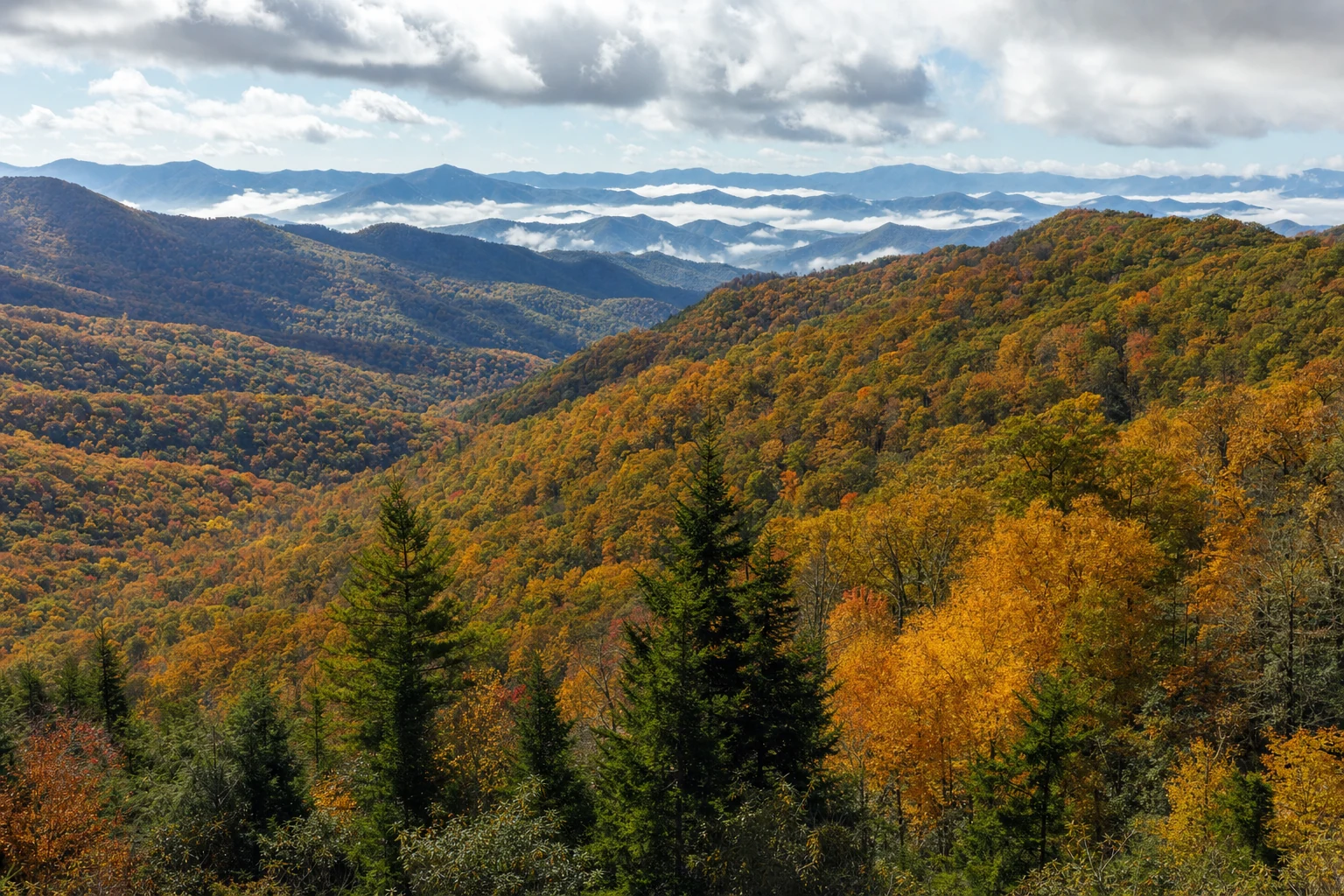
Spring gives you the highest water volume — March and April in particular, when snowmelt and sustained rain swell the Prong. The forest is actively leafing out at lower elevations during this window, which adds something to the climb. Fall is the other strong season: cooler temperatures on the ascent, color in the canopy from mid-October into early November, and solid flow at the falls.
Summer works but runs warm on the open sections of the trail. Starting by 8 a.m. matters more in July and August than any other time of year; you'll be heading back down before the worst of the afternoon heat. The falls themselves are worth visiting year-round, and the water doesn't disappoint in any season.
For photographers, mid-morning to early afternoon is consistently better than early morning here. The gorge is deep and surrounded by tall trees, which blocks direct light well into the morning. Overcast days are genuinely preferable to sunny ones at this location: flat light eliminates the contrast between white water and dark rock, and the cloudy skies common in the Smokies allow longer shutter speeds without overexposure. A tripod is worth the weight.
Getting There
From Gatlinburg, take US-321 East approximately six miles to the Greenbrier entrance on the left. Follow Greenbrier Road past the picnic area; pavement ends after three miles and gravel begins. Continue to the parking area at the trailhead.
A Park It Forward parking tag is required for any vehicle parked inside GSMNP for more than 15 minutes. Daily tags cost $5, weekly $15, annual $40. Purchase at recreation.gov before your trip or at park kiosks near the main entrance areas. Kiosk availability at Greenbrier can vary, so buying online in advance is the more reliable option.
Winter Conditions
Avoid this trail in winter unless you have cold-weather hiking experience and appropriate traction gear. The steep upper sections ice over badly, and the unbridged creek crossings become hazardous when ice covers the rocks. The NPS explicitly flags Ramsey Cascades as a winter hazard trail. Microspikes help on the iced trail sections, but they don't fully address the crossings, which require careful judgment about conditions.
The shoulder seasons are the better play for cold-weather visits: late November before sustained freezes set in, or a clear stretch in late February. Check the NPS current conditions page before you go either way.
Know Before You Go
Carry more water than seems necessary. The 2,200-foot climb is sustained work and the mountain air dries you out faster than expected; one liter per person is not sufficient for an 8-mile strenuous day hike.
Weather in the Smokies can shift inside an hour even in summer — a warm morning doesn't guarantee a warm afternoon at elevation. Pack a rain layer and a warm layer regardless of what the forecast says at departure.
Black bears are active throughout Greenbrier. Keep at least 50 yards of distance, make noise on the trail to avoid surprise encounters, and store all food and scented items in your car with windows closed. Never leave anything out at the trailhead.
Cell service is poor to nonexistent on this trail. Download an offline map before you leave, and let someone know your planned return time.
Frequently asked questions
- How tall is Ramsey Cascades?
- Ramsey Cascades drops approximately 100 feet.
- How do I get to the waterfall?
- The falls are reached via a 4-mile strenuous hike from the nearby trailhead.
- Is it safe to swim at the falls?
- No. Swimming, wading, and climbing near waterfalls in the Smokies is dangerous and often fatal. Hidden currents, slick algae, and submerged rocks cause most waterfall deaths in the park. Enjoy the view from designated lookouts.