
About Big Creek Cascades (various)
Big Creek runs down the eastern flank of Great Smoky Mountains National Park, and along its first few miles it drops over a long series of small cascades, most ranging from about 5 to 20 feet. No single dramatic plunge defines this place; instead, you get a repeating rhythm of white water over rock, sustained across a wide stretch of trail. That consistency, combined with year-round flow and an approach that suits most fitness levels, makes it one of the more reliably rewarding waterfall walks in the park.
The Cascades
What the maps label "Big Creek Cascades" isn't a single waterfall. It's a collection of drops scattered along the creek corridor, varying considerably in character: some spill wide across broad rock faces, others funnel into narrow chutes, and a few are the kind of thing you walk past before realizing you've just passed a waterfall. The creek stays full regardless of season, fed by the ridges above, so you're not gambling on water volume the way you might be at smaller drainages during dry stretches in late summer.
The surrounding forest stays dense along the trail. Hemlocks and rhododendron frame most of the cascade views rather than open sky, which gives the corridor a closed-in, quiet character. In spring, the rhododendron blooms along the creek add a burst of color that won't show up in most photos of this trail. By midsummer, the canopy closes over completely and temperatures along the water run noticeably cooler than in town — worth knowing if you're visiting during a heat stretch in July or August.
Getting There
The trailhead is Big Creek Trailhead, near Waterville, North Carolina, on the park's far eastern edge. This is not the Sugarlands or Newfound Gap side of the park; it sits well east of the main visitor corridor approaching from Gatlinburg. The drive takes longer than you might expect from town, but the tradeoff is real: this corner of the park draws far fewer visitors than Laurel Falls or Rainbow Falls, and you'll notice it immediately in the parking area.
A Park-It-Forward parking tag is required for any stay over 15 minutes inside GSMNP. Tags run $5 per day, $15 per week, or $40 annually, available through recreation.gov or park kiosks. America the Beautiful passes don't cover this fee; it's separate from the entrance pass system and specific to the park's parking program. Plan to pay it regardless of how long you think you'll be there.
On the Trail
Trail difficulty runs easy to moderate, and the cascades start appearing early in the walk rather than at a single destination at the end. You're not hiking toward one payoff and turning back; the falls come to you at intervals as you move upstream along Big Creek. Families with kids who can handle a couple miles on relatively level ground will manage fine.
The trail surface is natural and gets slick when wet, which in this corridor is often. The path runs close to the creek for much of its length, and spray, overflow after rain, and simple proximity mean wet rocks are the norm rather than the exception. Shoes with actual grip matter here: trail runners or hiking boots beat sneakers, and sandals are a bad idea regardless of season. The trail isn't technical, but the consequence of a slip near some of the drops is a fall into fast-moving water over rock.
Expect to share the trail with other hikers on weekends and holidays, though not at the volume you'd see at the park's more famous waterfall hikes. The corridor is narrow enough that passing requires courtesy.
When to Go
Year-round flow is one of the genuine advantages Big Creek has over smaller waterfalls in the park that go thin or intermittent during dry spells. Come in February and the creek is running; come in August and it's still running well. Season affects character more than volume here.
Winter is the one serious qualifier. Ice forms around the cascades and on the adjacent trail sections, and it builds quickly when temperatures drop overnight. A section you walked safely in the morning can be glazed by afternoon if the air stays cold enough. If you visit between December and March, bring traction devices for your boots, or plan a mid-morning start to let the sun work on the shadiest stretches first. When multiple consecutive days are forecast below 25°F, consider delaying; the trail can be genuinely dangerous and the park will occasionally close sections under severe ice conditions.
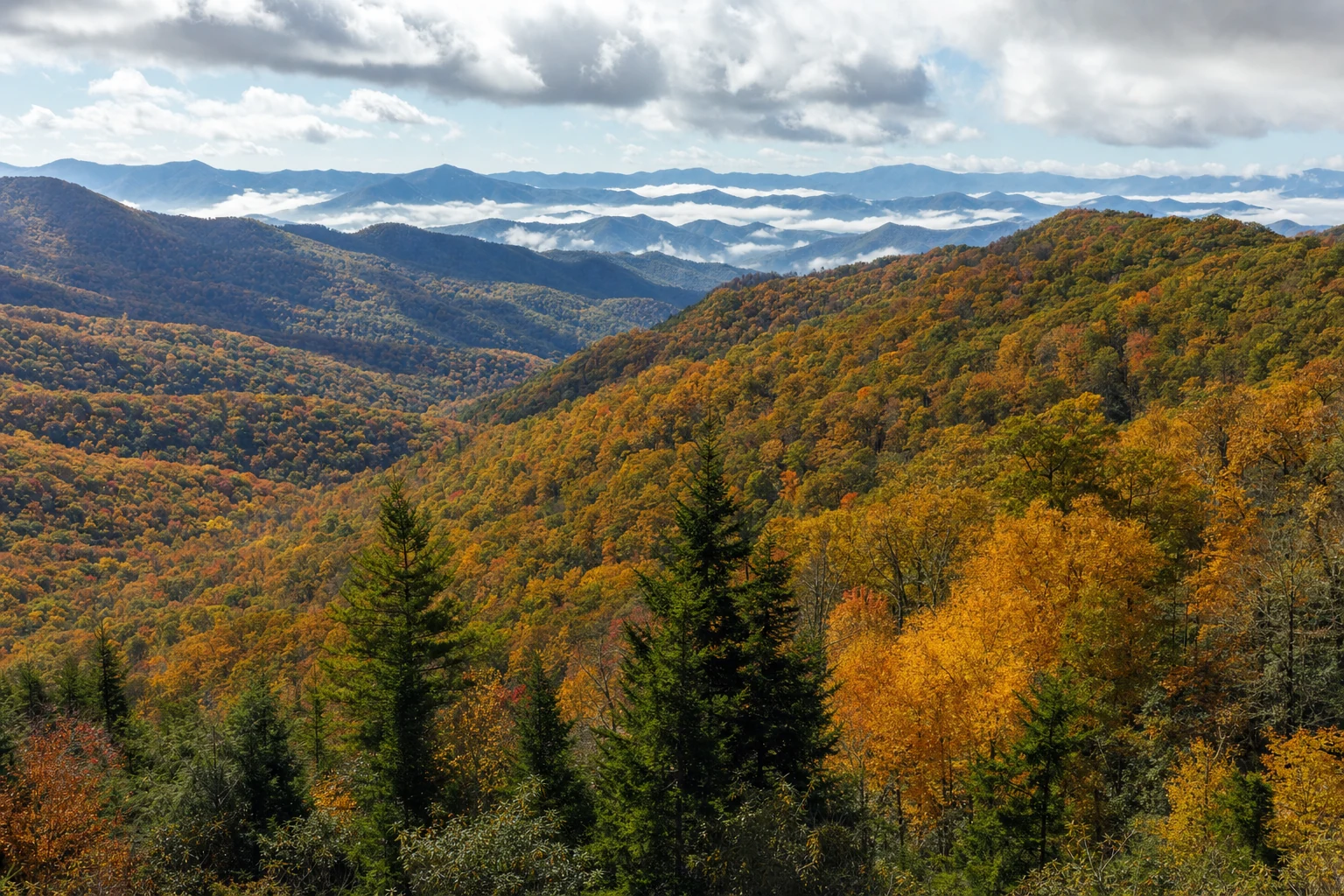
Spring brings the heaviest flow after snowmelt, and the rhododendron corridor along Big Creek blooms roughly late May to mid-June at this elevation. Fall color in this section of the park typically peaks in October, when the canopy turns before the crowds from Gatlinburg thin out. Both seasons offer excellent conditions without winter's ice complication, and either is worth planning around if you have flexibility.
Photography
Morning is the correct call for photography here. The creek runs roughly east-to-west through this section, and morning light comes in at angles that catch the moving water well; by afternoon, much of the corridor sits in deep shade regardless of season, which flattens texture and muddies colors in ways that are hard to recover in post.
Because you're working with a series of drops rather than one featured waterfall, you'll have multiple compositions available along the walk. Wide shots that take in the creek corridor and surrounding forest tend to work better than tight shots on individual cascades, most of which are modest on their own. A polarizing filter helps cut glare off the wet rock surfaces and makes the water color read more accurately.
Long exposures work well for the silky water effect that reads clearly in print and on screens. The morning light gives you enough brightness to hold a 1/4 to 1 second exposure at low ISO on a tripod without the image going too bright. The park prohibits leaving tripods unattended on the trail, but there's enough space near most of the drops to set up without blocking other hikers.
Safety and Park Rules
Black bears move through this corridor regularly. Keep 50 yards between yourself and any bear you spot, and never approach for a closer look. Secure all food at your vehicle before you start walking; bears at GSMNP have learned to associate parked cars with food, and a smashed window is not a rare outcome of a cooler left visible in the back seat.
Swimming near the cascades is a serious risk regardless of how calm the water looks. Wet rocks surrounding the drops are genuinely slick, and currents above falls move faster below the surface than they appear from the bank. Most fatal accidents in the park happen at waterfall sites, almost always involving people who waded into water or climbed onto rocks near a drop. Stay out of the water at the cascade sections.
Cell coverage along the Big Creek trail runs poor to nonexistent. Download an offline map before you leave the hotel; the NPS app and Gaia GPS both allow you to cache trail maps. Let someone know your planned turnaround point if you're going more than a mile or two from the trailhead. Mountain weather shifts faster than phone forecasts update, so check conditions the morning you go and carry a rain layer regardless of what the sky looks like at departure.
Frequently asked questions
- How tall is Big Creek Cascades (various)?
- Big Creek Cascades (various) drops approximately 5 feet.
- Is it safe to swim at the falls?
- No. Swimming, wading, and climbing near waterfalls in the Smokies is dangerous and often fatal. Hidden currents, slick algae, and submerged rocks cause most waterfall deaths in the park. Enjoy the view from designated lookouts.