
About Foothills Parkway Cascades
Rain makes these cascades. Without it, many pull-offs along the Foothills Parkway hold little more than rock faces streaked with old watermarks. Arrive 12 to 24 hours after a solid storm and the same spots look different: unnamed drainage channels off the surrounding ridgelines fill fast, sending water over ledges in drops from a few feet to about 20, and the whole drive starts to feel like a moving waterfall survey. This isn't a single destination waterfall with a trailhead sign — it's a scattered collection of small, seasonal falls spread across both the East and West sections of the parkway, most visible from a pull-off or within a very short walk of the road.
What these cascades actually are
The falls here have no individual names. They run from small, unnamed drainage channels that collect rainwater off the ridgelines above the parkway and send it over the roadside rock faces below. Elevation on the parkway means the slopes collect a lot of precipitation, but they also drain quickly; on a dry afternoon in late summer, many of the same spots that cascade strongly after a storm show nothing but weathered stone.
The height range across the various falls runs roughly 5 to 20 feet. Some are narrow curtains of water over a single ledge; others spread across several levels broken by outcroppings. None require serious hiking to reach, which makes them accessible to visitors who aren't up for a full trail day but want something more than a roadside overlook.
Driving the Foothills Parkway
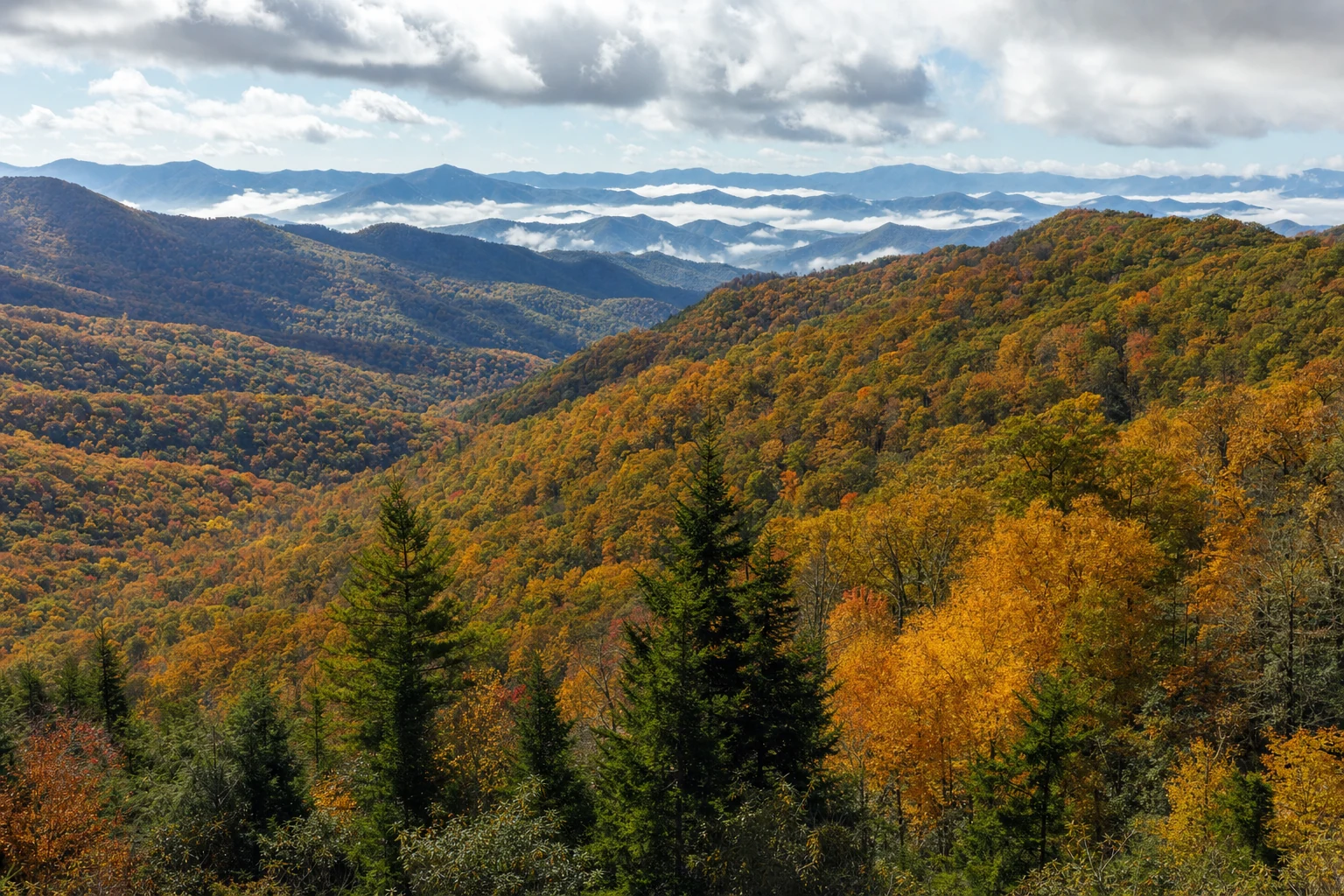
The parkway runs along the northwestern boundary of Great Smoky Mountains National Park in Tennessee, split into two disconnected sections. Both offer ridge-top views of the park and the broader mountain landscape beyond — the kind of vantage point that normally requires a strenuous climb, reachable here from a paved road with established pull-offs.
The East section connects the Cosby area to the I-40 corridor; the West section runs from near Walland toward Townsend, close to the Cades Cove entrance. Both sections have spots where the cascades show up after rain. Plan enough time to stop at multiple pull-offs rather than driving straight through; the falls are easy to miss at road speed when they're running light.
If the primary goal is the cascades, a gray, post-storm morning is the right call. If the goal is mountain views, any clear day works. A lot of visitors combine the two — timing the drive for the day after rain so that visibility has returned and the water is still running.
Timing and flow
Late fall and early spring give the best odds of finding the falls active. The canopy is thin enough in those seasons to see water falling through the foliage, and the rain patterns keep drainage channels fuller for longer after each storm. Mid-summer can produce good flow immediately after a thunderstorm cell passes through, but the falls dry out within 48 hours in warm weather; the post-rain window is shorter than it is in shoulder months.
That window is real, though. Within a day of significant precipitation, spots that look unremarkable on a dry day can produce visible, audible flow. Checking a recent rain total for Gatlinburg or the park area before making the drive takes 30 seconds and saves a lot of guessing.
Photography here is more forgiving than at many named park waterfalls. Overcast post-rain skies give even light without harsh shadows; the falls are small enough that you're shooting close, so indirect light is more useful than a perfectly positioned sun angle. Bright midday sun on a dry rocky face makes for a far less interesting shot than a gray morning with water actually moving over the ledges.
Winter access
Sections of the Foothills Parkway close during winter weather events, which happen several times most seasons. The same moisture that feeds the cascades in spring and fall freezes along cliff faces in winter, producing ice formations that are worth seeing if conditions allow. Getting to them, though, depends on whether the section you need is open — and on whether the pull-off surfaces are safe to walk on.
Check road conditions through the NPS before making the drive between late November and March. Partial freeze-thaw cycles leave pull-offs and the short walks to the water's edge genuinely treacherous; if there's been a recent hard freeze followed by a warm afternoon, give it another day. The ice formations will still be there.
Getting there and parking
The Foothills Parkway runs inside the GSMNP boundary, so standard national park parking requirements apply. A Park-It-Forward tag is required for stays over 15 minutes; daily tags are $5, weekly $15, annual $40, available through recreation.gov or at kiosks near the main entrances before heading out.
For current road conditions, closures, and pull-off location details, the NPS trip-planning page at nps.gov/grsm/planyourvisit/foothills-parkway.htm is the most reliable source. Cell coverage is inconsistent along both sections; download offline maps before leaving Gatlinburg or Townsend.
Know before you go
Post-rain surfaces along the roadside are consistently slick. The same conditions that put water over the falls also coat the rocks and ground cover near pull-offs; waterproof footwear matters on a wet-day visit in a way it doesn't for a dry-day drive.
Black bears range through GSMNP including parkway corridors. Keep at least 50 yards of distance. Don't leave food or food packaging visible through car windows, even at a brief pull-off stop.
Ridge-top temperatures on the parkway can run noticeably colder than the valley towns below. Bring a warm layer and a rain layer regardless of what the forecast looked like when you left Gatlinburg — the ridge elevation changes the math quickly.
Swimming at these cascades isn't a good idea. The drops are modest, but the rocks underneath are uneven and wet stone footing is unpredictable at any water level. The point of this visit is the view, not a swim.
Frequently asked questions
- How tall is Foothills Parkway Cascades?
- Foothills Parkway Cascades drops approximately 5 feet.
- Is it safe to swim at the falls?
- No. Swimming, wading, and climbing near waterfalls in the Smokies is dangerous and often fatal. Hidden currents, slick algae, and submerged rocks cause most waterfall deaths in the park. Enjoy the view from designated lookouts.