
About High Falls (DuPont State Forest)
High Falls drops 125 feet through DuPont State Recreational Forest near Cedar Mountain, NC, and it's one of the tallest freefalling waterfalls accessible via an easy trail anywhere in the Southern Appalachians. The trailhead sits at the Hooker Falls Access Area, and the hike in runs 1.2 miles one-way as part of a longer loop system through the forest. Flow holds strong regardless of season, which makes it genuinely useful for trip planning — you don't have to time your visit around spring snowmelt or pray for recent rain.
The falls themselves
The Little River makes that 125-foot drop in a single wide curtain, forceful enough that you can hear it well before you reach the viewing area. This isn't a cascade split across several ledges; it's one coherent fall, and the volume holds through summer dry spells better than most waterfalls in the region. The "excellent year-round" flow rating isn't filler language. By August, smaller falls in the broader Smokies area are often running thin or bare, while High Falls maintains genuine water volume worth making the trip for.
Standing at the base, the scale registers differently than photos suggest. The surrounding rock walls rise on both sides of the plunge pool, and continuous mist carries far enough out that you'll get damp within a minute or two of arrival. The roar is substantial; bring a pack cover or dry bag if you're carrying electronics, and plan on it.
The trail in
The Hooker Falls Access Area puts you at the start of a well-maintained trail system through DuPont State Recreational Forest. The 1.2 miles to High Falls runs through mixed hardwood forest with minimal elevation change on the approach. It's genuinely easy walking; the "easy to moderate" difficulty rating reflects the terrain around the falls themselves, where wet rocks at the base require attention to footing, not the approach.
The path is part of a loop network and sees traffic beyond foot hikers. Cyclists and trail runners use DuPont's trails regularly, so don't expect the solitary backcountry feel you'd get on a single-track route inside GSMNP. The trail is wide and well-signed. For a longer outing, the loop system extends well beyond High Falls and connects to additional viewpoints throughout the forest.
When to go
Spring brings the highest water volume, fed by snowmelt and sustained rainfall through April and into May. That said, if you're visiting in late summer or early fall, you're not missing much. The flow holds through dry months reliably enough that it's worth making the trip regardless of season, which is a rarer thing to say than it sounds.
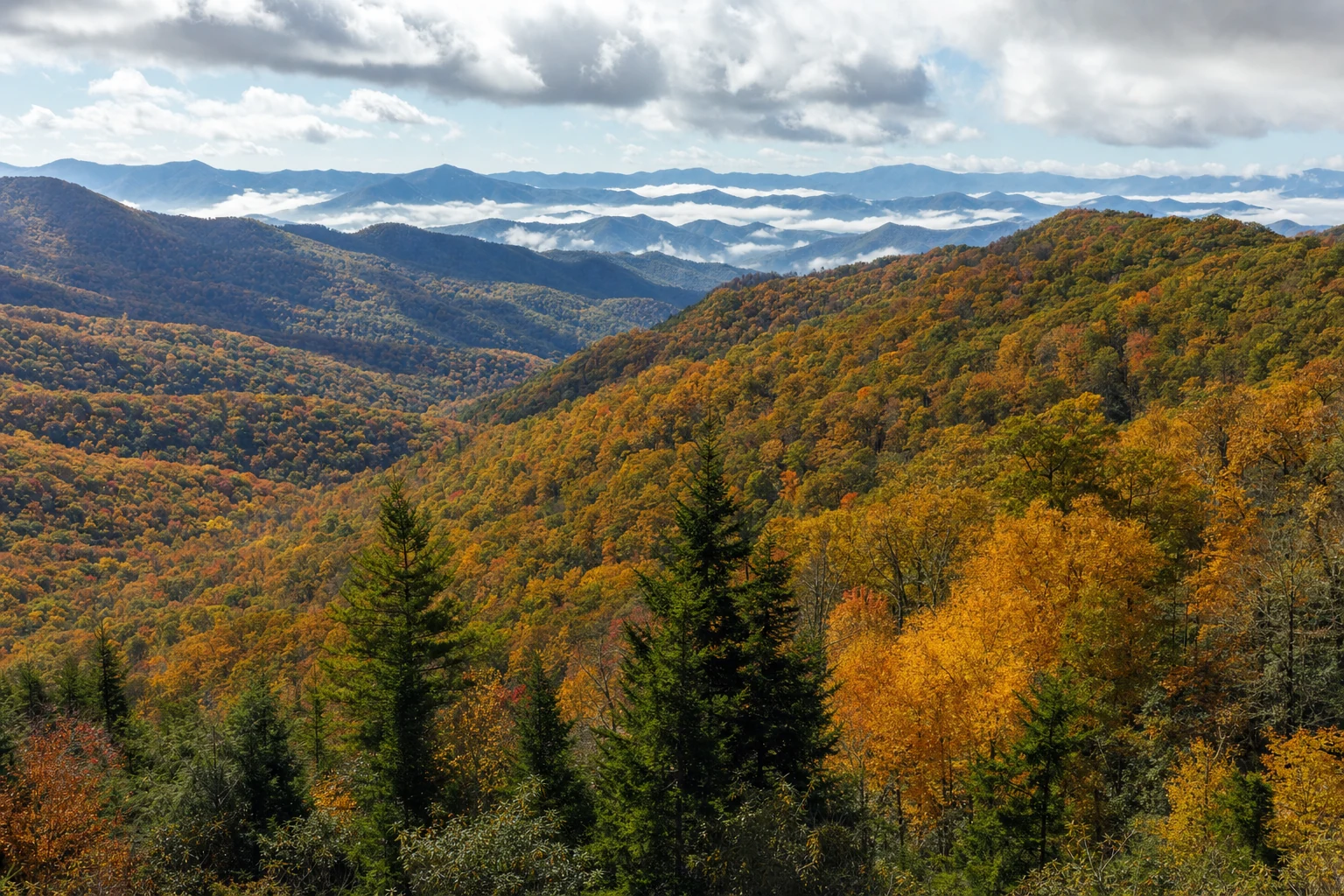
Fall is arguably the best combination of factors: foliage color in October frames the falls with warm reds and oranges, temperatures in the forest are comfortable for hiking without summer humidity, and weekdays thin out considerably. Weekends during peak color are a different story; parking at the Hooker Falls Access Area fills by mid-morning on Saturdays in October.
Summer mornings work well if you arrive early. By late morning on a weekend in June or July, the lot fills and the trail gets busy. Before 9 a.m., you'll have the falls largely to yourself and the light is still workable for photography.
Winter cautions
Cold weather changes the character of the site significantly. The continuous mist that makes warm-weather visits pleasant deposits ice on rock surfaces when temperatures drop below freezing, and the area around the base can glaze over without warning. The approach trail may be completely clear while the last stretch near the plunge pool is genuinely hazardous. If you're visiting between late November and February during a cold snap, traction devices — microspikes or slip-on cleats — are worth carrying even for this otherwise easy trail.
Ice formations develop on the surrounding cliff faces and can fall without warning. Stay behind any posted barriers at the base, and avoid lingering directly beneath rock overhangs. The falls themselves won't freeze, but the zone around them becomes unpredictable in sustained cold.
Shoulder season visits in late March or mid-October through early November give you good flow, comfortable temperatures, and none of the ice variables to manage.
Photography
Standard waterfall photography advice is to shoot at golden hour. High Falls is an exception. The canyon orientation means direct overhead light illuminates the full face of the falls cleanly; in early morning and late afternoon, the surrounding walls shade significant portions of the water. Mid-day, specifically 11 a.m. to 2 p.m., gives you the most evenly lit shot of the full 125-foot drop.
Wide-angle lenses work better here than telephoto, letting you capture the height alongside the surrounding rock and forest context. Within thirty feet of the base, mist is heavy enough to wet your front element quickly; bring a lens cloth and plan to wipe frequently. A polarizing filter helps cut glare off wet rock surfaces and deepens water color. Slow shutter speeds for motion blur are straightforward to achieve here.
Getting there
High Falls is in DuPont State Recreational Forest near Cedar Mountain, NC. This is not a National Park site; the NC Forest Service manages DuPont, and the access structure is separate from Great Smoky Mountains National Park. The Park It Forward tag required inside GSMNP doesn't apply here. The nearest towns are Brevard to the west and Hendersonville to the north. The Hooker Falls Access Area is the specific parking area for this waterfall and is signed within the forest.
For current access conditions, hours, and any seasonal closures, check the NC Forest Service directly at ncforestservice.gov before you go. Cell coverage through DuPont State Forest is unreliable; download offline maps for the trail system before you leave.
Know before you go
Mountain weather changes faster than forecast models capture. Even on a clear morning, pack a rain layer and a warm layer; the mist from the falls will get your outer layers damp regardless, so something you don't mind wetting is worth having. Carry more water than a 2.4-mile round trip seems to require.
Black bears are active in DuPont State Forest. Keep at least 50 yards of distance from any bear you encounter, make noise on the trail to avoid surprise encounters, and secure food in your vehicle rather than leaving it accessible at the trailhead.
Wet rocks and hidden currents around waterfall plunge pools cause most of the serious accidents at sites like this. The falls look approachable and the plunge pool can appear calm from a distance. Don't wade near the base, and stay off the slick rocks immediately around the water's edge. The falls are worth the trip without taking risks that don't add anything to the experience.
Frequently asked questions
- How tall is High Falls (DuPont State Forest)?
- High Falls (DuPont State Forest) drops approximately 125 feet.
- How do I get to the waterfall?
- The falls are reached via a 1.2-mile easy hike from the nearby trailhead.
- Is it safe to swim at the falls?
- No. Swimming, wading, and climbing near waterfalls in the Smokies is dangerous and often fatal. Hidden currents, slick algae, and submerged rocks cause most waterfall deaths in the park. Enjoy the view from designated lookouts.