
About Mill Creek Falls
Mill Creek Falls sits in the Cosby section of Great Smoky Mountains National Park, about 18 miles east of Gatlinburg through an area that sees a fraction of the park's annual 13 million visitors. The falls run roughly 20 feet over a broad rock face fed by Mill Creek, and the trailhead is a half-mile walk from Cosby Campground. If you're after something uncrowded with a genuine payoff and without the parking headaches that stack up at Laurel Falls or Alum Cave, this side of the park earns the extra driving time.
The hike
Half a mile one way, rated easy, starting from Cosby Campground. The route can connect into a longer loop through the Cosby trail system if you want more mileage without retracing your steps; check the campground trailhead map before you set out so you don't end up committing to more trail than you planned. The grade is gentle throughout, and most people in reasonable shape will make it to the falls without stopping. It's a realistic option for kids, older travelers, and anyone who wants to see moving water without earning it via elevation gain.
The trail runs alongside Mill Creek for much of the approach. Hemlocks and hardwoods press in on both sides; the creek noise builds steadily as you get closer. Don't expect any open views along the way. This is a forest walk where your attention goes to roots underfoot and the sound of water, not any long sightline.
The falls
Twenty feet isn't the highest waterfall in the Smokies, but Mill Creek Falls is more interesting than its stats suggest. The water fans out across a wide ledge rather than shooting through a narrow channel, giving it a broad, layered profile that looks especially full after rain. Flow holds up well through most of the year, though it can drop off noticeably in the dry late-summer weeks. If you visit in August and the water looks thin, that's seasonal; come back in April or after a wet spell and you'll see a noticeably different falls.
A plunge pool sits at the base, flanked by rounded boulders that invite you to get close. Don't. The rock directly adjacent to the falls stays perpetually slick, and the currents around any waterfall base are harder to read than they look. The park's prohibition on swimming and climbing near falls is consistent across GSMNP, and the Cosby corridor is no exception.
Timing and seasons
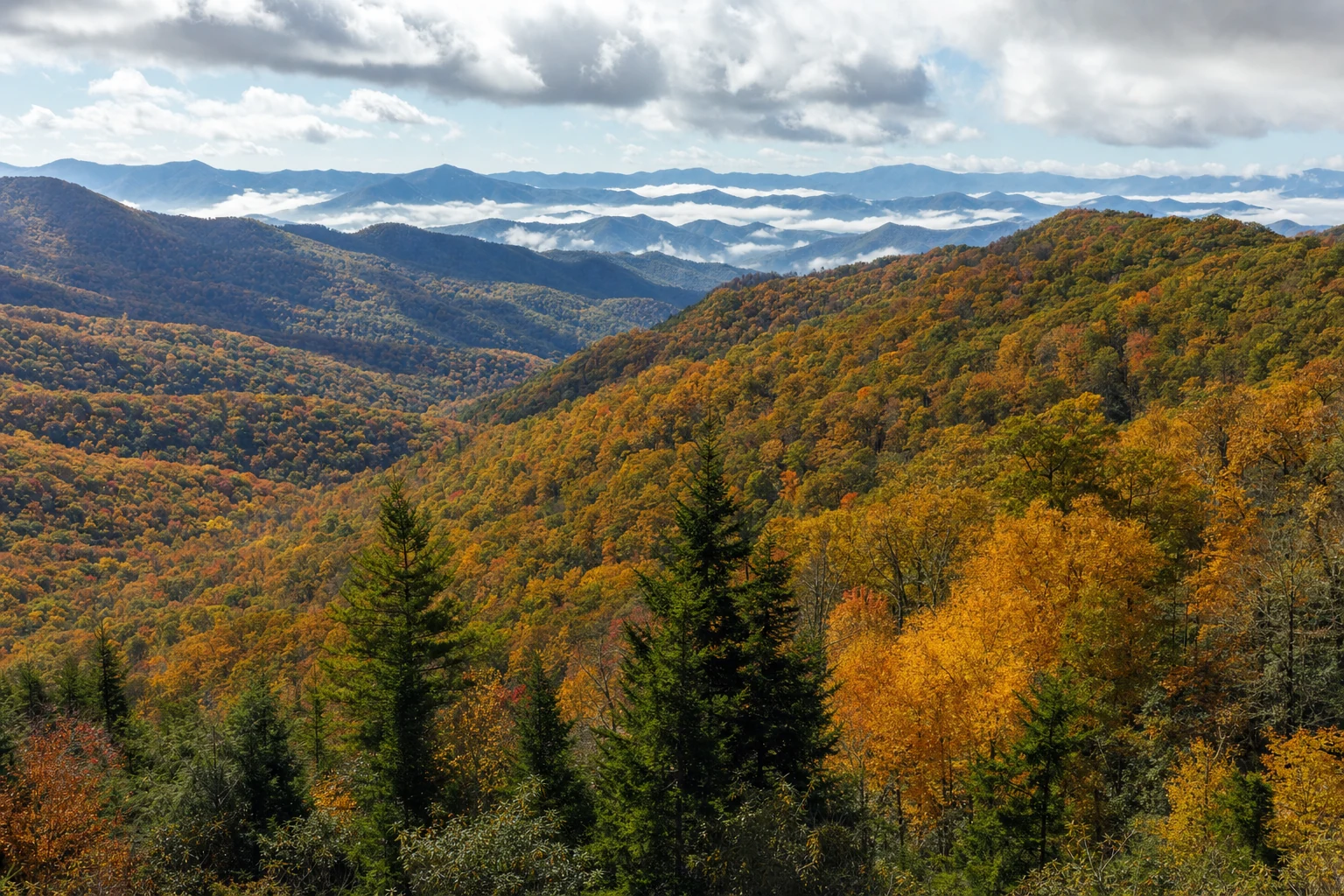
Spring is the best time for water volume; late April into early May also brings wildflower cover through the forest around Cosby, so the walk itself rewards more attention than it would in other seasons. Fall turns the canopy orange and yellow hard enough that the trail becomes part of the visual appeal, though flow typically runs lower.
Winter access is possible but requires real caution. Ice forms on and around the falls consistently during cold stretches, and a slip here means a long return walk to the campground with no cell signal to call for help. If you go between November and early March, wear boot traction devices and stay alert within at least 50 feet of the water.
Mornings are reliably better year-round, for photography and for avoiding whatever crowd the campground has generated. The Cosby area draws far less day-use traffic than the Gatlinburg or Cades Cove corridors; still, earlier is cleaner.
Photography
Morning light hits the falls at a useful angle, and the dense canopy makes midday shooting genuinely difficult in summer. When the sun is high and the light is punchy, you get harsh contrast between shadows and bright water that's hard to manage in post. Overcast days are more forgiving than clear ones if you arrive late. A circular polarizer cuts glare off wet rock considerably if you're shooting with any camera that accepts filters.
Autumn gives you the opportunity to pull the trail itself into the frame with color overhead, and spring's higher flow fills out the fan shape of the water across the full width of the ledge. For either, arriving before 9 a.m. is the practical target if light quality matters to you.
Getting there
The trailhead is at Cosby Campground, which sits in the northeastern corner of GSMNP near the small community of Cosby, Tennessee. This is a separate park entrance from the Sugarlands corridor out of Gatlinburg; you don't drive through downtown Gatlinburg to reach it. From I-40, take Exit 435 toward Wilbur Dam Road, then follow TN-32 south to Cosby Road and into the park. From Gatlinburg proper, count on roughly 18 miles and about 35 to 40 minutes of driving.
Because the trailhead sits inside park boundaries, the Park-It-Forward parking tag applies for any stop over 15 minutes. Tags cost $5 per day, $15 per week, or $40 for an annual pass; buy them at Recreation.gov or at kiosks near the major park entrances. There's no vehicle admission fee to enter GSMNP at any gate, but the parking tag is required regardless of which entrance you use.
Cosby Campground operates seasonally, with opening and closing dates that shift year to year. Confirm it's open before building a trip around this trailhead, especially during spring or fall shoulder visits. The NPS GSMNP Cosby page has current status and any trail closures.
Know before you go
Cell coverage disappears on Cosby Road and stays gone inside the campground and on the trail. Download offline maps before you leave the highway, and tell someone your plans if you're going solo. Short and easy doesn't mean the park service treats it differently when something goes wrong.
Carry water even for a half-mile walk in summer. The forest humidity is real, and the temperature inside the canopy disguises how much you're sweating. Restrooms are available at the campground, but there's nothing on the trail itself.
The Cosby area has historically seen above-average bear activity by park standards. Make noise on quiet days with low trail traffic, keep 50 yards of distance if you spot one, and treat food storage as mandatory rather than optional. Bears in this corridor are habituated to humans; that makes them more confident around people, not less dangerous.
One practical note for day hikers: if you want to combine Mill Creek Falls with other stops, Hen Wallow Falls is also accessible from Cosby Campground via a separate trail. Planning both in the same morning is reasonable; both are on the shorter, easier end of the park's waterfall hikes, and Cosby's relative quietness means you won't be fighting traffic between them.
Frequently asked questions
- How tall is Mill Creek Falls?
- Mill Creek Falls drops approximately 20 feet.
- How do I get to the waterfall?
- The falls are reached via a 0.5-mile easy hike from the nearby trailhead.
- Is it safe to swim at the falls?
- No. Swimming, wading, and climbing near waterfalls in the Smokies is dangerous and often fatal. Hidden currents, slick algae, and submerged rocks cause most waterfall deaths in the park. Enjoy the view from designated lookouts.