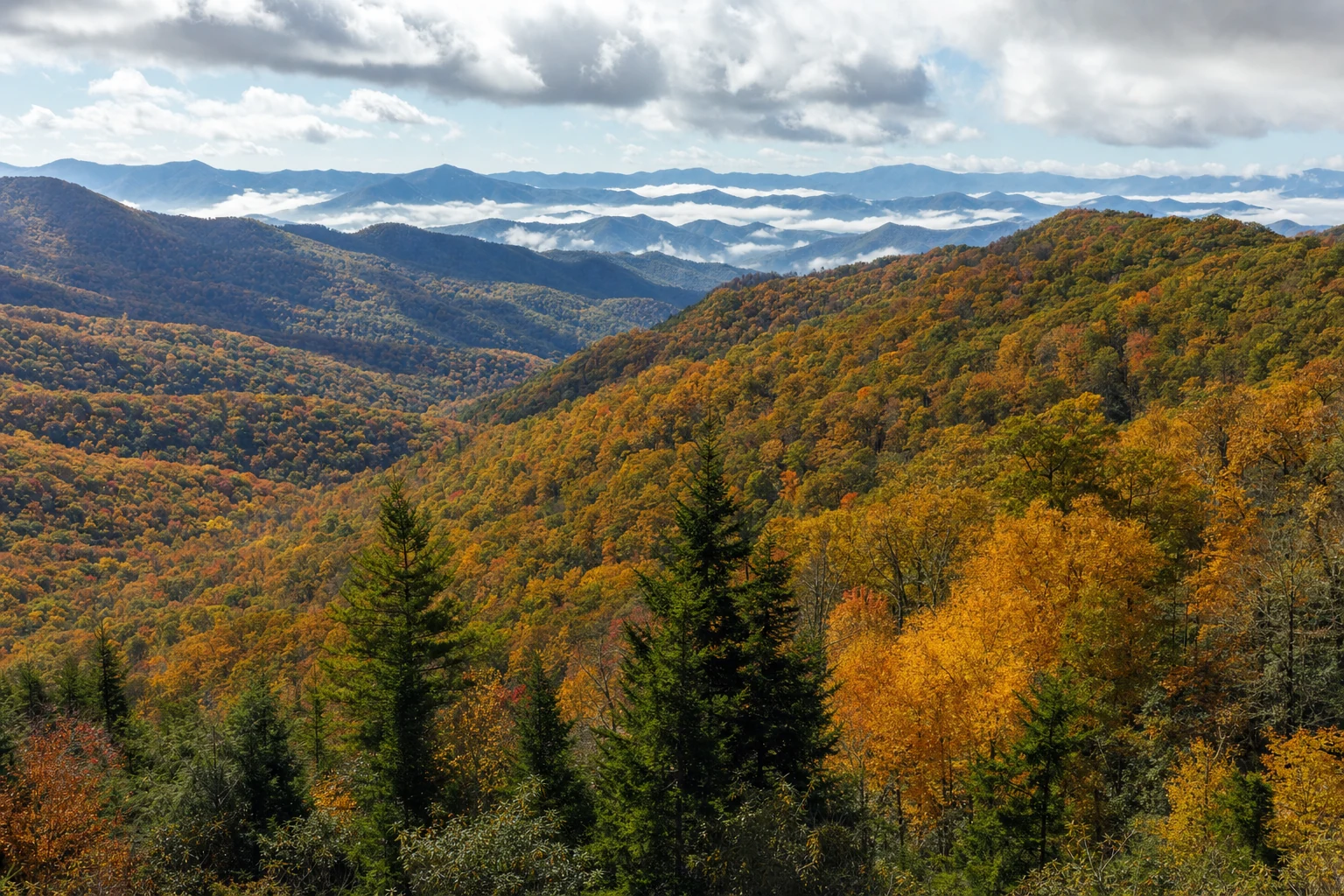

About Mouse Branch Falls
Mouse Branch Falls is a 20-foot cascade tucked along the Big Creek corridor on the far eastern edge of Great Smoky Mountains National Park. Getting here takes real effort — a 2.5-mile moderate hike from the Big Creek Trailhead, plus a short off-trail scramble to reach the base — but the payoff is a waterfall most park visitors never see, in one of the park's quietest and most impressive old-growth hollows.
The Hike
The route begins at the Big Creek Trailhead near Big Creek Campground off Big Creek Road in Hartford, Tennessee, just off I-40. The trail follows an old logging railroad grade for much of its length, which keeps the grade remarkably gentle for a Smokies hike — no sustained switchbacks, no brutal climbs. The first few miles feel almost effortless compared to the park's more famous corridors, and the wide path gives you room to watch the creek and the surrounding forest rather than your footing.
At roughly 1.5 miles in, you'll pass Midnight Hole, a deep green swimming pool where Big Creek carves through rock — it's a popular stop in warm months and worth a pause. Keep following the trail another mile and watch for the side scramble toward Mouse Branch, a smaller tributary that drains off the slopes above. The falls themselves require leaving the marked trail for a short distance; the scramble is manageable but footing can be slick, particularly after rain or in cold weather. Total one-way distance to the falls is approximately 2.5 miles.
Total elevation gain to the Walnut Bottom area farther up the trail is around 600 feet, but the grade to Mouse Branch Falls is gentle enough that most hikers with moderate fitness will find the out-and-back trip (5 miles round trip) manageable in a half-day.
The Falls and What to Expect
Mouse Branch Falls drops about 20 feet over a mossy rock face into a small pool below. It's not the kind of waterfall that roars year-round — flow is genuinely variable and tied closely to recent precipitation. Visit in late winter or early spring, or within a day or two after a good rain, and you'll find a full, vigorous curtain of water. Come in August after a dry stretch and you may find a trickle.
The setting matters as much as the falls themselves. The Big Creek drainage contains some of the park's finest old-growth forest, with trees that survived the widespread logging era that cleared most of the Smokies in the early 20th century. The surrounding hardwoods and hemlocks create a canopy that feels genuinely ancient, and the relative remoteness of the eastern park means you're unlikely to share the trail with crowds.
The scramble off-trail to reach the falls adds a degree of genuine exploration to the trip. There are no guardrails, no developed viewing platforms, and no interpretive signs — just a waterfall in the woods. That's either a feature or a limitation depending on what you're after.
Photography and Timing
Mid-morning light is the best window for photography at Mouse Branch Falls. The surrounding canopy and the angle of the hollow mean direct sun reaches the falls in that window; arrive too early and the scene sits in deep shadow, arrive midday and harsh overhead light flattens the water. If you're specifically after photos, plan your hike start to put you at the falls between roughly 9:00 and 11:00 a.m. — which means departing the trailhead by 6:30 or 7:00 a.m. at the latest.
The most dramatic conditions for waterfall photography are overcast skies combined with high water. An evenly lit, cloudy sky eliminates blown-out highlights in the white water and allows a longer exposure without overexposing the frame. If you arrive after recent rain, you'll likely have both.
Winter Conditions
Ice is a real concern here in winter. Mouse Branch Falls is noted as an icy site when temperatures drop, and the scramble to reach it becomes genuinely hazardous once the rocks freeze. The trail itself, following a shaded creek corridor, holds ice longer than exposed south-facing slopes. If you visit between December and early March, check conditions before you go and carry traction devices — microspikes are useful on the approach trail in icy conditions. The falls can be striking in winter when frozen or partially frozen, but the risk level rises significantly.
Big Creek Campground closes in late October and reopens in early April, which also signals the off-season window when the access road may have reduced services.
Getting to the Trailhead
Big Creek sits on the north side of I-40 near the Tennessee-North Carolina state line, about 20 miles east of Gatlinburg. From Gatlinburg, take US-321 North to I-40 East and exit at the Waterville/Big Creek exit. Follow signs to Big Creek Road; the trailhead and campground are at 1375 Big Creek Road, Hartford, TN 37753 (GPS: 35.7607° N, 83.1028° W).
This eastern entrance is meaningfully farther from the main Sugarlands Visitor Center than most park trails — plan for a 35-40 minute drive from downtown Gatlinburg. The distance works in your favor: the Big Creek area draws a fraction of the crowds that show up at Laurel Falls or Alum Cave on a Saturday morning.
A Park It Forward parking tag is required for any vehicle parked inside GSMNP for more than 15 minutes. Passes are $5/day, $15/week, or $40/annually, available through recreation.gov or at park entrance kiosks.
Staying in the Area
Big Creek Campground is the closest overnight option — a small, tent-only facility with 12 sites, flush toilets, and cold running water. There are no hookups and no showers, and it's not suitable for RVs or trailers. Rates are $25/night and reservations are available through recreation.gov. The campground runs from early April to late October. If you're planning to hike Big Creek in the morning, camping here the night before puts you on the trail at first light with zero commute.
For those preferring a roof, Gatlinburg and the wider I-40 corridor offer a range of options at different price points. Staying in Gatlinburg gives you easy access to park amenities on the Tennessee side, while the small communities near Hartford serve hikers targeting the eastern park routes.
Practical Notes
- The off-trail scramble to the falls is short but requires sure footing; poles help on the return.
- Cell coverage is poor throughout the Big Creek corridor — download offline maps before you leave.
- Black bears are active in this area; store food properly and maintain the required 50-yard distance.
- Pets are not permitted on Big Creek Trail or any GSMNP trail; they are allowed in the campground on a 6-foot leash.
- Carry more water than you think you need — the hike is longer than the mileage suggests once you account for pace on uneven terrain.
- The swimming hole at Midnight Hole is better for the purpose than Mouse Branch itself; plan time for both on the same trip.
Frequently asked questions
- How tall is Mouse Branch Falls?
- Mouse Branch Falls drops approximately 20 feet.
- How do I get to the waterfall?
- The falls are reached via a 2.5-mile moderate hike from the nearby trailhead.
- Is it safe to swim at the falls?
- No. Swimming, wading, and climbing near waterfalls in the Smokies is dangerous and often fatal. Hidden currents, slick algae, and submerged rocks cause most waterfall deaths in the park. Enjoy the view from designated lookouts.