
About Sliding Rock
Sliding Rock is not a traditional waterfall. It's a 60-foot sheet of water-slicked granite on Looking Glass Creek in Pisgah National Forest that thousands of people ride down into a deep pool every summer, and the fact that it draws repeat visitors should tell you something about what it's actually like to stand at the top and push off. It sits about 60 to 90 minutes southeast of Cherokee on US-276, making it a natural add-on to any trip through the western North Carolina mountains.
The slide and what to expect
The water runs cold. Looking Glass Creek feeds this thing year-round, and even in August the pool temperature hovers well below comfortable-swim territory. That becomes relevant about two seconds after you hit the water. The slide itself is smooth enough that you don't fight it, but abrasive enough that denim is a serious mistake; worn board shorts or old athletic swimwear work better than anything you'd care about keeping intact.
From Memorial Day through Labor Day, the recreation area operates with lifeguards on duty from 10 AM to 6 PM. There's a small vehicle entry and parking fee during staffed hours; verify the current rate on the USDA Forest Service website before you go, since it adjusts periodically. Outside those hours and outside that season, the site remains open but unsupervised. The Forest Service is direct about this: conditions are at your own risk. The water stays cold, the rocks stay slippery, and there's no one there to pull you out if something goes wrong.
The pool at the base is deep enough that the impact isn't the hazard most people expect; the current is. Younger kids who are comfortable around moving water tend to do fine during supervised hours when lifeguards can intervene quickly. First-time visitors who've never been in a mountain creek pool sometimes underestimate how fast the temperature registers.
When to go
Peak crowds cluster between late June and mid-August, concentrated in the 10 AM to 2 PM stretch. Get there before 10 AM and the parking lot has room. Arrive at noon on a Saturday in July and you may wait 20 minutes just to get in. Late afternoon, from around 3 PM to close, runs consistently quieter than midmorning, without sacrificing much of the experience.
Mid-day light is actually the better window for photography here, though not for the reasons you'd expect at most waterfalls. The creek runs east-west with open canopy above the slide, so flat overhead sun fills the scene evenly. That removes the hard contrast shadows across the rock face that make other times of day harder to shoot. If photography is the point rather than sliding, 11 AM to 1 PM is your target.
Flow is strong year-round since Looking Glass Creek doesn't run dry. In early spring, snowmelt pushes the volume higher and the slide runs faster and harder — spectacular to watch, genuinely dangerous to attempt, and the lifeguard operation isn't open yet to manage behavior. Late May through early September gives you the full experience in reasonable conditions.
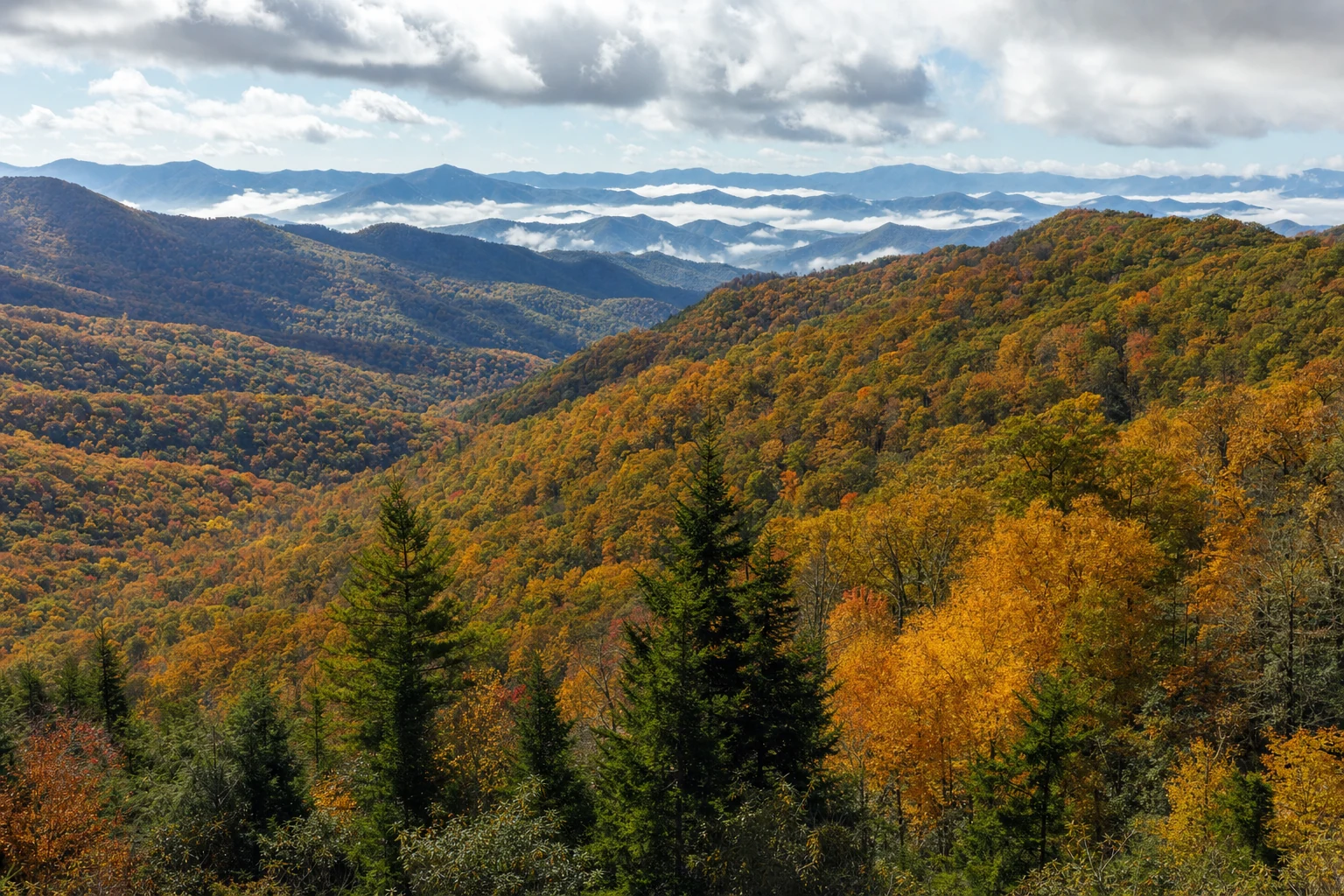
Autumn deserves separate mention. The slide itself closes after Labor Day, but the site stays accessible for walking and photography. The forest along US-276 peaks in mid-October, and this stretch of Pisgah is one of the finer fall color corridors in western North Carolina. Coming out in October to photograph the creek against turned foliage is a completely different kind of visit and a much less crowded one.
What to wear and bring
Old shorts — that's the practical advice that gets buried in most summaries. The granite face exfoliates anything that slides across it, so wear something you don't value, and skip anything with metal rivets or hardware that could catch on rock. Water shoes or old sneakers make more sense than bare feet; the parking area and the walk to the water cover uneven pavement and rock surfaces.
A dry bag or leaving valuables in your vehicle is the practical call. There's no staffed area to hold your phone while you slide, and the pool isn't forgiving to electronics. A towel seems obvious until you forget it on a 65°F overcast afternoon in June and spend the drive back shivering. Pack one regardless of what the morning forecast says.
Getting there from the Smokies
Sliding Rock sits on US-276 in Pisgah National Forest, roughly 60 to 90 minutes southeast of Cherokee depending on traffic. From Cherokee, the most direct route runs south on US-19 toward Bryson City, east on US-74 toward Asheville, then north on NC-280 and US-276 into Pisgah. That routing sidesteps the main tourist corridors and tends to move faster during peak season than anything through Gatlinburg.
From Gatlinburg, count on about 2 hours in clear traffic, routing through Cherokee and then following the same path above. This works best as part of a longer Blue Ridge day, not as a round trip from downtown Gatlinburg for its own sake. Pair it with a parkway drive toward Asheville and the mileage starts making sense.
The parking lot is paved and sits right off US-276; the walk to the water is short enough that families with small children handle it without difficulty. That said, the lot fills on summer weekends. Getting there before 10 AM is the most reliable solution.
One important logistics note: Sliding Rock operates under USDA Forest Service authority, not the National Park Service. The Park-It-Forward parking tag required inside Great Smoky Mountains National Park doesn't apply here; the Forest Service runs its own separate vehicle fee structure during staffed season.
Nearby worth combining
Looking Glass Falls is 4 miles north on US-276 — a 60-foot plunge falls viewable from a short staircase off the road, no significant hiking required. Strong combination with Sliding Rock on the same afternoon, since they're separated by less than 10 minutes of driving.
Moore Cove Falls takes more time but rewards the effort: a 1.5-mile round-trip trail from a trailhead just north of Looking Glass Falls leads to a 50-foot waterfall that you can walk directly behind. The trail runs flat and is appropriate for families. It's quieter than the recreation area and gives you something to do once you're done riding the slide.
If you're heading south on US-276 after, the Cradle of Forestry is worth a stop. The Biltmore Forest School operated at this site at the turn of the 20th century, and the restored buildings walk you through the early history of American conservation management — specific enough to be genuinely interesting rather than generically educational.
Frequently asked questions
- How tall is Sliding Rock?
- Sliding Rock drops approximately 60 feet.
- Is it safe to swim at the falls?
- No. Swimming, wading, and climbing near waterfalls in the Smokies is dangerous and often fatal. Hidden currents, slick algae, and submerged rocks cause most waterfall deaths in the park. Enjoy the view from designated lookouts.