
About Whitewater Falls (Upper & Lower)
Whitewater Falls drops 411 feet on the North Carolina side of the state line, then picks up again with another 400-foot cascade in South Carolina, making the combined drop one of the tallest waterfall sequences east of the Rockies. The Whitewater River does this without buildup or preamble — you reach an upper viewing platform in 0.25 miles, look out, and the scale takes a moment to register. This is not a quick detour from Gatlinburg. It's a genuine day trip to the far western edge of North Carolina's mountain country, near Cashiers, and worth planning accordingly.
What you'll see
The upper falls is the main event. At 411 feet, it drops in a broad sheet that fractures mid-air before hitting the gorge below, throwing mist well back from the viewing area. Volume holds consistent all year because the Whitewater River drains a large watershed that doesn't go dry in summer heat or thin out in fall. You're not gambling on flow.
From the upper platform, the drop fills your field of view completely. The lower falls, at 400 feet on the South Carolina side, require another 0.25 miles past the upper platform down a steep staircase; that's where the "easy to moderate" rating comes from. The descent is manageable for most people in reasonable physical condition, but the stairs are narrow and footing demands attention. At the bottom, the perspective shifts entirely: instead of looking out across the gorge, you're looking up at water falling toward you.
Both viewpoints are worth doing if your group has the legs for it. The upper platform offers the broader, more dramatic view; the lower is closer and louder. If you have to pick one, the upper is the priority.
The trail
The trailhead is off NC-281, near Cashiers, NC, with a dedicated parking lot. From the parking area to the upper viewing platform is 0.25 miles one way on a well-maintained path with minimal elevation change. It's short enough that people regularly walk it in street shoes without trouble; children, older adults, and anyone skipping the staircase can reach the upper platform without issue.
To reach the lower falls, continue past the upper platform for the additional 0.25 miles via the steep stairs. Take your time descending; the stairs aren't technical, but they're not casual either, and the return climb is the harder direction. Give yourself 90 minutes minimum at the site, even accounting for the short distances. The round trip takes longer than the mileage suggests.
The falls are managed under the Gorges State Park system, part of the NC State Parks network — separate from Great Smoky Mountains National Park. Check the NC State Parks website before your visit for current access conditions and any day-use fees.
Getting there from the Smokies
Whitewater Falls sits roughly 1.5 hours southeast of Cherokee, NC, the closest Smokies gateway. Take US-74 East toward Brevard, then south on NC-281. The drive is mountain road the whole way — two lanes, continuous curves, no meaningful shortcuts.
From Gatlinburg or Pigeon Forge, budget at least two hours each way. That's a full-day commitment, not a casual add-on. If you're already planning a day into the Nantahala area or routing toward Highlands, it fits naturally. If you're based in Pigeon Forge and primarily interested in waterfalls, the GSMNP corridor has several that require far less driving.
This is not a GSMNP site, so the Park It Forward parking tag does not apply. Parking is at the trailhead lot on NC-281; NC State Parks fees may apply separately.
Timing and photography
Flow is reliable in every month, which distinguishes Whitewater Falls from smaller cascades that thin out by August or run weak in dry falls. Spring typically pushes the highest volume as snowmelt and rainfall combine, but the falls hold up well regardless of season.
For photography, mid-morning to early afternoon gives the best light on the falls face. Earlier, the gorge walls keep the cascade in shadow; after early afternoon, the angle flattens and contrast drops. If capturing the water well matters, plan to arrive by 10 a.m. and allow an hour at each platform.
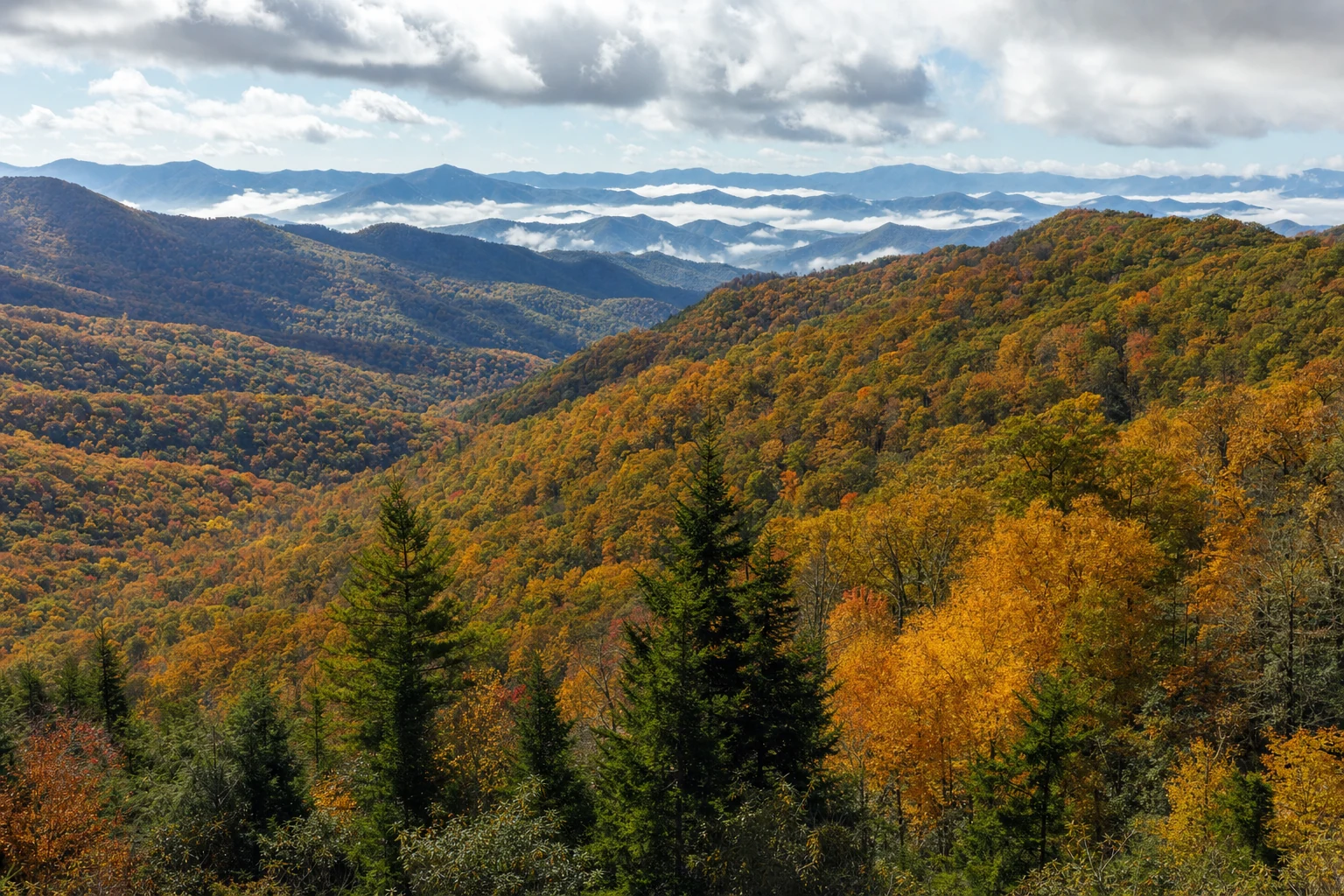
Fall color in the Cashiers area peaks in mid-October, and the canopy around the trail turns at the same time. The foliage frames the upper platform view better than any other season. Fall weekends draw crowds; weekdays are noticeably quieter, and the trail feels like a different experience on a Tuesday in October than on a Saturday.
Winter
The falls don't freeze, but the staircase to the lower platform gets genuinely dangerous in cold snaps. Mist from the falls keeps the stairs wet continuously; when temperatures drop at or below freezing for even a day or two, ice forms on the steps while the rest of the trail looks clear. Without microspikes or similar traction, the lower platform is effectively off-limits in cold conditions.
January and February carry the most risk. March is variable. If you're visiting with children or anyone unsteady on their feet, aim for November before the sustained cold sets in, or plan for April when conditions reliably improve. The upper platform trail is flatter and usually accessible even in mild winter weather; that's a reasonable consolation if conditions close the staircase.
Practical notes
Cell service is limited at the trailhead and largely absent on the trail itself. Download an offline map before you leave, and tell someone your plans if you're going solo. The parking lot is the last reliable signal point.
Mountain weather shifts faster than phone forecasts reflect. The gorge generates its own micro-conditions; it can be sunny at the parking lot with rain falling at the lower platform. Pack a rain layer regardless of what the app says, and a warm layer in any season outside summer.
Black bears range throughout this part of western NC. Standard practice applies: food stays stored, don't approach, give any bear you spot a clear exit. The main viewpoints see enough foot traffic that encounters are uncommon, but the surrounding forest is not a different situation.
Adding nearby stops
Cashiers and Highlands are both 20 to 30 minutes from the falls and worth building into the day. Highlands has a compact main street with coffee shops and restaurants that work well as a pre-hike stop or a post-hike meal. The Cullasaja Gorge along US-64 between Highlands and Franklin passes several roadside waterfalls, including Dry Falls, where a short paved walkway lets you walk behind the cascade with no real hiking required.
Routing back toward Cherokee, the Nantahala Gorge along US-74 breaks the drive naturally. Nantahala Outdoor Center runs rafting trips on the river with same-day booking available, and there are lunch options at the gorge itself. It adds a different kind of water experience to round out the day without significantly extending the drive.
Frequently asked questions
- How tall is Whitewater Falls (Upper & Lower)?
- Whitewater Falls (Upper & Lower) drops approximately 411 feet.
- How do I get to the waterfall?
- The falls are reached via a 0.25-mile easy hike from the nearby trailhead.
- Is it safe to swim at the falls?
- No. Swimming, wading, and climbing near waterfalls in the Smokies is dangerous and often fatal. Hidden currents, slick algae, and submerged rocks cause most waterfall deaths in the park. Enjoy the view from designated lookouts.