
About Elkmont Campground
Elkmont Campground sits roughly five miles from Gatlinburg's commercial strip along the Little River, making it the closest large campground to town inside Great Smoky Mountains National Park. The 220-site setup (tent and RV, no hookups) is bigger than most, and the location, surrounded by second-growth forest and the ruins of a vanished early-20th-century resort community, gives it depth that purely utilitarian campgrounds lack. The season runs early March through early December; reservations open six months out on Recreation.gov, and for summer weekends and October, that six-month window is when actual competition happens.
The Ghost Town Adjacent to Your Campsite
This isn't a metaphor: a genuine resort community was abandoned here, and you can walk through what's left. Elkmont developed as a summer retreat for Knoxville families who bought land from the Little River Lumber Company after logging cleared the area around 1910. The Wonderland Hotel opened in 1912, and over the following decades, families built dozens of private cabins clustered into two communities — the Appalachian Club area and a section called Daisy Town. When the National Park Service acquired the land in the late 1930s, original owners negotiated lifetime leases that finally expired in the 1990s.
The remains are substantial enough to occupy a solid hour: window frames standing in open air, stone chimneys, porch foundations, the Appalachian Clubhouse still structurally intact. The NPS has stabilized several structures, and Daisy Town is walkable on your own. The Wonderland Hotel footprint takes more navigation to reach. If the historical layer is what drew you here, it rewards time.
Campground Logistics
Sites accommodate tents and RVs, with a maximum vehicle length of 35 feet and maximum trailer length of 20 feet. There are no electrical, water, or sewer hookups. The campground has flush toilets, cold running water, and a dump station; showers are not available. The nightly rate was $30 in 2024 — verify current pricing on Recreation.gov before booking.
Pets are allowed in the campground and picnic areas on a leash no longer than six feet, but dogs are not permitted on park trails. That's a park-wide rule rather than campground policy. If hiking with a dog is part of your plan, Elkmont won't accommodate it; the Gatlinburg Trail, one of the few pet-friendly routes in the park, is accessible from Sugarlands rather than from camp.
Food storage is non-negotiable: all food, coolers, toiletries, and anything with a scent must stay in a hard-sided vehicle or bear box when not in active use. Bear activity at Elkmont is real and year-round, not hypothetical.
Trails Within Walking Distance
The campground functions as a genuine trailhead, which is a large part of why it fills so quickly.
Little River Trail starts at the campground (GPS: 35.6560° N, 83.6000° W), following the historic logging railroad grade along the river for 4.9 miles one-way to Huskey Gap Trail. Total elevation gain is about 500 feet, keeping the difficulty in the easy-to-moderate range. The wildflower display along the bank in spring is one of the trail's strongest draws, and old homesites appear throughout the route. Most day hikers turn back well before Huskey Gap; the first two miles carry the heaviest foot traffic.
Jakes Creek Trail begins near camp and follows Jakes Creek past historic cabin sites connected to the Huskey family, eventually connecting to the Cucumber Gap Trail and Sugarlands Valley Nature Trail. Moderate terrain and historical context make it a natural pairing with a morning walk through Daisy Town.
Two smaller waterfalls are accessible from the Elkmont area. Cataract Falls is an easy walk from the campground, dropping roughly 25 feet over layered rock, and draws far fewer visitors than Laurel Falls. Husky Branch Falls is nearby and more secluded; the cascade is modest, but easy access makes it worth a side trip. Laurel Falls itself — paved, popular, and heavily visited — is off Little River Road and requires driving to its own trailhead. Not walkable from camp, but a short drive.
The Synchronous Fireflies
In late May or early June each year, the forest around Elkmont hosts synchronous fireflies (Photinus carolinus), a species where males flash in coordinated patterns that produce visible waves of light moving through the trees. The exact window shifts by a week or two depending on seasonal conditions; the NPS posts confirmed dates each spring.
Since 2016, access during the viewing period has required shuttle tickets obtained through a separate Recreation.gov lottery. Campground guests during the event are not automatically exempt from the shuttle requirement, and the specific logistics have changed across recent seasons. Treat the NPS synchronous fireflies page as the only reliable source before planning a trip around the event; secondhand accounts of how the process worked two or three years ago are not dependable.
Outside the lottery window, fireflies are present at Elkmont throughout summer evenings, just without the synchronization. An evening walk through Daisy Town during ordinary firefly conditions, without the lottery crowds, is worth doing on its own terms.
Getting There and Park Fees
The campground address is 4349 Little River Rd, Gatlinburg, TN 37738; GPS is 35.6669° N, 83.5855° W. From Gatlinburg, enter the park at Sugarlands Visitor Center and follow Little River Road — the turnoff to Elkmont is clearly marked. Plan 15 to 20 minutes from the park entrance, longer in peak summer traffic.
The Park-It-Forward parking tag is required for all vehicles parked anywhere in Great Smoky Mountains National Park for more than 15 minutes. Pricing is $5 per day, $15 per week, or $40 annually, available through Recreation.gov before your trip or at self-service kiosks at major trailheads. An annual tag pays for itself after two or three visits. Your campground reservation and your parking tag are separate transactions; one doesn't satisfy the other.
Before You Arrive
No showers is the most consistent complaint about Elkmont. If that matters to your group, plan to drive into Gatlinburg, or book a campground outside the park that has shower facilities. The trade-off is real: the proximity to the historic area, direct trailhead access, and river corridor that runs adjacent to much of the campground are genuinely hard to replicate elsewhere in the park.
Cell service drops off once you pass Sugarlands, so download offline maps, weather forecasts, and your full itinerary before entering; anything time-sensitive needs to be handled before you lose signal.
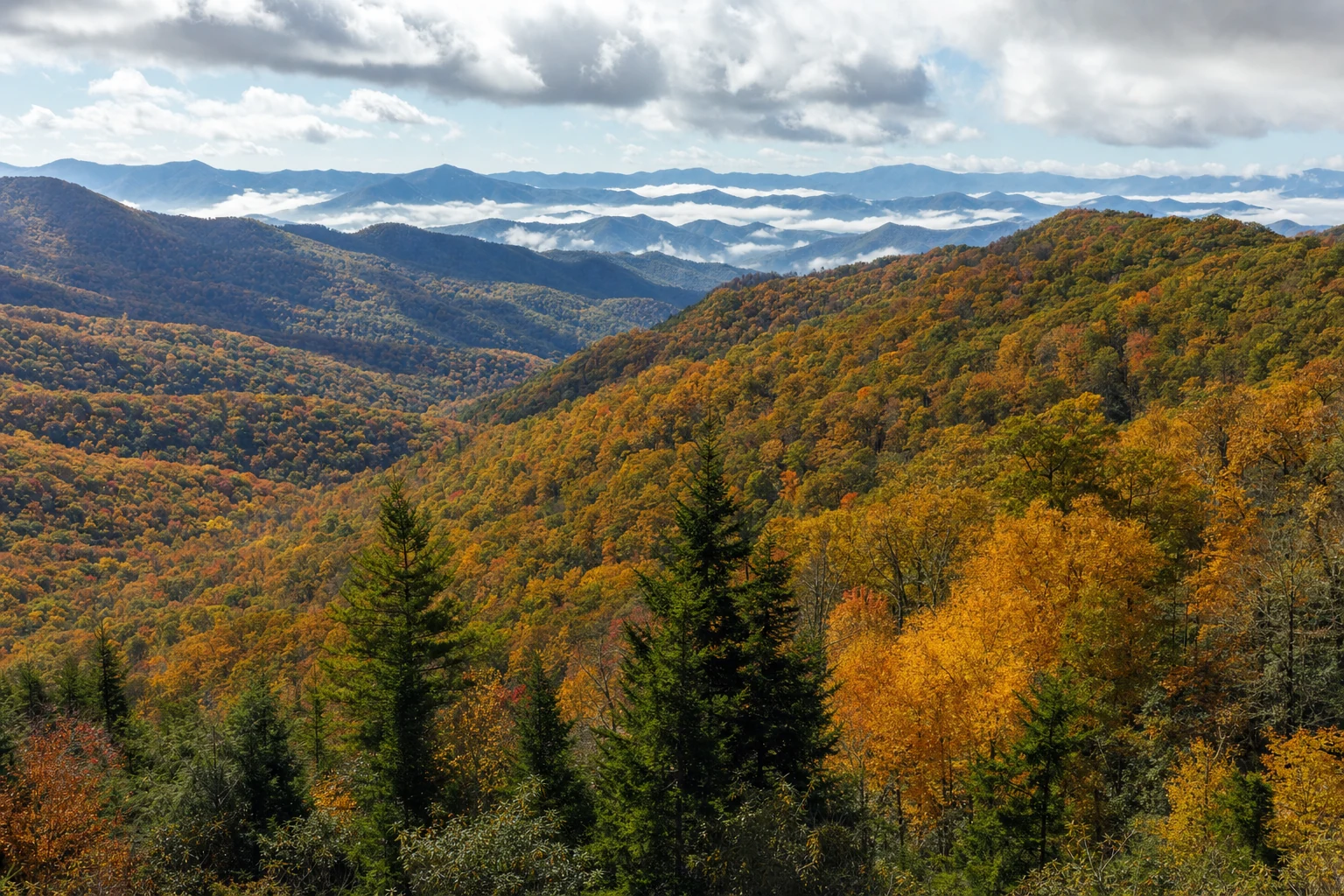
October fills almost as fast as peak summer. Fall color in this section of the park typically peaks mid to late October, and demand during that window is intense. Book at exactly the six-month mark.
Frequently asked questions
- How many sites are available?
- 220 sites total.
- Can I bring my pet?
- Leashed pets are welcome at most frontcountry campgrounds but are prohibited on most park trails.