
About Campbell Overlook (TN Side)
Now I'll write the guide, clean against that banned-words list.
Campbell Overlook sits at roughly mile marker 5.5 on Newfound Gap Road (US-441), about 3,000 feet up the Tennessee side of the Smokies, where the forest has already traded its lower-elevation mix for higher hardwoods. The pullout faces east and holds five to seven cars, which means it's rarely the scene of gridlock that the bigger named stops become on a fall weekend. It earns a stop for the right reasons: a genuine view of layered ridges and reliable late-afternoon light, with rarely more than a handful of other cars competing for the same edge.
The View
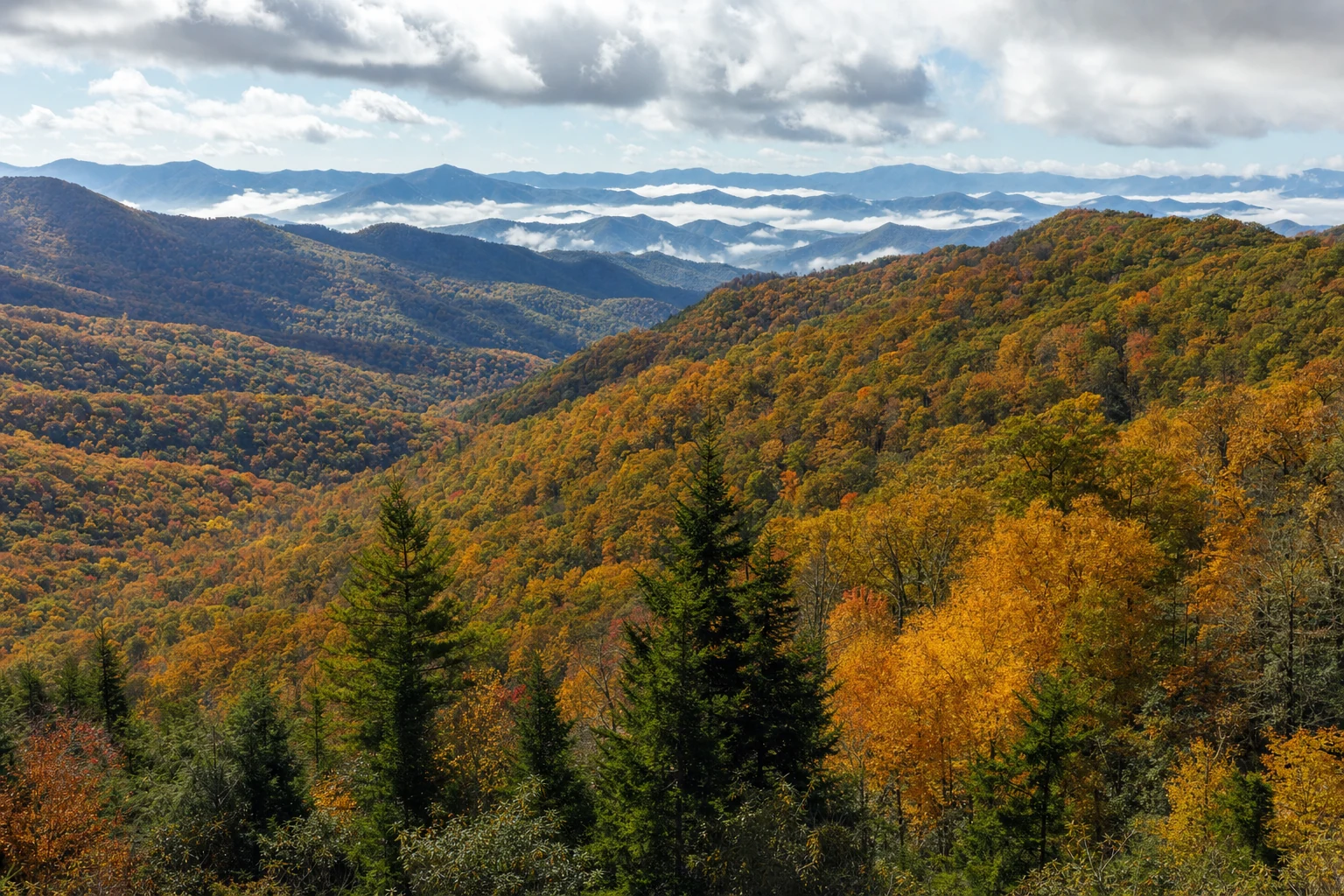
This isn't a panoramic sweep. What the east-facing position gives you is a framed corridor of forested slopes rolling away into a succession of ridges that progressively soften in color and definition as they recede. On humid days, the haze that named these mountains turns those far ridges into lighter blue-gray bands, each one sitting slightly above the next. On clear days, the actual topography comes forward more sharply: distinct drainages, ridge spurs, and the full scale of unbroken forest becomes legible in a way it rarely does from below.
The view rewards looking rather than speed. There's enough depth in the composition to hold attention, especially when clouds are moving through and light shifts across the slopes in patches. At 3,000 feet, you're above the valley haze that sits low over Gatlinburg on summer mornings, which gives the far ridges a clarity that some of the lower overlooks on the road don't always deliver.
Light and Photography
The east-facing orientation is the defining factor for when this stop works. Mid-day delivers the clearest views; direct overhead light burns off haze and the ridgelines stand out with real definition, which suits documentation over mood. Late afternoon is a different story. Low western sun rakes across the slopes from behind the viewer, throwing every ridge into shadow relief and giving the middle-distance terrain dimensionality that flattens out at noon. That late-afternoon window is worth planning around if you care about the quality of the shot.
Sunrise is worth considering for anyone already planning an early Newfound Gap run. Light from the east comes straight toward the overlook, illuminating the foreground ridges while the deeper valleys remain in shadow — a layered look that reads well photographically. Confirm the sky is reasonably clear before committing to the early drive up, because an overcast sunrise here is just a gray wall.
One practical note: the pullout is compact, so compositional variation is limited. The best frames tend to come from the road-side edge rather than the center of the lot, where you get more foreground interest from the slope below.
Fall Foliage
Newfound Gap Road climbs nearly 4,000 vertical feet over its 33-mile run from Gatlinburg to Cherokee, and that gradient means color peaks at different elevations at different times. At Campbell Overlook's roughly 3,000 feet, peak color typically arrives in mid-October, after the high ridges have already turned but while some lower slopes are still green. You can often see that gradient directly from the pullout: warm color on the near ridges and darker valley tones below. If the sky cooperates and you're there in late afternoon, the whole composition lights from the west.
Traffic on Newfound Gap Road in October is heavy, especially on weekends, and parking pressure at the major overlooks reflects that. Campbell runs quieter than Morton and Newfound Gap further up the road, which makes it a useful stop when you want to stand at the edge without competing for position. The crowd level is characteristically low to moderate even during peak foliage weekends, which is one of its real practical advantages.
How Campbell Fits on the Newfound Gap Drive
Newfound Gap Road is set up for sequential stops, and Campbell lands early in that progression. Starting from the Sugarlands entrance near Gatlinburg:
- The Gatlinburg Scenic Overlook, about 1.5 miles in, faces back toward town and reads best at sunset or after dark when the lights come on below.
- Campbell Overlook follows at approximately MP 5.5, east-facing, best suited to mid-day clarity or late-afternoon shadows.
- Chimney Tops Overlook arrives around MP 6.7, framing the distinctive twin peaks that are still visibly recovering from the 2016 wildfires; it's a larger lot but also draws hikers, so it can fill quickly.
- Morton Overlook at roughly MP 10.5 is where most photographers stop first: the classic layered-ridges view with the deep Smokies haze, a lot that holds 15 to 20 cars, and strong results in mid-morning or late-afternoon light.
- Newfound Gap at approximately MP 14.5 sits at the Tennessee/North Carolina state line above 5,000 feet, carries the Rockefeller Memorial and an Appalachian Trail crossing, and delivers views into both states simultaneously.
Running this sequence without hiking is manageable in a half-day. Adding the Kuwohi spur from Newfound Gap (seven miles each way to the park's high point at 6,643 feet) extends that to a full day. The spur closes from early December through late March.
Parking and the Park It Forward Tag
Campbell Overlook holds roughly five to seven vehicles. Smaller RVs can fit, but the lot is tight when occupied and larger rigs will find maneuvering difficult when other cars are present. If you arrive and the pullout is full, Chimney Tops Overlook is about 1.2 miles further up the road with more capacity.
A Park It Forward parking tag is required for any stop inside Great Smoky Mountains National Park lasting more than 15 minutes. Tags cost $5 daily, $15 weekly, or $40 annually, available through recreation.gov or at kiosks near the park entrances. For a full-day Newfound Gap Road run hitting multiple overlooks, the weekly pass is the straightforward choice over paying daily.
Road Conditions and Seasonal Notes
Newfound Gap Road is well-maintained but winding, and the elevation means conditions can shift quickly in cold weather. Ice and snow can close sections in winter without much advance notice; the National Park Service publishes current road status and it's worth checking before you drive from November through March. The Kuwohi spur has a formal closure window from early December through late March, but the main road can also close temporarily during severe weather events.
In summer and fall, the road stays open but traffic builds early on weekends. The overlooks along the lower section of the road, Campbell included, see lighter use on weekday mornings than at any other time. If your schedule has flexibility, a Tuesday or Wednesday morning in October is a materially different experience from a Saturday.