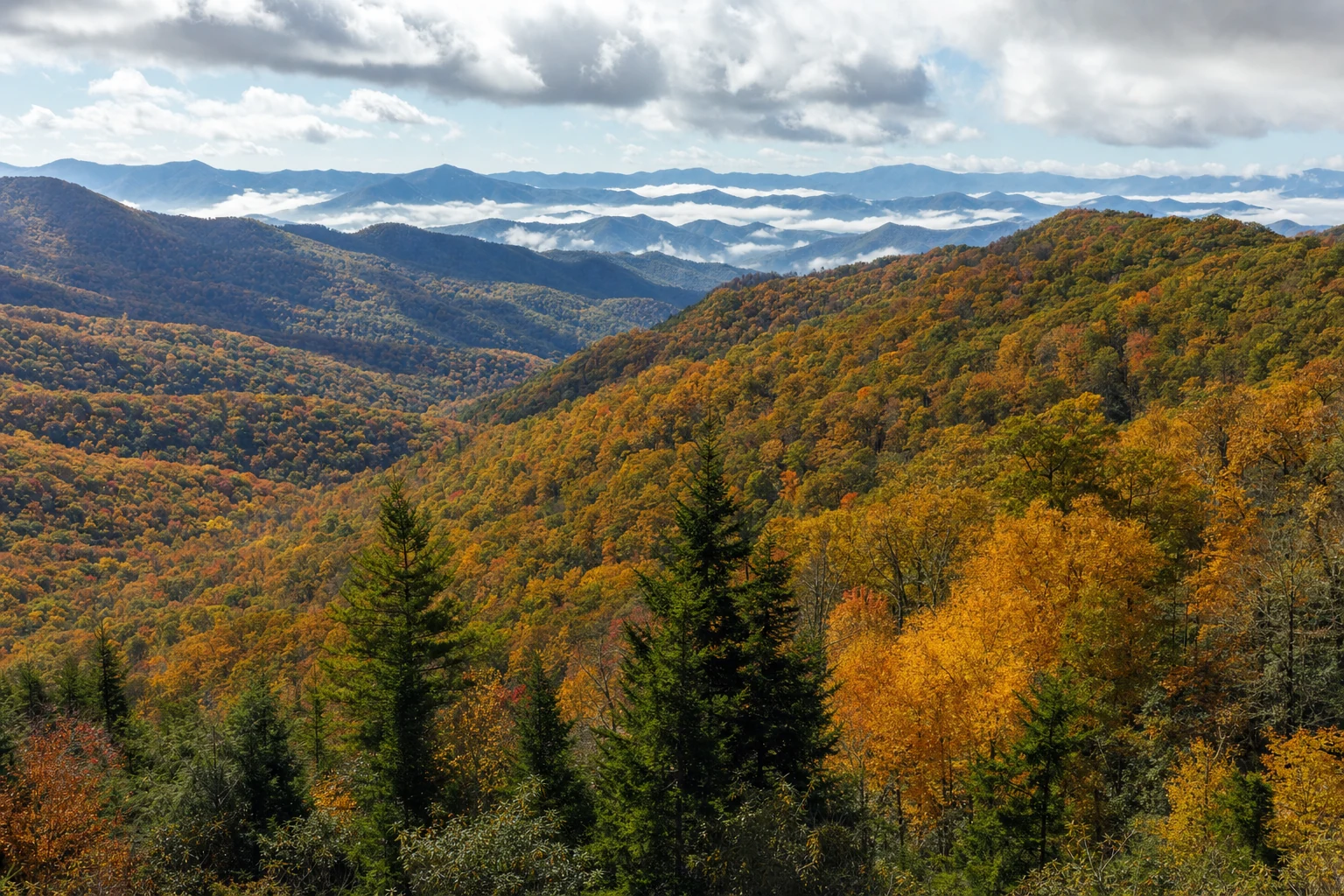

About Balsam Mountain Overlook
Balsam Mountain Overlook sits at the far end of a one-way road through the high country of Great Smoky Mountains National Park, and you don't stumble onto it by accident. Getting there means driving the full length of the Balsam Mountain one-way section, starting at Heintooga Overlook and working your way along a corridor that sees considerably less traffic than the park's main roads. The payoff is a wide sweep across the Balsam Mountains, ridge after ridge stacking into the distance, with crowd levels that run low to moderate even on busy park weekends.
The view
From the overlook, the Balsam Mountains and the surrounding ranges spread out in a sweeping panorama. Because the elevation puts you at ridgeline rather than below it, the view has a horizontal quality: you're looking across the landscape rather than down into a valley. The mountains fold into each other in diminishing planes of green and blue, and the full scale doesn't register until you've stood there for a few minutes.
This is the strongest vantage point along the one-way corridor. Heintooga Overlook, at the start of the section, faces back toward the Blue Ridge Parkway. The Flat Creek Trailhead area offers glimpses through dense spruce-fir canopy. Balsam Mountain Overlook faces the full range without significant tree obstruction, which is what makes it the destination rather than just a waypoint.
Morning light produces the clearest views; haze builds as the day progresses, particularly from late spring through early fall, and by mid-afternoon the distant ridges can soften into an indistinct blue. Late afternoon works differently: golden-hour light warms the slopes and adds depth to the shadows between ridges, producing better photography conditions even if the air clarity has dropped. Clarity favors morning; color favors late afternoon, and which matters more depends on what you're going for.
Getting there
The road to Balsam Mountain Overlook runs one-way, with Heintooga Overlook marking the entry point of the single-direction section. From there, the road passes the Flat Creek Trailhead before terminating at this overlook. There's no reversing through a one-way section, so committing to the drive means finishing the route out — plan your timing accordingly, especially if you're heading back toward Gatlinburg before dark.
From Gatlinburg, the main park entry points are Sugarlands Visitor Center on the Tennessee side and Oconaluftee Visitor Center on the Cherokee, North Carolina side. A current park map will show you which entry puts you on the most direct path to the Balsam Mountain corridor; the internal road network isn't always legible from a distance. Cell service can be unreliable inside the park, so downloading an offline map before you leave saves headache once you're on the road.
Parking and fees
The overlook has a moderate-sized lot, more room than most pullouts along the park's busier roads offer. Arrive earlier if you're visiting on a summer or fall weekend, though the lower profile of this corridor means you'll typically have better odds than at the main-road overlooks along Newfound Gap.
A Park It Forward parking tag is required for any stop longer than 15 minutes anywhere inside Great Smoky Mountains National Park. Daily tags cost $5, weekly $15, annual $40; all are available through Recreation.gov and at park entrance kiosks. The park has no entrance fee, which sometimes leads first-time visitors to assume parking is also free. It isn't. Buying the tag online before you arrive is the most reliable option, particularly in peak season when kiosks can be sold out or offline.
When to go
Fall tends to be the strongest season for this overlook. High-elevation color peaks earlier than in the valleys below, so mid-to-late October often delivers foliage conditions here while the main Gatlinburg corridor is still coming in. Summer offers clear green landscape and good morning views before haze builds. Spring brings wildflowers to the surrounding forest, and the spruce-fir canopy at this elevation holds interest well into the season.
Winter is the unpredictable variable. High-elevation roads in the park close when ice makes them unsafe, and this corridor is exposed enough to be affected. The park publishes road conditions online and at entrance stations; if this drive is a specific goal rather than a casual add-on, confirm the road is open before committing to the trip in January or February. Getting to a closed gate after an hour of driving into the park is not a rare outcome in winter.
Pairing it with the rest of the corridor
The one-way road organizes itself naturally into a half-day itinerary: Heintooga Overlook at the entry, Flat Creek Trailhead for anyone who wants to step out of the car and into the high-elevation spruce-fir forest, then Balsam Mountain Overlook as the finish. Each stop is distinct enough that you're not repeating the same experience. The trailhead hike is optional; many visitors drive it as a scenic route without stopping to walk.
Visitors who treat the corridor as its own destination, rather than squeezing it in before somewhere else, consistently find it more satisfying. The one-way structure enforces a pace, and trying to rush the drive misses most of what makes it worthwhile. A half-day built around this route also delivers a genuinely different piece of the park than the main Newfound Gap road offers, which matters if you've already done that corridor and want something quieter and less trafficked.
What to expect on arrival
No facilities at the overlook: no visitor center, no interpretive panels, no concessions, no restrooms. Bring water and anything else you need before turning onto the one-way section, because there's nowhere to resupply once you're committed to the route.
The lot, when you reach it, is quiet relative to most GSMNP stops. Low to moderate crowd levels reflect the fact that this road requires a deliberate choice to drive it, and most park visitors never make that choice. What that means in practice is that you'll probably have room to stand at the overlook without waiting for a gap in the crowd, which is not something you can count on at Clingmans Dome or the main Newfound Gap pullouts on a Saturday in October. For a park that draws millions of visitors a year, that kind of space is genuinely rare.