
About Bunches Bald Overlook (MP 440.9)
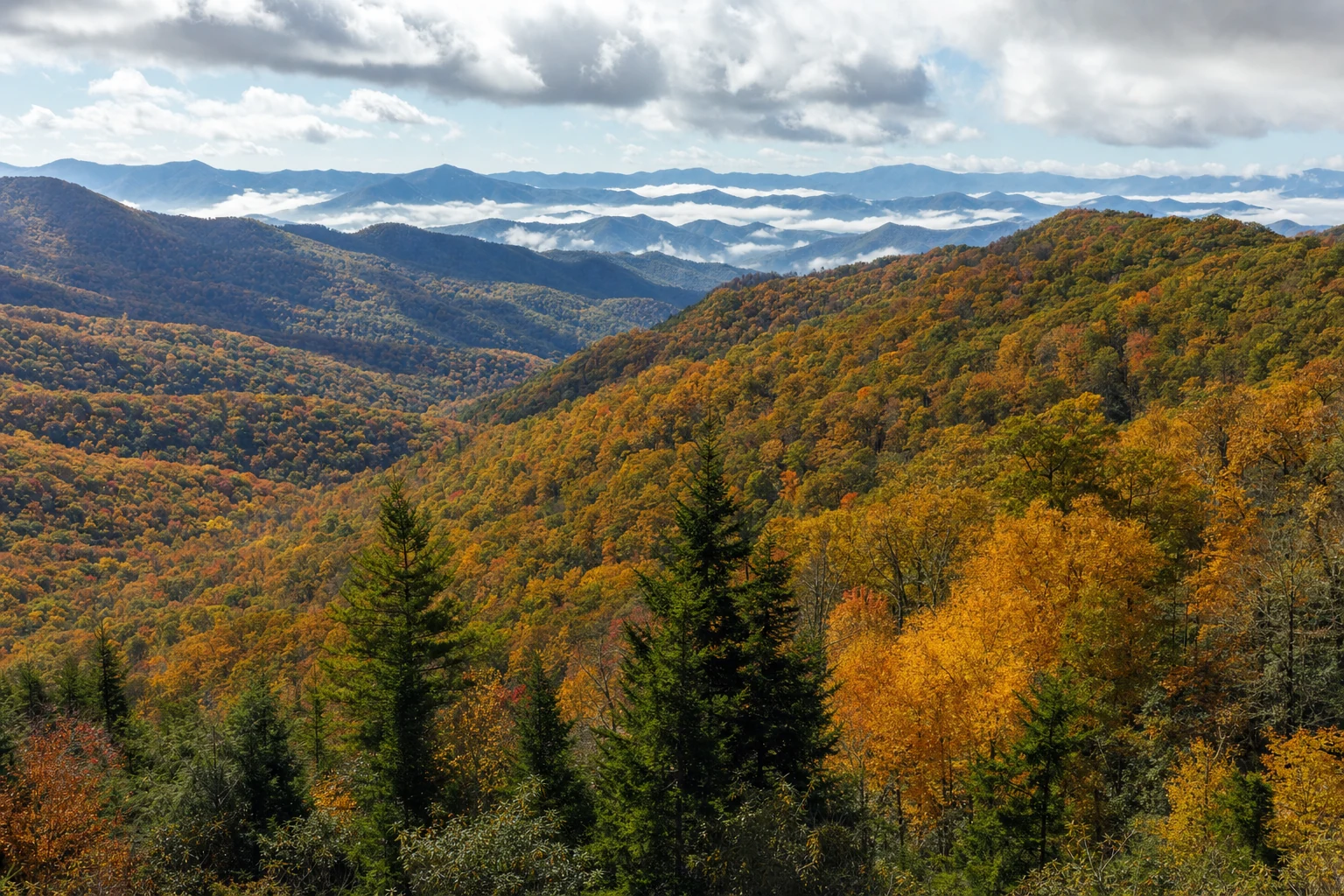
Bunches Bald Overlook sits at milepost 440.9 on the Blue Ridge Parkway, well above the foot traffic concentrated in Gatlinburg and the nearby valley towns. The pullout is small and the crowd level stays genuinely low; this isn't a stop featured in visitor center brochures or the itineraries pushed to first-time park visitors. What you get here is a forested bald on the near horizon, long sightlines across layered mountain ridges, and morning light that hits the high country cleanly before haze builds through the day.
The view
The bald visible from this overlook isn't a bare-rock summit; it's a rounded, forested high point of the type common in the southern Appalachians, where thin soils and exposed conditions produce a mounded profile covered in spruce and fir rather than stone. From the pullout, the view opens into a sweep of ridges layered toward the horizon, and that kind of long-range visibility is actually less common along the heavily wooded upper Parkway than you might expect. On a clear morning, multiple ranges stay distinct. By early afternoon in summer, even nominal humidity turns the distances soft and the layers compress into a single pale blur.
This stretch of the Parkway between Richland Balsam and Waterrock Knob draws significantly less traffic than the summit stops at either anchor, and Bunches Bald doesn't appear in any of the top-ten Parkway roundups that funnel visitors toward the same handful of overlooks. You'll likely share the pullout with nobody, or at most one other vehicle.
When to visit
Morning is the straightforward answer for clear views, and it holds up practically since mountain haze accumulates as the day heats. Getting there before 10 a.m. on a clear day covers the best window for visibility. Afternoon visits aren't worthless; the quality of the light shifts and the bald takes on different character in low afternoon sun. But if long sightlines are the point, come early.
Autumn is when this stretch of the Parkway earns more of a detour. High-elevation sections typically hit peak fall color a week or two before the valley floor does, so a mid-to-late October visit catches color on the bald's slopes while lower elevations are still transitioning. Combined with morning clarity, the overlook delivers considerably more than a casual summer stop would suggest.
Spring is genuinely underused here. The high-elevation forest greens out later than the valleys, and a visit in early May finds a mix of bare branches and fresh growth that's visually distinct from summer's uniform canopy. Crowds are minimal until Memorial Day.
Getting there and parking
The natural approach from Gatlinburg is US-441 south through the park, which connects to the Blue Ridge Parkway. The exact routing to milepost 440.9 depends on which direction you're traveling along the Parkway once you reach it.
The pullout itself fits a small number of standard passenger vehicles; don't plan on parking an RV or pulling a trailer here. If the pullout is occupied when you arrive, other stopping points are close in both directions along this corridor. The density of overlooks along this section means alternatives are always within a few miles, and turning around isn't a significant cost.
A Park It Forward parking tag is required for stays over 15 minutes inside Great Smoky Mountains National Park. Rates are $5 for a day pass, $15 for a week, or $40 annually; purchase through Recreation.gov or at park entrance kiosks before you reach the road. There's no payment option at roadside pullouts, so handle it before you get on the Parkway.
Road conditions
This section of the Parkway runs above 5,000 feet, and the road closes when winter weather makes it unsafe — which can happen anywhere from November through March with limited notice. The Park Service gates sections rather than treating the surface the way municipal roads get treated in winter; don't assume the Parkway is open just because the valley roads are clear. Check road status through the National Park Service before heading out in cooler months.
Fog deserves separate consideration. Persistent low cloud is a defining feature of the Smokies climate, and when fog sits at elevation, the long views that make this overlook worth stopping at specifically won't be there. That said, fog at high-elevation overlooks produces its own effects: ridgelines emerging from cloud, the bald floating above a floor of mist. Worth seeing, just different from the clear-day version. Neither condition should necessarily keep you away; it just changes what you'll find.
Pairing it with nearby stops
Waterrock Knob (MP 451.2) is the natural anchor for any itinerary that includes this corridor. About 10 miles northeast along the Parkway, it has a larger parking lot and a seasonal visitor center, plus a short trail to a summit with views across the Plott Balsam range. Sunrise and sunset draw real crowds; morning visits outside of peak season are manageable. Budget an additional 30 to 45 minutes if you're stopping there after Bunches Bald.
Richland Balsam Overlook (MP 431.4) holds a different kind of interest: at 6,047 feet, it's the highest point on the entire Blue Ridge Parkway. The view there is enclosed rather than sweeping, with spruce-fir forest pressing in closely on all sides, but the elevation is genuinely distinctive and the air quality on a clear morning sets it apart from anything lower on the road.
Wesner Bald Overlook sits along the same stretch, offering open grassy bald terrain that contrasts with the forested character at Bunches Bald. The two work well as a paired stop rather than separate detours, and doing them back-to-back illustrates how much the visual character of the high-country balds can differ over just a few miles.