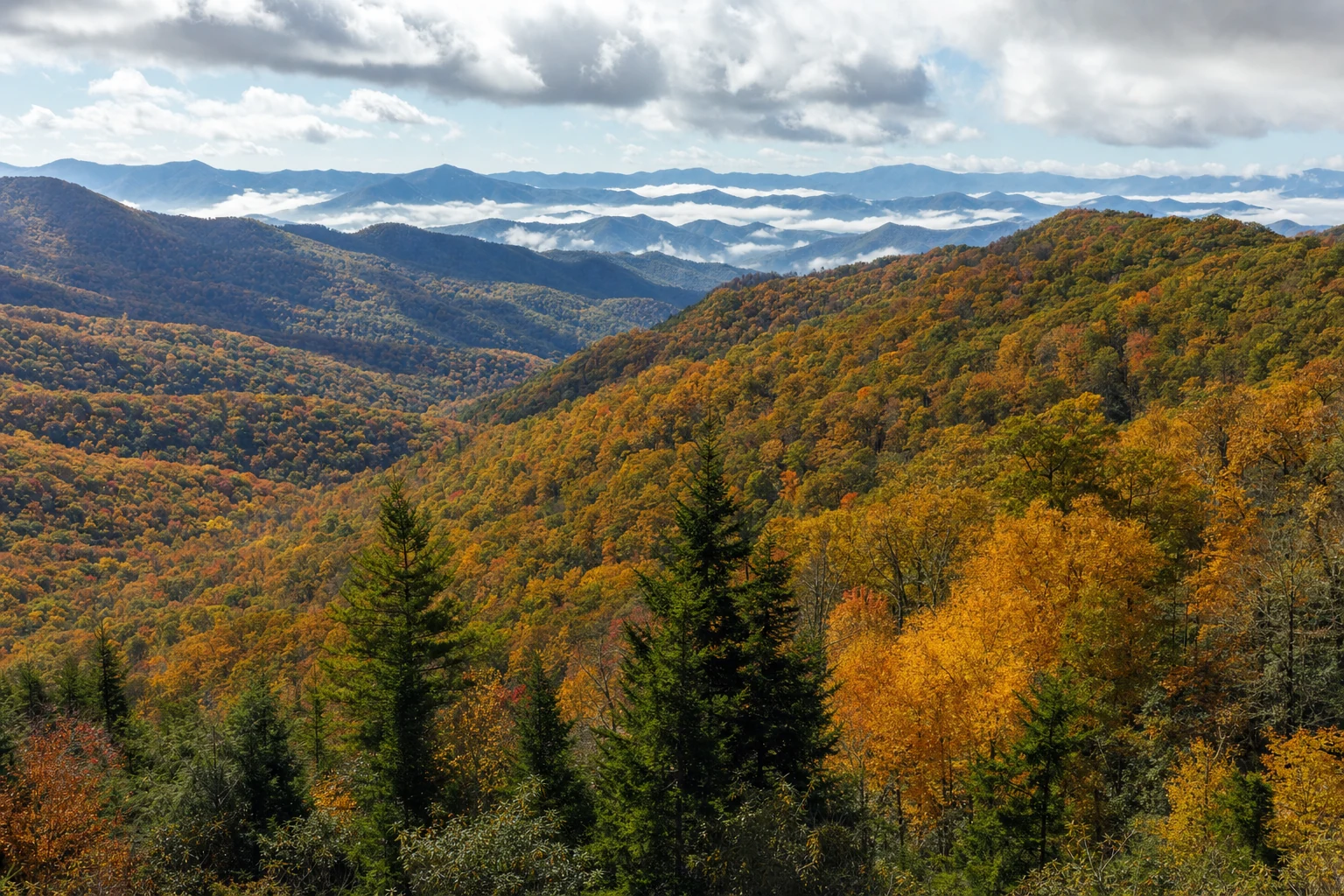

About Gatlinburg Scenic Overlook (TN Side)
About 1.5 miles south of downtown Gatlinburg on Newfound Gap Road, a moderate-sized pullout offers one of the most direct views of the town you'll find anywhere inside Great Smoky Mountains National Park. From this elevation, Gatlinburg spreads across the valley floor in full — its streets, rooftops, and the ridge-to-ridge backdrop of the Smokies forming a single frame. It's a genuinely useful stop, whether you're arriving into the park or heading back out.
What You're Looking At
The view from this overlook faces north toward Gatlinburg, with the town sitting below you in the valley carved by the West Prong of the Little Pigeon River. The mountain ridges rise immediately behind the town, layering back in the way the Smokies do — pale blue tones stacking on each other toward the horizon. During the day, the scale of the valley becomes apparent: Gatlinburg looks compact from up here, surrounded by steep forested slopes on every side. At night, the town lights fill the valley with a warm glow that reads surprisingly well from this distance.
This is not a wilderness panorama. It's a view of a mountain town inside a national park, and that's exactly what makes it distinctive. You won't find this angle from anywhere in downtown Gatlinburg itself — the town is too low and too surrounded to see itself clearly. The overlook gives you the geography.
Timing and Light
Late afternoon and the hour before sunset produce the best conditions. The sun drops toward the ridge behind you, sending golden light across the valley floor and catching the west-facing slopes beyond the town. Shadows start to define the terrain, and the light on the downtown buildings has warmth that flat midday sun doesn't offer.
Sunset draws crowds. The pullout fills early on clear evenings, particularly in fall when foliage color adds a third layer to the scene — the town, the slopes, and a band of orange and yellow that runs across the middle distance. Arrive at least 30 to 45 minutes before sunset if you want to choose your parking spot rather than take what's left.
Night is worth the trip on its own. Once Gatlinburg lights up after dark, the valley glows more dramatically than you'd expect. City-light photography from here is straightforward — a tripod, a long exposure, and you have a clean composition without interference from streetlights directly overhead. The road stays open after dark during good conditions, so this isn't a logistics challenge.
Morning visits are quieter. The light hits the far ridges first and the valley can hold mist in the colder months, which adds atmosphere even if it occasionally obscures the town itself. If you're after a less-crowded experience and don't need the dramatic sunset light, early morning will serve you better.
Getting There and Parking
From downtown Gatlinburg, drive south on US-441 / Newfound Gap Road toward the park entrance. The overlook appears on the right side of the road approximately 1.5 miles in from the Sugarlands Visitor Center area. There's no significant signage buildup — watch for the pullout on your right as you climb away from the valley.
Parking is a moderate-sized lot that fills fast during peak seasons and any evening with clear weather. Summer weekends and the fall foliage season (mid-October through early November) are the most competitive. If you arrive and the lot is full, the next realistic option is driving further into the park to another stop and circling back when the lot turns over — typically within 20 to 30 minutes during busy periods.
A Park It Forward parking tag is required for any stay over 15 minutes inside Great Smoky Mountains National Park. Tags cost $5 per day, $15 per week, or $40 for an annual pass. You can purchase one at park entrance kiosks, at the Sugarlands Visitor Center just inside the main entrance, or in advance via recreation.gov. Enforcement is active — rangers do check, and there's no grace period beyond the 15-minute threshold.
What to Expect On the Ground
The pullout itself is straightforward: paved parking, a guardrail along the overlook edge, and a clear view without significant obstacles. There are no facilities here — no restrooms, no water, no interpretive signs. It's a stop and look, not a destination with amenities.
Crowd behavior here tends toward quick visits. Most people pull in, spend five to fifteen minutes, take photos, and move on. That turnover keeps the lot cycling even when it's technically full. If you're willing to wait a few minutes rather than giving up, a space usually opens.
The road at this elevation can close during winter ice events. GSMNP closes Newfound Gap Road when conditions are hazardous, and the overlook goes with it. Before driving up in December through March, check the park's road status — updated daily and available through the park's official channels. Closures are often short but unpredictable.
Photography Approach
The composition from this overlook is fairly consistent: town in the valley, ridges behind, sky above. The variables are light quality and atmospheric conditions. A standard telephoto — anywhere from 50mm to 200mm equivalent — compresses the ridges behind the town and makes the mountain backdrop appear closer and more substantial than a wide-angle lens would. Wide-angle works better for capturing the full sweep of the valley when you want context.
For night shooting, a tripod is necessary. The town lights are bright enough to expose in reasonable time, but handholding won't produce clean results. The guardrail can serve as a stabilizing point in a pinch, though a proper tripod setup gives you better control over framing.
Fog behaves unpredictably at this elevation. On mornings after rain or in shoulder-season conditions, the valley can be completely socked in with low cloud, which makes for a different and sometimes more dramatic photo — the Smokies living up to their name, town completely hidden, just ridge tops poking above the gray. Whether that's useful to you depends on what you're shooting for.
Pairing It With Other Stops
This overlook pairs naturally with the Sugarlands Visitor Center, about 1.5 miles back toward town. If you're entering the park from Gatlinburg, the visitor center is a logical first stop — maps, road condition updates, ranger information — and the overlook sits almost immediately after on your way in.
Further south on Newfound Gap Road, Campbell Overlook (around mile 5.5) and Morton Overlook (near mile 10.5) offer progressively different perspectives as you gain elevation — less town, more mountain ridgeline. Newfound Gap at mile 14.5 marks the Tennessee-North Carolina border and is a major destination in its own right, with an entirely different view character. A morning drive from Gatlinburg to Newfound Gap and back covers all of these overlooks in sequence and takes two to three hours at a relaxed pace, stopping where conditions look good.