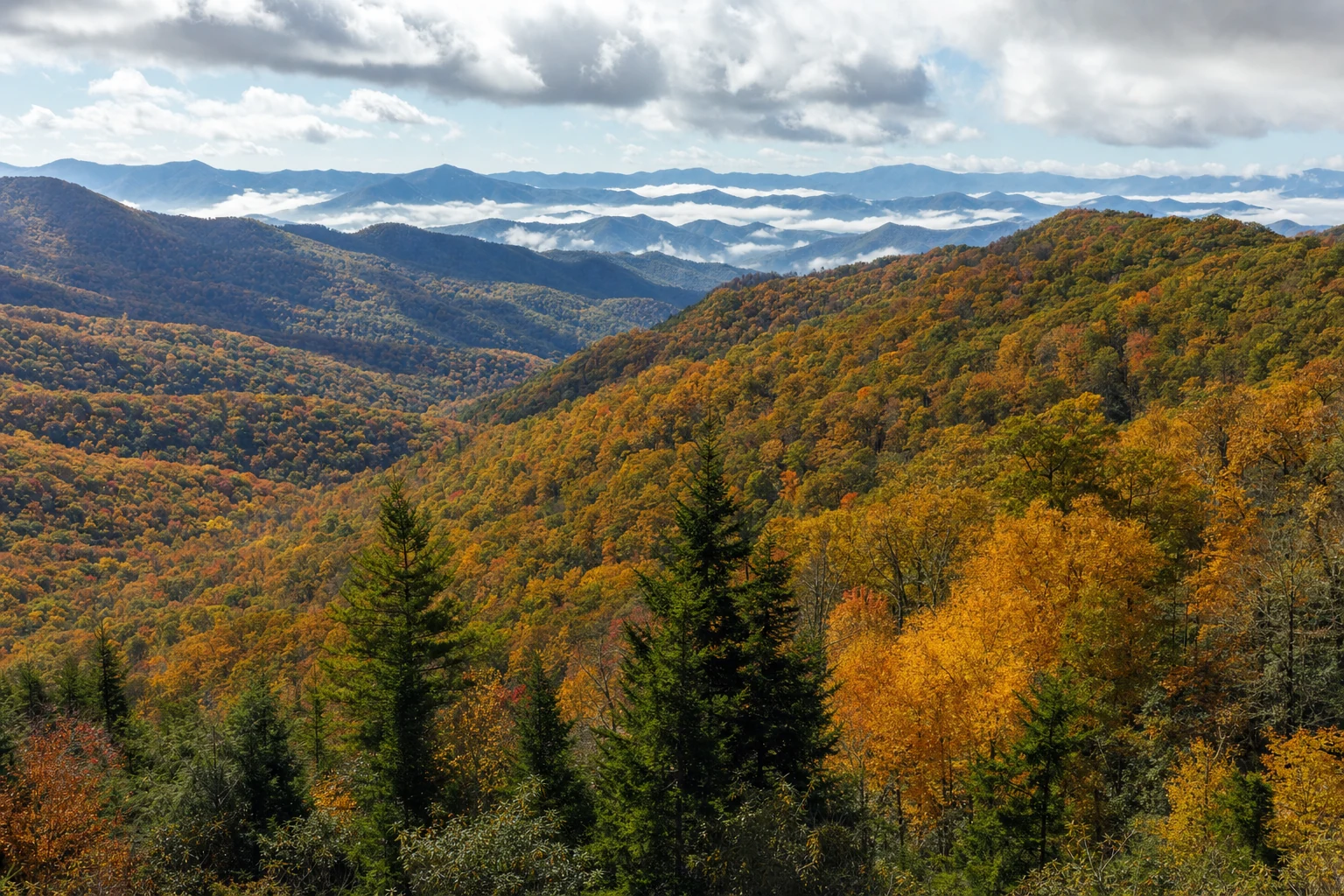

About Morton Overlook (TN Side)
Morton Overlook earns its reputation not through a single dramatic feature but through sheer atmospheric depth. At milepost 10.5 on Newfound Gap Road, the view opens southwest across ridge after ridge of forested mountain, each layer fading slightly bluer and softer than the one before it, until the furthest ranges dissolve into gray. This is the view that put the "smoky" in the Smokies' name, and Morton Overlook is one of the better spots along the entire 31-mile corridor to watch it happen.
The view itself
The phenomenon you're watching from Morton Overlook is the same one that named these mountains: biogenic volatile organic compounds released by billions of trees react in the atmosphere to scatter light, layering the ridgelines in a blue-gray haze that thickens with distance. From the overlook's elevation, you're looking across multiple parallel ridges receding into North Carolina, each one progressively less distinct than the last. On clear mornings, five or six ridgelines are visible before they merge completely into atmosphere; in humid summer or damp fall weather, even the second or third ridge can go ghostly before noon.
What Morton offers that Newfound Gap doesn't is a lower-angle vantage, closer to tree level, that makes those stacked ridges feel immediate rather than distant. You're not surveying the whole park from a summit; you're watching it fold away from you, valley by valley.
When to be here
Mid-morning light hits Morton particularly well. The overlook faces roughly south-southwest, so by 9 or 10 a.m. the sun is high enough behind you to illuminate the near ridges clearly while the distant ones stay hazy — exactly the contrast that makes layered-ridge photography worth the early alarm. Late afternoon adds warmth to that haze and shifts the shadow angles on the closest slopes, deepening the sense of recession into the far ranges.
Sunrise is the most committed option and often the most rewarding. On damp mornings, fog pools in the inter-ridge valleys and the overlook sits just above it, looking down across a white surface with ridge tops emerging through it. This happens most reliably in spring and fall, less predictably in summer. Getting there before first light means arriving in the dark and waiting; the parking area at Morton is small (roughly 15 spaces), and on popular fall mornings it fills before sunrise.
Getting there
Morton Overlook is on the left (east) side of Newfound Gap Road heading south, about 10.5 miles from the Sugarlands Visitor Center just inside the Gatlinburg park entrance. The road is paved, well-maintained in fair weather, and open year-round except during ice events. There are no tricky approaches; the overlook is clearly marked and the pullout is visible well in advance.
A Park-It-Forward parking tag is required for any stop over 15 minutes anywhere inside Great Smoky Mountains National Park, Morton Overlook included. Tags cost $5 per day, $15 per week, or $40 annually; buy them at recreation.gov before your trip or from kiosks at the Sugarlands and Oconaluftee visitor centers. There's no fee booth at the overlook itself, and rangers do check.
Pairing Morton with the full Newfound Gap Road drive
Morton makes the most sense as part of a longer drive rather than a standalone destination. Newfound Gap Road runs 31 miles from Gatlinburg to Cherokee, crossing the state line at Newfound Gap (MP 14.5), and several overlooks cluster along the Tennessee side. Campbell Overlook at roughly MP 5.5 gives you a framed view of forested slopes and distant peaks; Chimney Tops Overlook around MP 6.7 offers a look at the park's iconic twin peaks and their ongoing recovery from the 2016 wildfires. Morton comes next at MP 10.5, then Newfound Gap itself, which sits at 5,046 feet, marks the Tennessee/North Carolina border, and provides access to the Appalachian Trail. The Rockefeller Memorial at Newfound Gap is worth stopping for.
If you continue past Newfound Gap, the seven-mile spur road to Kuwohi (the official name for what was formerly Clingmans Dome) climbs to 6,643 feet, the highest point in the park. That spur road is typically closed from early December through late March. A round-trip drive from Gatlinburg to Kuwohi and back takes about two hours with brief stops at each overlook; build in an extra 30 to 45 minutes if you're photographing seriously.
Photography specifics
The layered-ridge composition has been made from Morton so many times that it's practically its own genre, but the conditions for a genuinely good version are specific. Haze is an asset here, not a problem; shooting on an unusually clear day can actually flatten the view because there's less atmospheric graduation between near and far ridges. What you want is fog sitting in the valleys while leaving the ridge crests visible, and that requires arriving early on a humid morning, particularly in April, May, and October.
For color photography, late afternoon in October produces the most saturated version of the shot: fall color on the near slopes, atmospheric haze on the middle ridges, a blue-gray horizon line beyond. Overcast days reduce contrast and flatten the scene; they're better suited to waterfall photography elsewhere in the park.
Midweek mornings in October are noticeably less contested than weekends. If you want a spot on a fall weekend morning, plan to arrive before 8 a.m.
Before you go
Newfound Gap Road closes periodically for ice, especially above 4,000 feet where Morton Overlook sits. A forecast that looks fine down in Gatlinburg can mean a closed road a few miles up the mountain. Check the NPS road conditions page before you leave; in winter, check it twice.
Crowd levels at Morton run moderate to high during summer and fall. Weekdays before 9 a.m. offer the best combination of good light and available parking. If you arrive at a full lot, Campbell Overlook to the north and Newfound Gap to the south are both within five miles and rarely fill simultaneously. Accessibility at Morton is reasonable: the parking area is paved and the viewing area requires no significant walking from your vehicle.