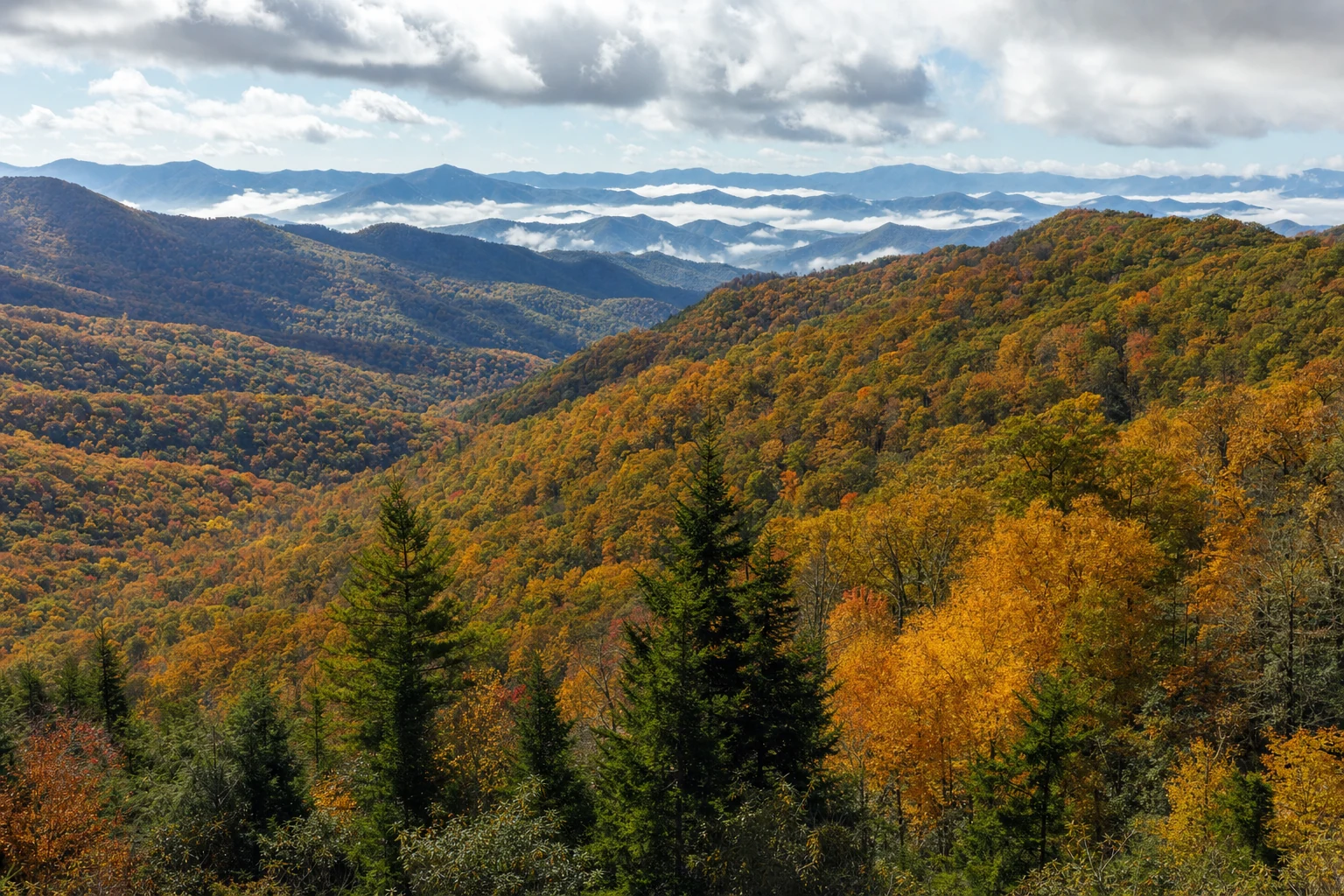

About Chilhowee Mountain Overlook (MP 39)
Now I'll write the page copy using the anti-slop rules and the facts provided.
---
Most scenic overlooks in the Smokies region reward early risers or sunset chasers. Chilhowee Mountain Overlook at Milepost 39 on the Foothills Parkway breaks that pattern: the water below reads clearest in the middle of the day, when the sun sits high enough to cut through any remaining morning haze and light up Chilhowee Lake without glare. For photographers who prefer sleeping in, this is one of the rare spots where a 1 p.m. visit is genuinely the right call.
The View
Chilhowee Lake dominates the foreground from this pullout, a reservoir cupped between ridges with the surrounding mountain terrain rising behind it. The combination of water and layered mountain silhouettes gives the composition a depth that's harder to find at overlooks facing only forested slopes. On clear days the water turns an almost impossible shade of blue against the green ridgelines; on partly cloudy days, moving shadows across the mountain faces keep the scene shifting even if you stand there a while.
This isn't the full panoramic sweep you get at Look Rock (MP 43, just four miles east), where a short hike to a fire tower opens up 360-degree sight lines to the Tennessee Valley and the Cumberland Plateau. Chilhowee Mountain Overlook is a narrower, more focused composition: lake, ridge, sky. If that sounds limiting, it's actually what makes it feel settled rather than overwhelming. The lake anchors everything. Many Foothills Parkway stops are all ridgeline and sky; this one has a foreground worth looking at.
Timing
Mid-day is the right call here, and that's not typical advice for mountain overlooks. The reason is the lake itself. Water reflects and scatters light differently than forested slopes; at sunrise or sunset, low-angle light tends to create surface glare that washes out detail. By 11 a.m. or noon on a clear day, the lake shows its actual color and you can make out ridge reflections in the water. Golden-hour light is attractive here in a general sense, but if you're specifically after the lake views, plan for midday.
Crowd levels at this pullout are moderate relative to the Foothills Parkway as a whole, with a parking area large enough to handle several vehicles but not so large that it feels like a major stop. Weekend mornings in July and August tend to be the most congested window; arriving on a weekday, or before 10 a.m. even on weekends, gives you room to linger without jockeying for a spot.
Getting There
The overlook sits on the western section of the Foothills Parkway in Tennessee. If you're coming from Wears Valley or Townsend, connect to US-321 heading toward Walland and pick up the parkway from that end. If you're based in Gatlinburg, the most direct route runs through the park past Cades Cove and out toward Townsend via Laurel Creek Road, then south to Walland — a longer drive, so it's worth treating the western Foothills Parkway as a dedicated outing rather than a quick detour.
GPS coverage along the Foothills Parkway is inconsistent in places. Download an offline map before you leave, or note your landmarks. Cell service at the overlook itself is unreliable.
A Park It Forward parking tag is required anywhere inside Great Smoky Mountains National Park for stays over 15 minutes. Tags cost $5 daily, $15 weekly, or $40 annually, available through recreation.gov or self-service kiosks at major park entrances. The Foothills Parkway is NPS-managed land, so this applies here.
What to Expect at the Pullout
This is a roadside pullout, not a developed stop. There are no restrooms, no water, no ranger presence. You park, walk a few steps, and you're at the viewpoint — no trail, no elevation change from the car, which makes it accessible for most visitors regardless of mobility. Pack out whatever you bring in.
If you want a longer stop with actual facilities and a trail option, Look Rock (MP 43) is a few minutes east and has more infrastructure along with the fire tower hike. Chilhowee Mountain Overlook is a stop-and-look spot, not a picnic destination. That's fine; not every overlook needs to be a production.
Pairing It With Nearby Stops
The western Foothills Parkway is worth treating as an afternoon's drive rather than a single-stop errand, and this overlook fits naturally into that sequence. Look Rock to the east is the anchor stop of the western section, with the most expansive views and the only developed trail; pair it with Chilhowee Mountain Overlook on the same run since the two views don't repeat each other. Look Rock faces the open Tennessee Valley; this overlook faces the lake. Together they cover the range of what this stretch of the parkway offers.
Heading back west toward Walland, you pass the Walland Overlook (MP 32) and the Wears Valley connector (MP 28). The Wears Valley stop offers broad, open views of the valley floor and distant ridge — a different character than the lake scenery here, more pastoral, oriented toward the main Smoky Mountain range in the background. None of these stops require more than 10 or 15 minutes each; the full western Foothills Parkway as an out-and-back runs comfortably in a half-day, with enough time to actually stand at each pullout rather than photograph through the windshield and drive on.
Know Before You Go
High-elevation roads in the Smokies close when ice or snow make them unsafe, typically somewhere between late November and early March depending on conditions. The Foothills Parkway western section is subject to these seasonal closures. Check road status on the GSMNP website before making the trip in winter or following any cold snap — showing up to a closed gate wastes the drive.
Summer afternoon thunderstorms build quickly at elevation, particularly in July and August. Clear mornings can turn into active storm cells by 2 or 3 p.m.; the overlook has no shelter, so if you see anvil-shaped clouds building, head back to the car and continue the drive. The same advice holds for the rest of the Foothills Parkway.
Finally: if you're visiting specifically for lake photography, bring a polarizing filter. It cuts glare off the water surface at mid-day and pulls out the color and reflection detail that makes this overlook worth stopping for in the first place.