
About Townsend Wye Pullouts (MP 18)
Now I'll write the page copy, applying all anti-slop constraints.
---
At Milepost 18 on Little River Road, just inside the Townsend entrance to Great Smoky Mountains National Park, the river widens into something almost lake-like. The current slows, the banks open up, and the whole scene pulls you off the road before you've consciously decided to stop. This is the Townsend Wye, named for the Y-shaped junction where Laurel Creek Road splits from Little River Road, and the pullouts scattered along this stretch rank among the most accessible river-viewing spots anywhere in the park.
What you're looking at
The Little River here bears little resemblance to the narrow, boulder-choked channel you'd find higher up toward Sugarlands. It spreads wide and unhurried over a smooth gravel bed, with forested banks rising on both sides. On a clear day you can see the bottom in most places. The water runs cold even in midsummer, fed by elevations upstream, and the soundscape shifts too; less whitewater roar, more low, steady pull across gravel.
The pullouts are informal. The park offers several small gravel shoulders cut into the road's edge along this stretch rather than one consolidated lot. Some fit two cars, some fit four or five; none carry signage beyond the road's mile markers. Photographers tend to work from the road's edge looking either upstream or downstream, catching the long river curve framed by the ridgeline above.
Light and timing
Mid-day light works better at the Wye than at most spots along Little River Road, which is unusual for landscape photography. Because the river runs roughly east-west at this section and the canopy opens up over the water, you get direct overhead sun hitting the surface, reading as shimmer and clarity rather than harsh glare. Mornings here can feel flat when clouds sit in the valley, and late afternoon puts the sun behind the ridge earlier than you might expect.
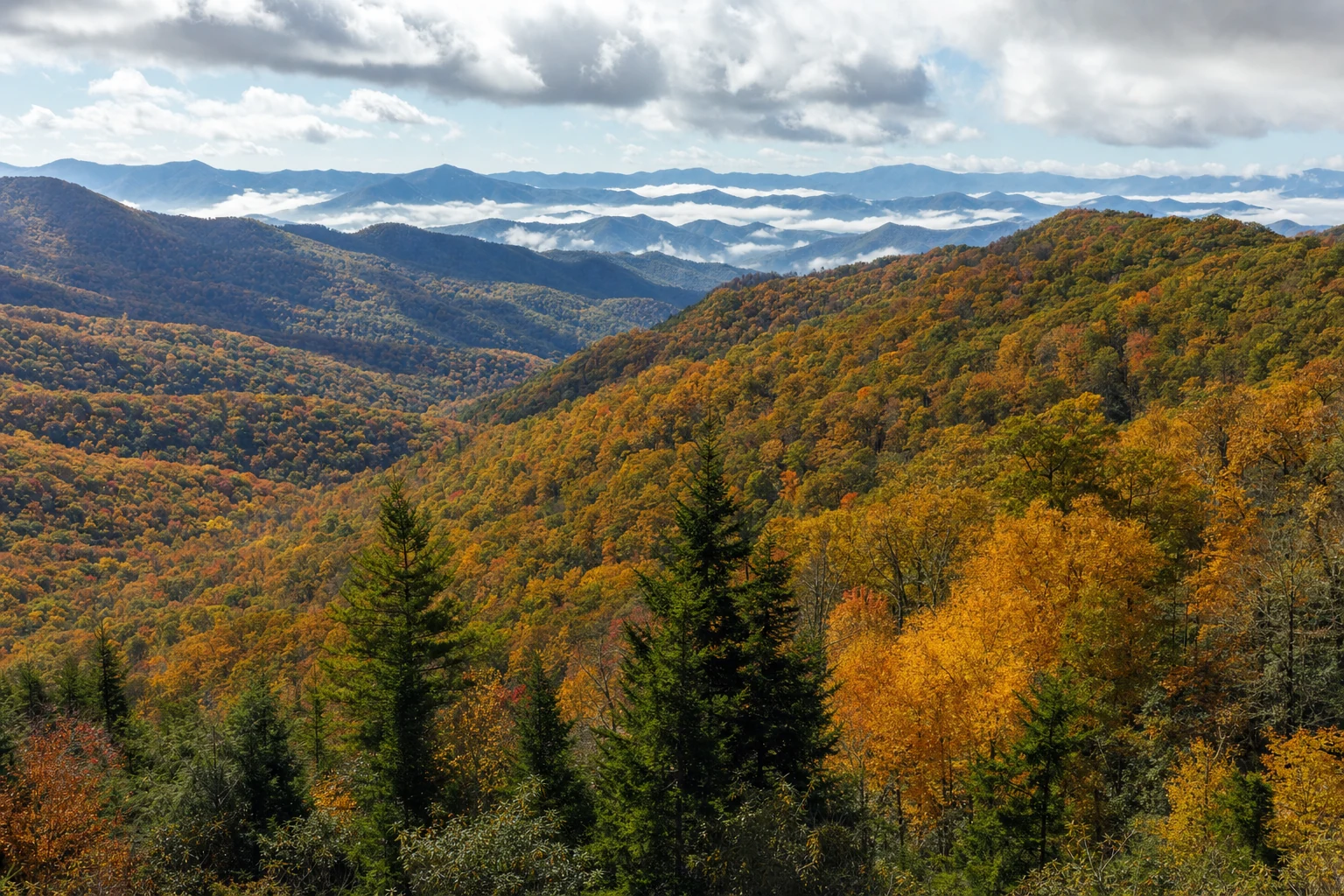
Summer is the most popular time to stop, and for good reason and at a cost. The Wye draws tubers and swimmers from Townsend through July and August; by mid-morning on weekends, the small pullouts fill fast. Arriving on a weekday, or within the first hour after the park entrance opens, makes the difference between a relaxed stop and a frustrating loop looking for a shoulder wide enough to park. Fall shifts the character entirely. The hardwoods on the far bank go yellow and amber, the tubers vanish, and the river drops low enough to expose sandbars invisible in spring.
Winter visits are quiet to the point of solitude, though Little River Road itself stays open unless ice forces a closure. Check park road status before driving up any time temperatures have been near freezing overnight.
The river itself
The gentle current at MP 18 is what draws swimmers and tubers. Families wade along the gravel bars; outfitters in Townsend run tube rentals specifically for this section. The water temperature stays cold enough to be a genuine shock even at peak summer, typically settling in the mid-60s Fahrenheit, which is exactly what people come for after a morning on the trail.
You can fish this section with a Tennessee state fishing license and a park-required trout permit, available at most license agents near the park or online. The calmer water here holds different fish than the faster riffles upstream. Most anglers position themselves on the gravel bars or near the deeper channel along the far bank.
One practical note: the rocks in this section carry algae year-round and are genuinely slick. The bottom looks stable from the road and isn't. Go slow if you're wading, especially with kids.
Getting there
The Wye pullouts sit on Little River Road roughly a half-mile inside the park from the Townsend entrance. Coming from Townsend, cross through the entrance area and the pullouts appear along the right side of the road as it curves with the river. No formal sign marks them as a destination; look for the river widening alongside the road and the gravel shoulders where others have pulled off before you.
From Gatlinburg, take US-321 south through Wears Valley to Townsend, then enter the park on TN-73. The drive runs about 45 minutes to an hour depending on traffic on the US-321 corridor. From Knoxville or Maryville, US-321 south gets you to the same approach. From Cherokee and the Oconaluftee entrance on the North Carolina side, the drive across the park is roughly 30 miles of two-lane road through Newfound Gap; scenic, but plan an hour and a half minimum.
Parking and fees
GSMNP requires a Park It Forward parking tag for stays over 15 minutes anywhere inside the park. Tags cost $5 daily, $15 weekly, or $40 for the annual version. Buy one before you arrive at recreation.gov or at self-serve kiosks near the entrance; rangers check compliance at pullouts including the informal shoulders at the Wye.
The pullouts along this stretch fill in sequence from the Townsend end during busy periods. If the first two or three are taken, continue a short distance up the road toward Meigs Creek; additional shoulders appear as the road curves, and doubling back on foot only takes a few minutes. Don't leave your car partially blocking the travel lane, even briefly. The road narrows, sight lines are limited, and park traffic moves faster than it looks.
Pairing the Wye with other stops on Little River Road
The Wye makes natural sense as the first stop on a longer drive east rather than a standalone destination. A few miles up the road, the Meigs Creek Trailhead pullout at MP 10.5 offers similar river access with noticeably fewer people. Continue to MP 12 and you reach The Sinks, where the Little River drops through a narrow rock chute into a swirling basin — the complete opposite of the Wye's calm, and worth the contrast. The full road runs about 18 miles to Sugarlands Visitor Center near Gatlinburg, mostly hugging the river the entire way, with informal pull-offs appearing throughout. Allocating two to three hours for the complete drive gives you room to stop at several of them without rushing.