
About Wildlife Viewing Pullouts (Throughout Cades Cove Loop)
Cades Cove is a one-way loop road through a broad Appalachian valley, and the wildlife viewing pullouts scattered along it aren't marked on any official map. You find them by slowing when a line of cars has already formed, or by watching the field edges at first light before anyone else has arrived. The informal nature of these stops is part of what makes them work.
What you're actually stopping for
The open meadows on the valley floor hold deer year-round; they concentrate visibly at dawn and dusk when they move from the tree line into the grass to feed. Wild turkeys cross the road through most of the morning. Black bears are the primary draw, and when one appears near the loop, word travels instantly among vehicles crawling in the same direction. You'll see the backup forming from a quarter mile back.
The pullouts have no signs identifying them as wildlife stops. Some are paved turnouts, others are just where gravel widens enough for a few cars. Read the situation: if vehicles are stopped and people have windows down with cameras out, something's in the field. Pull far enough off the pavement that traffic behind you can pass, then kill the engine. Animals in Cades Cove have adapted to a lot of vehicles; a parked, quiet car bothers them far less than a slow-rolling one.
How timing changes everything here
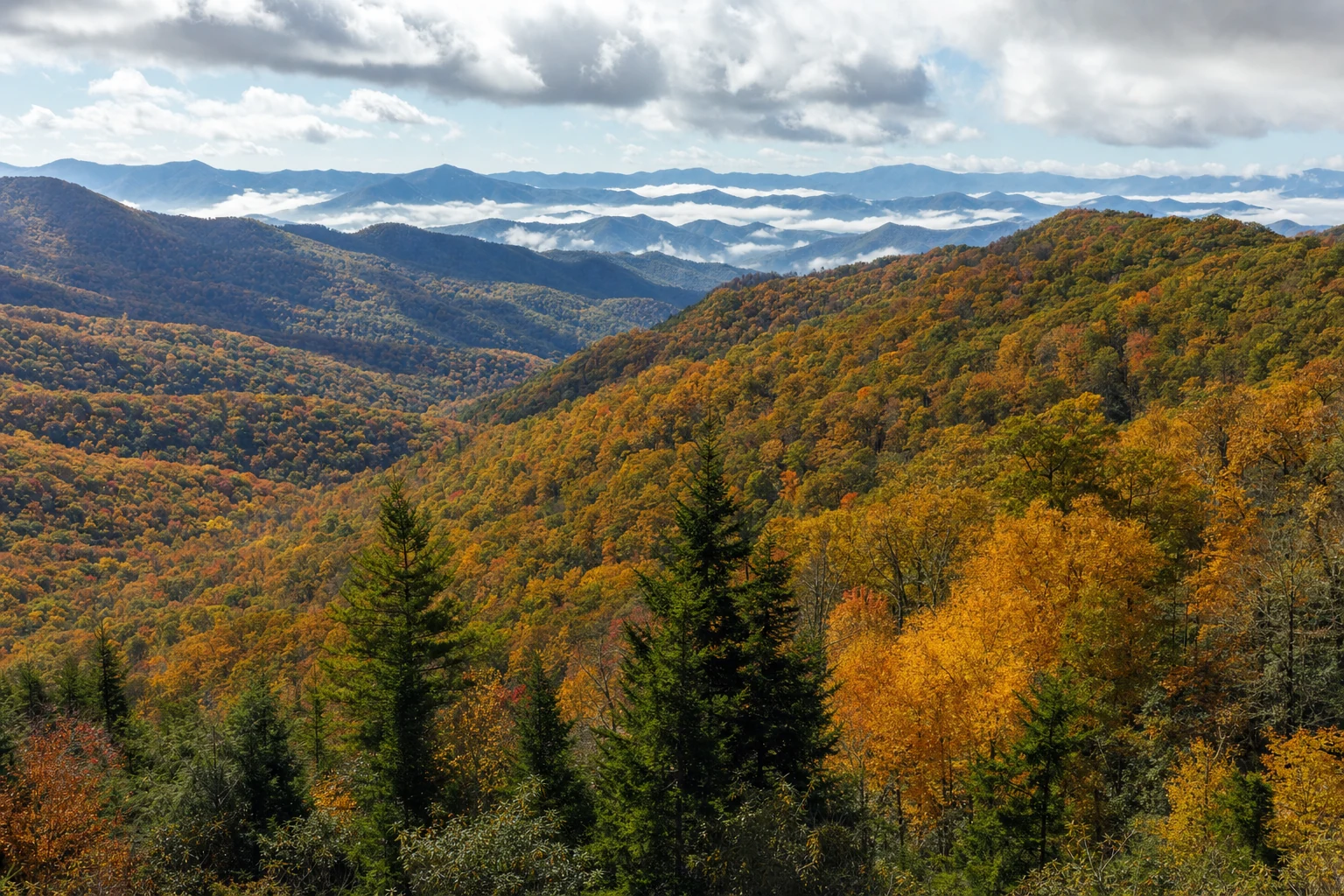
The loop opens at sunrise and closes at sunset. The hour after opening is categorically different from midday. Mist often settles in the low spots of the valley floor in spring and early fall, making light softer and wildlife more active before it burns off. Deer are nearly always visible in the eastern fields early; bears are harder to predict but tend to appear later in the circuit, in the fields past the Cable Mill area.
Midday in summer is the least productive window for wildlife. The animals move back into forest cover, the road fills up, and since the loop is one-way with no exit shortcut once you've entered, you're committed for the full circuit. A busy Saturday afternoon can stretch the drive to well over an hour. If you're primarily there for wildlife, early weekday mornings in spring, early summer, or fall give you dramatically better conditions.
The named pullouts, mile by mile
Several formal stops along the loop double as wildlife observation points. John Oliver Cabin (around MP 0.5) sits in an open clearing with forested ridgelines on all sides; the field in front of it gets deer traffic in the mornings. The Primitive Baptist Church (MP 2.5) occupies a similar clearing, and the church pullouts at MP 4.2 and MP 5.2 look out over fields that often hold turkeys in the grass.
Cable Mill at MP 5.5 is the loop's main hub: a large parking lot, a working grist mill, historic buildings, and enough foot traffic that wildlife near it tends to stay well back at the field edges. Tipton Place (MP 7.5) is a farmstead worth scanning carefully at dusk, when deer move in from the surrounding forest. Carter Shields Cabin near the far end at MP 9.5 sees fewer visitors than the earlier stops and is often the quietest stretch of the entire loop for that reason.
When bears show up
A bear sighting on the loop creates an immediate traffic event: vehicles stop, people step out of cars, and rangers ask everyone to keep at least 50 yards from bears and 25 yards from other wildlife. When a bear is working the field edge close to the road, that spacing standard is difficult to maintain and rangers manage the crowd actively.
Bears are most reliably visible in late summer and fall, when they're feeding heavily across the valley floor before winter. Bring a telephoto lens if bear photography is the goal; they're not going to come close, and a phone screen at distance produces nothing useful. Early morning gives you the best light and the calmest animals, before road traffic picks up and the bear retreats to the tree line.
Practical logistics
All vehicles parked inside Great Smoky Mountains National Park for more than 15 minutes need a Park It Forward tag: $5 daily, $15 weekly, $40 annually. Buy through recreation.gov or at kiosks near park entrances. The informal pullouts on the loop have no kiosks, so purchase before you arrive.
The loop road closes to motor vehicles on Wednesdays and Saturdays until 10 a.m. during the warmer months, reserved for cyclists and pedestrians in that window. Check the current schedule before planning a morning drive. Road conditions at Cades Cove are generally stable in winter given the valley's lower elevation, but check park road status before an early-morning visit during cold weather.
Who gets the most out of it
Patience is the determining variable. Visitors who arrive before 8 a.m., park quietly, let the animals dictate the pace, and don't need something to happen immediately tend to leave satisfied. Those who feel the place didn't deliver typically came midday in high summer expecting an immediate sighting.
For photographers, the loop in shoulder season at dawn is among the more reliable spots for wildlife in the southern Appalachians; the combination of open meadow, high wildlife density, and predictable animal movement along forest edges produces conditions that forested trail access rarely replicates. Families with older kids who can sit still and watch a bear from a real distance get a lot out of an early-morning circuit. For younger children who need something to do, the Cable Mill area gives them historic buildings to move through while adults scan the adjacent fields.