
About Apple House:
Now I'll write the page body copy applying all the anti-slop constraints.
The Apple House is a preserved storage building from the late 19th century, relocated to the Mountain Farm Museum at Oconaluftee on the North Carolina side of Great Smoky Mountains National Park. It's not enterable, and it doesn't pretend to be more than what it was: the place where a mountain family kept apples and root vegetables through the months when nothing would grow. That simplicity is part of its value.
The Mountain Farm Museum
The Mountain Farm Museum sits adjacent to the Oconaluftee Visitor Center (1194 Newfound Gap Rd, Cherokee, NC) and is the clearest way to understand what daily life actually looked like for Appalachian settlers in this region. It's an outdoor collection of authentic log buildings, none of them built on this spot originally; park staff gathered them from homestead sites throughout the park where they had begun to deteriorate, relocated each one here, and reassembled them to represent a working farm of the late 1800s. The result is not a reconstruction. These are actual structures from actual households.
You walk through the grounds at your own pace. No tickets required beyond standard park entry, no tour to join, no crowd-control ribbon to follow. The site includes a farmhouse, a barn, and several outbuildings including the Apple House, each labeled with interpretive signage that explains its function without overexplaining its significance. What grounds the whole visit is the setting itself: the Oconaluftee River runs nearby, the ridgelines on every side close the valley in, and it becomes physically obvious how isolated these coves were. That isolation is not background. It's context for everything you're looking at.
What the Apple House Tells You
A structure dedicated solely to apple and root vegetable storage sounds like a small detail until you think through the winter arithmetic it represents. Appalachian settlers in this era grew what they ate, preserved what they couldn't eat immediately, and planned their cold-weather food supply months in advance. Apples could be dried, pressed, or stored whole given the right conditions: cool, dark, stable. Turnips, potatoes, and whatever else the harvest had yielded required similar treatment. A single bad growing season, or a storage failure, meant a genuinely difficult winter.
The Apple House solved a specific problem. Its construction reflects that: low walls of notched logs, a roof pitched for shed-off rather than aesthetics, a doorway sized for function. None of the dimensions suggest comfort or display. You can read the whole logic of the building from outside, which is the only view available. Because you can't enter, the visit runs short, but exterior inspection is actually sufficient here. The structure's purpose is legible in its form.
History and Context
The buildings at the Mountain Farm Museum didn't originate here. They came from homestead sites across what is now the park, built by families who were living on this land when the federal government established Great Smoky Mountains National Park in 1934. The park's creation required those families to leave, and the structures they left behind either decayed in place or, in select cases, were preserved through relocation. The Apple House is one of those preserved pieces.
That history changes how the museum reads. You're not walking through a period reproduction; you're looking at objects from real households, saved after the community that owned them was displaced. Whether you find that context sobering or simply informative, it shifts the Apple House from a curiosity to a document. Stored food represented survival for the family who built this structure, and the building survived long after the family couldn't stay. Spending a few minutes with that thought costs nothing and changes what you see.
Planning Your Visit
The Mountain Farm Museum is free to access once you're inside the park. Begin at the Oconaluftee Visitor Center, which offers maps, restrooms, park staff for current condition questions, and a small gift shop. Parking is in the visitor center lot.
Practical notes before you arrive:
- The Apple House is viewable from the exterior only. Don't attempt to enter or climb on any structure in the museum.
- Paths through the museum are gravel; comfortable walking shoes handle it easily enough.
- The Oconaluftee River Trail, a flat paved path, starts near the visitor center and makes a natural add-on for anyone who wants a longer morning.
- A Park-It-Forward parking tag is required anywhere inside GSMNP for stays over 15 minutes: $5/day, $15/week, $40/year. Buy at park kiosks or through recreation.gov.
The Farm Museum loop takes under an hour at a steady pace, longer if you read the signage at each structure. Most visitors pair it with the elk meadow just north of the visitor center, where a small herd is frequently visible in early morning and late afternoon, and extend into a half-day outing. The Oconaluftee area offers enough within walking distance of the parking lot that you won't feel rushed.
Getting There
The visitor center sits on the North Carolina side of the park. From Gatlinburg, that means heading south on US-441 through the park, climbing to Newfound Gap and then descending toward Cherokee. The drive is scenic and runs roughly an hour depending on traffic; budget extra time for the near-certain elk stop along the Oconaluftee Valley. Coming from Cherokee, the visitor center is a short drive north on US-441 from the park entrance.
When to Go
Oconaluftee sits well below Newfound Gap in elevation, which keeps its access road open through winter even when higher park roads close for ice. A cold January morning, with frost on the log structures and mist on the river, gives the Farm Museum a quality that peak summer crowds don't allow. Winter is genuinely worth considering for this particular site.
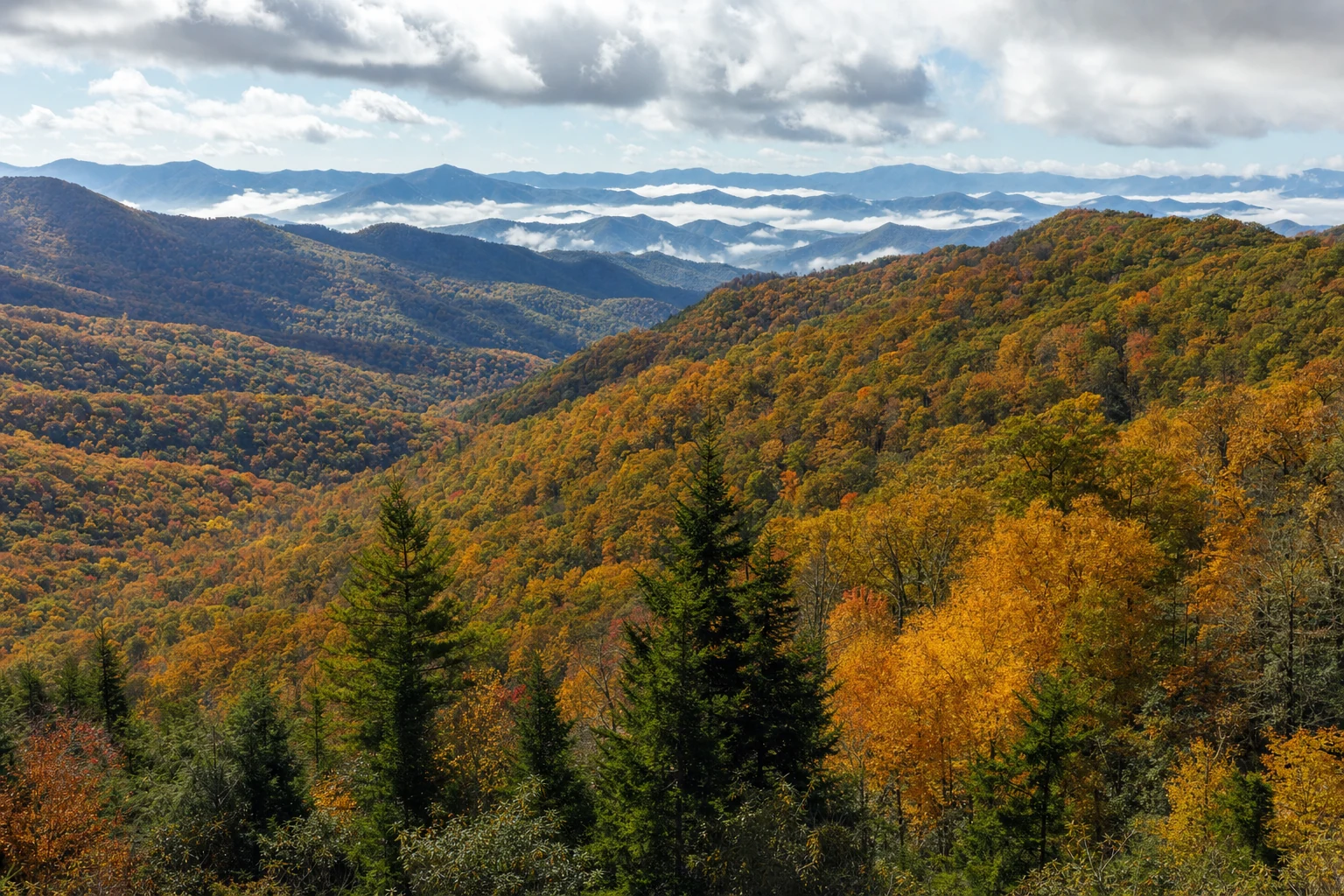
Fall draws the most visitors to the park overall. Mid-October typically marks peak foliage at the elevations around Oconaluftee, and parking pressure rises with it. Arrive before 9am on any fall weekend or plan to walk from wherever you can find a spot.
Spring suits this visit well. The surrounding meadows green up quickly, wildflowers show in the lower elevations by late March in a good year, and the farm buildings read clearly against new growth. Summer works but runs busy; if that's your window, early morning is the move.