
About Becky Cable House:
The Becky Cable House sits just a few steps from the Cable Mill in Cades Cove, and it's one of the few structures on the loop where you can actually step inside and look around. Built in 1879, it was home to Rebecca Cable for more than six decades; she died here in 1940. What makes the house worth stopping at isn't only the architecture — it's the specific life story attached to it: a woman who ran a small store out of her home and, by all accounts, outlasted most of her neighbors by decades.
Rebecca Cable and the House She Never Left
Rebecca Cable was a niece of John P. Cable, whose family built the grist mill that still operates a short walk away. She moved into the house as a young woman and stayed the rest of her life, long after most of Cades Cove's other residents had left or died. By the early 20th century the Cove's population was thinning, but Becky Cable held on, operating a small store out of the property and earning a reputation for hospitality with travelers who made it out to the Cove in those years.
Interpretive signs inside and around the house fill in that picture, with details about what daily life looked like for women in the Cove: the domestic labor, the seasonal rhythms, the particular social position of a woman running a household and a small commercial operation largely on her own. The history here is more specific than you get at most roadside historic sites, which tend toward generic pioneer-era summaries.
The house itself reflects a step up from the rougher cabins nearby. It's still log construction, still unmistakably 19th-century Appalachian, but the interior carries traces of a slightly more settled domestic life. The Cable family had been in the Cove long enough to accumulate some stability by the time this house went up, and the craftsmanship shows it.
What You'll Find Inside
The house is open during daylight hours. You can walk through at your own pace; no ticket, no ranger escort. The rooms are small, and it doesn't take long to move through the whole structure, but the interpretive signage makes it worth slowing down. The park has done better work here than at some of the Cove's other stops — the signs focus on Becky Cable's biography specifically, not just generic pioneer-life context.
Don't expect a furnished, museum-style interior. The rooms are sparse, which is historically accurate. A lot of what you take away from the space comes from the structure itself and from the park's written interpretation, not from period furniture arranged for effect. Plan to read; the signs carry the story.
Photographing the House
The Cable Mill area is the most-photographed cluster of structures in Cades Cove, and the Becky Cable House is part of it. Early morning gives you the best light on the log walls; on clear days in the warmer months, fog often rolls across the surrounding fields before burning off, and the house reads well against that kind of diffuse background. The access path gives you a clean angle on the roofline, with trees framing both sides.
If you want the house without other visitors in frame, arriving as early as possible is your best option. The Cable Mill pulls the larger crowds, which tends to leave the house itself slightly quieter, but that gap closes fast as the morning wears on.
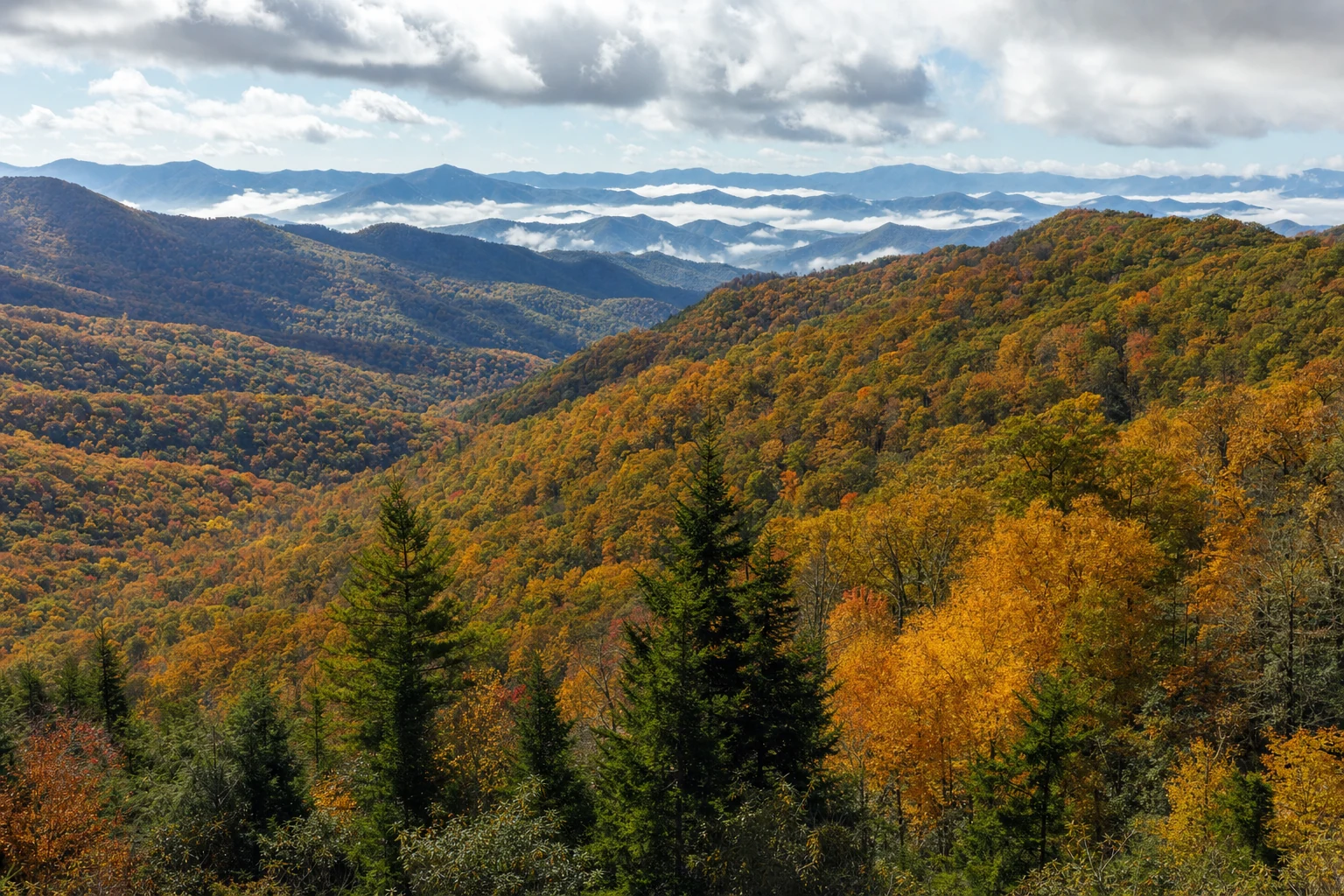
Autumn is a different scenario entirely. Mid-October tends to bring peak color to the surrounding hardwoods, and the contrast of weathered log walls against orange and yellow canopy is the kind of shot you'll find in most Cades Cove photography collections. It's also when the Cove gets crowded, so expect to work around other visitors if foliage is your reason for coming.
Getting There and Parking
Cades Cove is reached from Townsend via the park's western entrance. The Cove runs as a one-way loop; the Cable Mill area, where the Becky Cable House sits, comes up in the second half of the drive. Follow the loop road and the parking pulloffs will direct you naturally to the right spot.
A Park-It-Forward parking tag is required for any stay over 15 minutes inside Great Smoky Mountains National Park. Daily passes cost $5, weekly $15, and annual $40. Buy ahead via recreation.gov or at kiosks near the park entrance; it saves time once you're inside. Keep the tag visible on your dashboard.
When to Go
Summer brings the longest daylight and the heaviest traffic. If you're coming in July or August, aim to arrive when the loop opens in the morning; wildlife is more active at that hour and the parking areas haven't filled yet.
Fall is the most popular season in the Cove, full stop. Foliage typically peaks mid-October through early November, and afternoon traffic on the loop can back up significantly. A morning start remains the practical answer.
Spring is underrated here. The fields green up fast, wildflowers line the roadsides, and bears are active after winter. Winter visits are quiet, sometimes strikingly so, with bare trees opening long sightlines across the fields that summer obscures. Some high-elevation roads in the park close after ice or snow; check the park road status before you go regardless of season.
Pairing It With the Rest of the Cove
The Becky Cable House makes most sense as part of a longer Cable Mill stop rather than a standalone destination. The working grist mill draws the majority of the crowd and is usually the first thing people walk to; the house tends to be quieter by comparison, which makes it a better place to actually read the interpretive materials without people pressing in around you.
From there, the loop continues past the Cantilever Barn, the Elijah Oliver Place, and the three historic churches; each adds a different angle on how the Cove functioned as a community over roughly a century of settlement. If you want to extend the day into a hike, the Abrams Falls trailhead sits at the far end of the loop — a natural way to round out a morning already spent among the historic structures.