
About Tipton Place:
Mile 7.5 on the Cades Cove Loop pulls more vehicles past than it stops. The Tipton Place is among the more complete 19th-century farm complexes surviving in the park: two log cabins, a cantilevered barn, a blacksmith shop, a corn crib, and a smokehouse, all dating to around 1870, all open to walk through.
What the Complex Actually Looks Like
Two cabins occupy the main part of the property, and they read differently. One is a two-story log structure — the family's primary dwelling — with a stone fireplace built to heat the whole room and ceilings low enough that a tall person notices. The second cabin likely served a different generation or a separate purpose. You can step inside both during daylight hours; most preserved structures in Cades Cove are view-from-outside only, so this is worth factoring into how you plan your time.
The outbuildings explain the operational reality of farm life. A smokehouse meant food that kept through a long mountain winter. The corn crib, with its slatted walls, kept stored grain dry through natural airflow rather than modern ventilation. The blacksmith shop stands out physically, larger and more purposeful-looking than the storage buildings; this was where the farm's metal tools got made and repaired, because buying replacements required a long journey out of the cove.
The Cantilevered Barn
The barn anchors the property visually and architecturally. Cantilevered construction runs almost exclusively through the Southern Appalachians: the upper story extends past the lower walls on all four sides, held in place by horizontal log beams pushed through the structure rather than supported by posts or external columns. That extending upper loft sheds rain over the animal stalls below, keeping them dry without requiring a more elaborate roof.
You'll find this barn style referenced in historical surveys of the region, but intact examples you can actually circle and examine are genuinely uncommon. Most have collapsed or deteriorated past the point of being legible as structures. Tipton Place keeps one standing in full context, as part of a working farm layout. The construction logic becomes clear once you walk around it; the proportions look unusual until you understand the structural principle underneath.
The Tipton Family
The Tiptons ranked among the more substantial landowners in Cades Cove before the National Park Service acquired the valley in the 1930s. What survives here reflects that status. Multiple dedicated outbuildings, a separate smithing operation, enough grain storage for a real harvest — this wasn't a subsistence homestead. The Tiptons farmed at a scale that required infrastructure, and they built it.
Historical records from Cades Cove document that moonshining shaped the regional economy, not as an outlier activity but as a regular part of how families survived and accumulated resources. The Tipton property's range of structures and relative prosperity fit within a community that had more than one revenue stream. Drawing specific conclusions from the physical evidence is left to the visitor.
One other thing the site makes clear: the cove's residents built to solve specific problems using local materials. Every structure on the Tipton property came from timber available within a short distance. The architectural choices, including the cantilevered barn, derived from Scotch-Irish and German building traditions that settlers brought into the mountains and adapted across generations.
Getting There and Loop Logistics
Tipton Place sits at roughly mile 7.5 of the 11-mile one-way Cades Cove Loop. You reach the loop from Townsend via Laurel Creek Road; the entrance is about 8 miles from the Townsend Y at the park boundary. The loop runs one direction only, and there's no shortcut to the back half — you drive through the front before reaching Tipton Place.
A Park It Forward parking tag is required for any stop inside Great Smoky Mountains National Park lasting over 15 minutes: $5 per day, $15 per week, $40 annually. Buy one at recreation.gov before your visit or at the self-service kiosks at the loop entrance. Rangers do check.
Wednesdays and Saturdays from May through September, the loop road closes to motor vehicles until 10 a.m. Cyclists and walkers get the road to themselves during those morning hours, and the back half of the loop, where Tipton Place sits, gets much quieter than it does on a standard vehicle day. If you're not visiting on a closure morning but want less traffic around you, parking at Cable Mill around mile 5.5 and walking the next two miles to Tipton Place is possible — though you're sharing the road with cars, so stay alert.
The pullout at Tipton Place has a moderate-sized lot. It fills during peak hours but turns over steadily; most visitors spend 20-30 minutes at the complex before moving on.
When to Visit
Late afternoon light works well here. The Tipton property faces onto open fields to the west, and by mid-afternoon the sun hits the barn logs and cabin walls at an angle that shows the texture and construction detail better than flat midday light. Morning visits draw fewer people but sacrifice that directional quality.
Wildlife uses the open fields around Tipton Place throughout the year. Deer are common at most hours. Bears appear less predictably but with regularity. The back section of the loop draws fewer vehicles than the stretch between the entrance and Cable Mill, so when wildlife shows up near Tipton Place the resulting traffic backup tends to be smaller than what hits closer to the front.
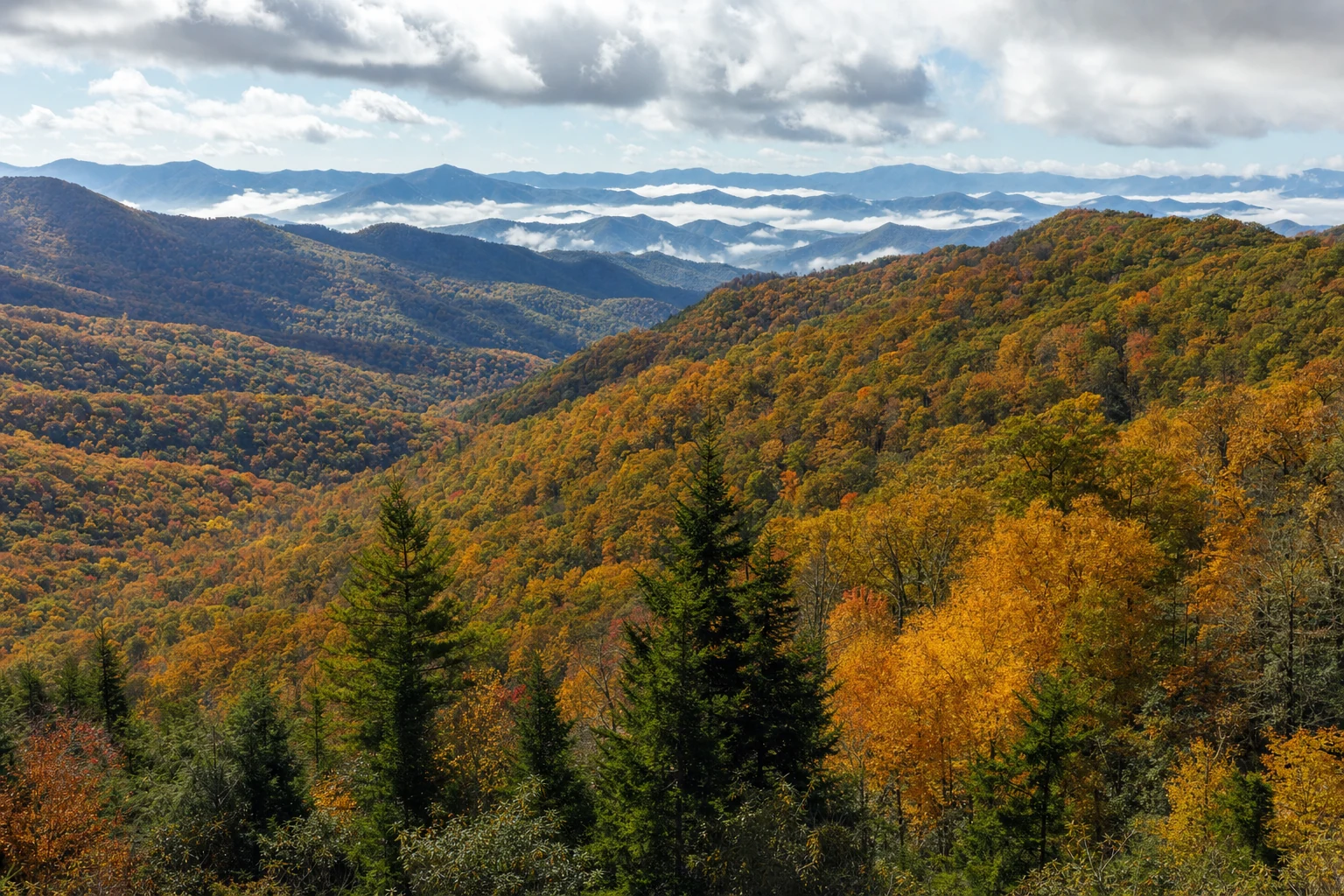
Fall is peak season for Cades Cove overall. Mid-October typically brings full color to the surrounding ridges, and the loop moves slowly on weekends through that period. Spring is quieter, with wildflowers across the cove's open fields. Winter visits work when roads stay clear; crowds on the back half of the loop become minimal, sometimes close to nonexistent. Summer weekday mornings before 9 a.m. are the most consistently manageable if crowds concern you.
Nearby Stops Worth Combining
Carter Shields Cabin is about two miles further along at mile 9.5. It's a single, smaller cabin in an open clearing — simpler and more austere than Tipton Place. Visiting both in sequence puts the Tipton operation's scale in relief; the contrast between the two properties makes the differences between Cades Cove households concrete rather than abstract.
Going the other direction: Cable Mill at mile 5.5 is the cove's main interpretive hub, with a working grist mill, a visitor center, and the densest crowd concentration on the loop. If you start at Cable Mill and continue to Tipton Place, the foot traffic diminishes noticeably by the time you arrive. The two sites cover different aspects of cove life — community-level commerce and milling at Cable Mill, and a prosperous private farm operation at Tipton Place — and they complement each other well in a single half-day visit.