
About Elijah Oliver Place:
Now I'll write the page copy following the anti-slop guidelines and grounding everything in the provided research.
---
Cades Cove preserves more historic farm structures than any other section of Great Smoky Mountains National Park, and the Elijah Oliver Place is the most complete homestead among them. Built around 1866, the property consists of four standing buildings: a main cabin, springhouse, smokehouse, and a cantilevered barn, all open to visitors during daylight hours. Elijah Oliver was the son of John Oliver, one of the valley's first European-American settlers, which puts this complex squarely in the second generation of a family that planted itself here well before the Civil War and stayed.
The Oliver Family and What They Built
The Oliver name runs through early Cades Cove history from its first chapter. John Oliver came to the valley as one of its earliest European-American settlers; by the time Elijah built this homestead in 1866, the family had been working this land for a generation. That timing puts construction in the post-Civil War years, when mountain families across East Tennessee were rebuilding and, for those who had come through intact, often expanding what they had. Elijah's property reflects that more established phase: multiple specialized outbuildings rather than a single structure doing everything.
The four buildings weren't incidental to each other; they formed an interdependent system. Each one handled a task that the cabin itself couldn't, and together they gave a family a reasonable chance of staying fed and warm through a Smokies winter without outside help.
Why the Outbuildings Matter
Most visitors to Cades Cove walk past log cabins without spending much time on the surrounding structures. At the Oliver Place, the outbuildings do as much interpretive work as the cabin itself.
The springhouse ran cold water through the floor to keep perishables at low temperature year-round. The technology is stone, water, and a careful read of the slope. It still sits over its original water source, and the stonework required real skill: build it too high above the flow and you lose the cooling effect; build it too close and it floods. The smokehouse interior still carries the dark staining of curing fires, sharp-smelling in a way that surprises visitors who lean in close. These aren't decorative structures kept for atmosphere. They were the difference between a family that ate through February and one that didn't.
The Cantilevered Barn
The barn deserves its own attention. Cantilevered construction, where the upper loft projects out beyond the lower walls without vertical support columns underneath the overhang, was a technique concentrated in specific parts of the Southern Appalachians. You won't find this design in Midwestern barns or New England farmsteads. Surviving examples inside the park are uncommon enough that the Oliver barn gets noted specifically in historical surveys of Cades Cove structures.
The practical logic was storage: a wider upper floor meant more room for hay and grain without requiring more foundation area or heavier stonework below. Stand under the overhang and the geometry is immediately legible. The timber joinery is visible and the construction quality, after more than 150 years, holds. It's the kind of building where the engineering decision is also the visual decision, and both are right.
Inside the Cabin
The main cabin is a single-pen log structure with a stone chimney that handled both heat and cooking. The interior dimensions stop most visitors short. The room is genuinely small, not just modest, and the low ceiling reinforces it. A family lived here through Appalachian winters, stored provisions, and conducted most of their domestic work in this space.
There are no interpretive panels inside and no labeled artifacts. Park staff or volunteers are occasionally present during peak season to answer questions, but generally you're left to read the building: the dovetail notching at the log corners, the chinking between courses, the door frame that has settled slightly over a century and a half. If you come expecting a curated museum with audio guides and display cases, the experience will feel spare. If you're willing to look carefully at what's actually there, it holds up.
Getting to Cades Cove
The cove is reached from the western side of the park via Laurel Creek Road, which connects directly to Townsend. This is not the Gatlinburg or Cherokee entrance. If you're coming from either of those sides, you'll cross through the park first, which adds time.
The Cades Cove Loop Road runs one-way and counterclockwise. The Elijah Oliver Place sits roughly in the first half of the loop; watch for the pull-off and the wooden marker. The walk from the parking area to the complex is short.
A Park-It-Forward parking tag is required for any visit over 15 minutes inside Great Smoky Mountains National Park. A daily pass costs $5, a weekly pass $15, an annual pass $40. Buy at recreation.gov before you arrive or at kiosks near park entrances. An America the Beautiful annual pass also covers the requirement.
One detail worth knowing: the loop road closes to vehicle traffic on Wednesday and Saturday mornings until 10 a.m. to give cyclists and pedestrians exclusive access. Those morning windows mean no car traffic competing for the pull-offs. If you plan around them, you get a substantially different experience.
When to Go
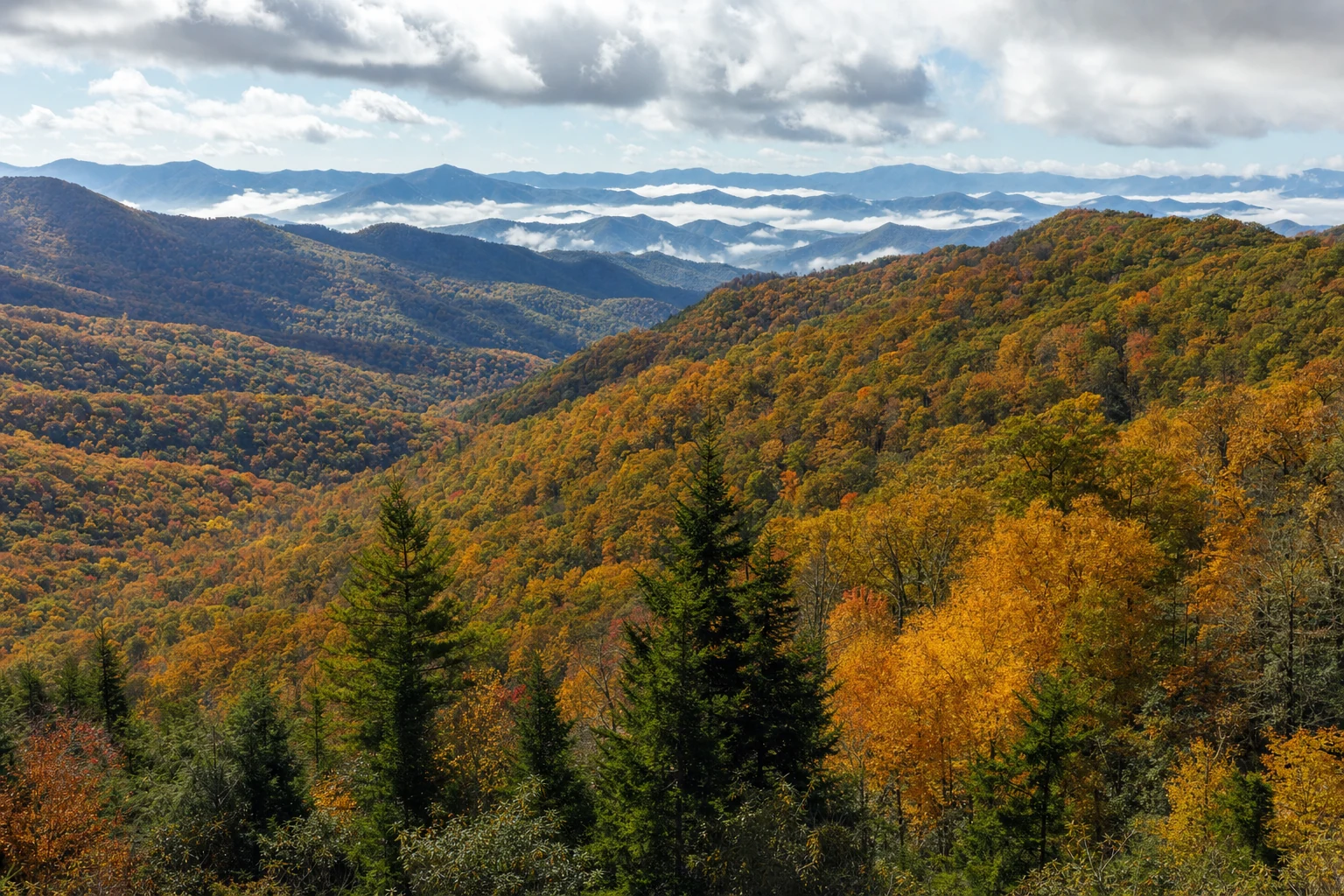
Fall draws the most visitors, and the surrounding ridgelines at mid-October peak color are genuinely worth it. The open valley floor of Cades Cove frames the ridges on all sides, so the foliage display is more panoramic than what you'd get in forested terrain. The tradeoff is real: fall weekends back up, pull-offs fill quickly, and the loop moves slowly when it's busy. Weekdays and early starts both help. Mid-October is the most consistent target for color, but the exact timing varies by year.
Spring runs quieter and the wildflowers along the forest margins near the historic structures can be dense. The early-season light and wet air bring out the texture of the weathered logs in a way that flat summer heat doesn't.
Summer is hot and the park draws consistent afternoon thunderstorms, though Cades Cove sits at a lower elevation than the high-country routes and handles the heat differently. Morning visits beat afternoons. Wildlife is active at dawn and dusk; white-tailed deer graze the open cove floor regularly, and black bear sightings are common enough that traffic delays from bear jams are simply part of a Cades Cove trip.
Winter delivers the cove at its quietest. The loop stays open in mild conditions, and a frost-covered morning with bare trees and no tour buses at the pull-offs puts you closer to what the Oliver Place looked like when it was actually in use. High-elevation roads elsewhere in the park may close in ice and snow, but check the park's road status page before heading out, particularly after a cold front.
Know Before You Go
Cell service inside the cove is inconsistent. Download the NPS app or a park map offline before entering. Budget more time than you think: stopping at the Oliver Place and a few other structures along the loop, plus the near-certainty of wildlife delays, and the full loop commonly runs several hours. That's not a complaint about the place. It's the pace the loop demands, and the Oliver complex rewards the time you spend at it.