
About John Oliver Cabin:
The John Oliver Cabin is the first real stop on the Cades Cove Loop Road, near the loop's entrance, and it earns that position. Built around 1822 by John and Lucretia Oliver, the first permanent European settlers in Cades Cove, this single-pen log structure is one of the oldest standing buildings in Great Smoky Mountains National Park. You can walk inside.
The Structure
Single-pen log construction is what you get: one room, hewn logs, a simple footprint that tells you how little space and material the early settlers had to work with. The joinery technique is called "notch-and-saddle" construction (sometimes called "hog pen" style), where the log ends are shaped to interlock at the corners without metal fasteners. This wasn't rough work done by people who didn't know better; it was the standard craft of Appalachian settlement, and it held up. The cabin has been preserved rather than restored, so what you're looking at is close to what John Oliver built, not a reconstruction.
You can step inside during daylight hours. No admission charge beyond your Park-It-Forward tag, no ranger stationed here, no velvet rope. Walk in, look around, let your eyes adjust to the dim interior.
John and Lucretia Oliver
The Olivers came from Carter County, Tennessee, and settled Cades Cove before it was part of any park or protected land. Cades Cove in the early 19th century was remote mountain valley, and John Oliver arrived in 1818 with essentially nothing to build on. He raised this cabin for his family in terrain that had no roads, no mill, and no neighbors for years.
Lucretia Oliver (née Frazier) is often mentioned alongside her husband in park literature, and rightly so. She survived the first winter in the Cove with no female neighbors, in a cabin that may not have been fully finished. The couple eventually had 11 children, several of whom became prominent in the Cove's later history.
What makes the cabin more interesting than its plain exterior suggests is who built it and why they stayed. The Olivers were effectively the seed of a whole settlement. By the time the National Park Service acquired Cades Cove in the 1930s, the valley held farms, three churches, a working mill, and generations of interconnected families. This cabin is where all of that started.
What the Visit Actually Looks Like
A short, level path leads from the small roadside pullout to the cabin door, maybe a two-minute walk. The cabin sits in an open field framed by forested ridges, and on a clear morning the light comes in low across the grass at a useful angle. There's enough open space around the structure to photograph it without other visitors crowding your frame, provided you arrive before mid-morning.
Inside, the room is spare: dirt floor, log walls, not much else. But the scale of it is what tends to get people. This was a family home, not a storage shed. Spending five minutes inside does more for your understanding of early settlement conditions than any interpretive sign.
The pullout parking is small, with room for only a handful of cars. The Cades Cove Loop is one-way, so if you miss the cabin pullout, you're driving the remaining 10-plus miles to loop back around. It comes up quickly after you enter the road, so watch for the signage.
Photography
Morning is the practical answer. The cabin faces roughly east, so early light hits the facade directly; by mid-morning the angle gets harsher. Fog is common in Cades Cove, particularly in autumn and early spring, and when it sits over the open field in front of the cabin the conditions are something else entirely. That's not schedulable; you show up early and either get it or you don't.
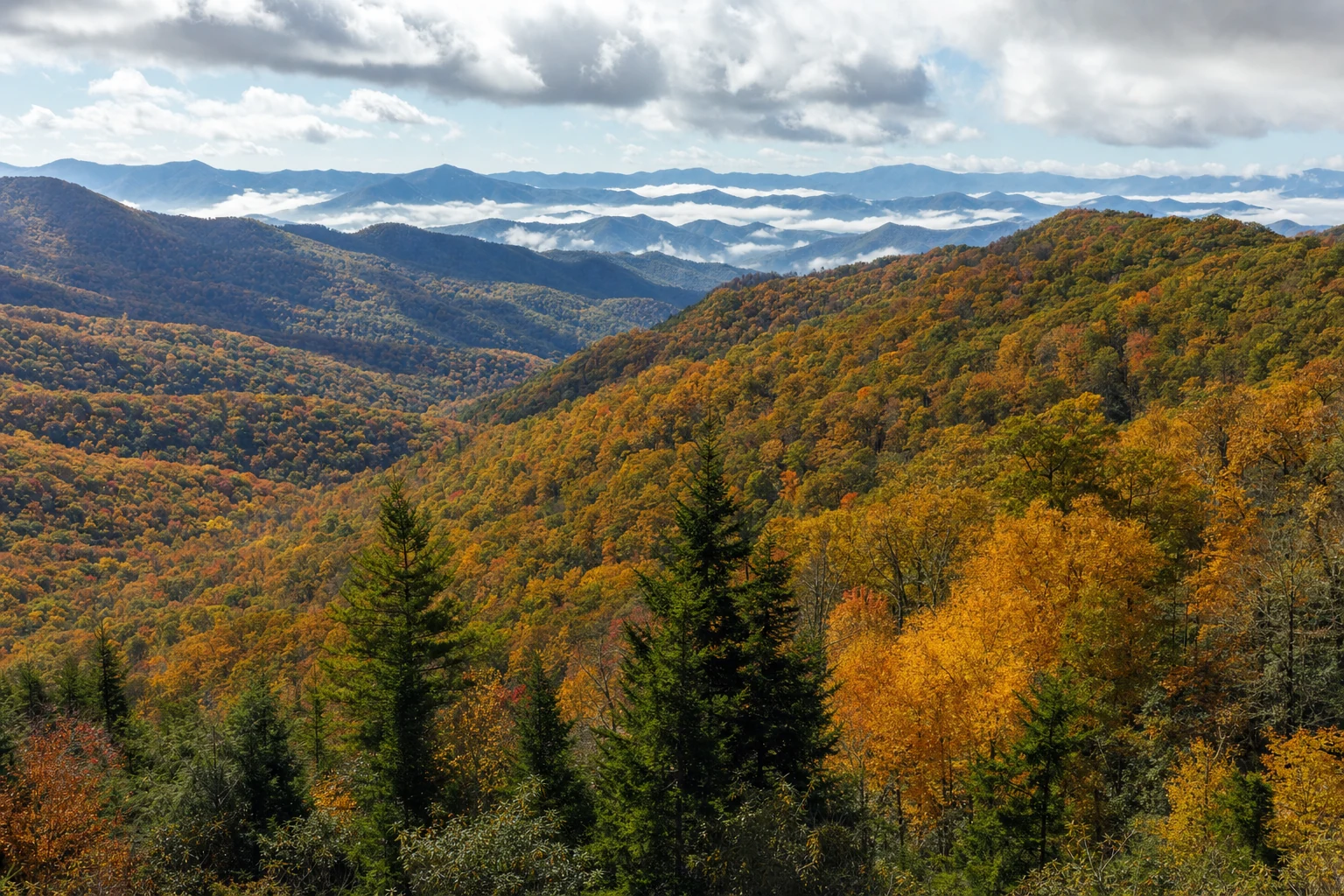
The forested ridgeline behind the cabin photographs cleanly, especially in autumn when the hardwoods turn. For composition, the low fence near the path gives you a foreground element to work with, and the open field provides enough distance to shoot the full structure without resorting to a wide-angle lens.
Wildlife moves through this section of the loop as well. Deer and turkeys are common in the adjacent fields at dawn and dusk; black bears appear in Cades Cove with enough regularity that you should stay aware, though the cabin area itself isn't a known concentration point the way some other parts of the valley are.
Timing and Crowds
The Cades Cove Loop Road runs 11 miles, one-way, and can take anywhere from 45 minutes to a full afternoon depending on wildlife sightings and how long you stop. On Wednesdays and Saturdays until 10 a.m. during the summer months, the road is closed to vehicles and reserved for foot and bicycle traffic only; check the park schedule before you drive out.
The cabin draws moderate crowds by Cades Cove standards. Because it's the first notable stop, visitors in a hurry often give it a quick look and push on, which means you can sometimes get a few minutes of relative quiet even on a busy day. Dawn is the reliable answer if you want the place largely to yourself.
Peak congestion on the loop runs from mid-June through late October, with fall weekends near foliage peak being the worst. Winter is genuinely quieter: fewer visitors, bare trees that open up the mountain views, and occasional frost on the log walls that makes the cabin look exactly as old as it is.
Getting There
Cades Cove is reached via Laurel Creek Road from Townsend, which brings you to the loop entrance in roughly 25 minutes from town. The route is well-signed from US-321. The John Oliver Cabin pullout is approximately at milepost 0.5 on the loop, the first significant stop after you enter the one-way road.
A Park-It-Forward parking tag is required for any stop inside Great Smoky Mountains National Park lasting more than 15 minutes. Daily tags are $5, weekly $15, and annual passes $40; you can buy them at recreation.gov or at self-service kiosks near the park entrances. If you're planning a full day in Cades Cove, the daily tag is the obvious choice. High-elevation routes can close in winter due to ice, but Laurel Creek Road and the Cades Cove Loop itself remain open year-round under most conditions; check road status at the park website before heading out in cold weather.