
About Enloe Barn:
Dating to around 1880, the Enloe Barn stands in the Mountain Farm Museum at Oconaluftee, a cluster of original Appalachian farm structures relocated from various locations across Great Smoky Mountains National Park to one accessible site on the park's southern end. The barn can't be entered, but the exterior is where the architecture actually speaks, and this particular structure rewards a closer look than most visitors give it.
History
The Enloe Barn originated on the Enloe family farm in the Oconaluftee valley, a wide strip of fertile bottomland that mountain families had worked for generations before the park's creation in the 1930s required them to give up private ownership of the land. Families were bought out and relocated; their structures, if the Park Service judged them significant, were sometimes preserved. The barn was among those selected for relocation to what became the Mountain Farm Museum. Not all original farm buildings from the valley survived that process; the ones that made it here were chosen for structural integrity and their ability to illustrate how mountain farms actually functioned.
What Makes a Cantilevered Barn
The cantilevered design is the architectural detail that sets this barn apart. In a true Appalachian cantilever barn, the upper crib extends outboard beyond the lower foundation logs on the long sides, sometimes by several feet, without any supporting columns underneath. That overhang created covered working space along the barn's flanks: shelter for animals in light rain, room to work on equipment without going inside, a dry zone for tools or fodder. Getting the weight distribution right required real skill; the geometry has to be calculated precisely or the structure fails. Builders in 1880 worked this out from experience and accumulated practice, not engineering drawings.
This barn type was once scattered widely across the southern Appalachians. Intact examples from the 1880s are uncommon, and seeing one that has held its structural coherence for well over a century is worth pausing at.
Mountain Farm Museum
The museum isn't a single building but a collected group of authentic period structures, each moved here from its original site within the park's boundaries. Besides the Enloe Barn, the site includes a farmhouse, springhouse, corn crib, smokehouse, and other outbuildings — all original construction, not period reproductions. Park interpreters sometimes work the grounds during peak season, demonstrating agricultural and domestic practices from the era.
The assembled layout makes the barn easier to read than it would be standing alone. Seeing its relationship to the smokehouse, the corn crib, and the main house gives you a clearer sense of how a 19th-century mountain farm divided its work across space. The arrangement wasn't incidental.
What to Expect on a Visit
Plan at least an hour to walk the full site and read the interpretive panels; budget more if interpreters are active. The grounds are unpaved and open-air, so shoes you don't mind muddying serve better than anything clean-soled. The Oconaluftee Visitor Center sits immediately adjacent; stop in before walking out to the farm for a park map and current conditions.
You can walk the barn's exterior at close range on all sides. Details worth looking for: the exact overhang point where the upper section extends past the lower, the log joinery at the corners, and the condition of the timbers. The weathered, irregular surface is what hand-cut original construction looks like after 140 years; that's not deferred maintenance, it's the material record of how the thing was built.
Crowds at the barn specifically tend to be light. The Mountain Farm Museum draws steady visitors but people spread across the property rather than concentrating at any single structure.
When to Visit
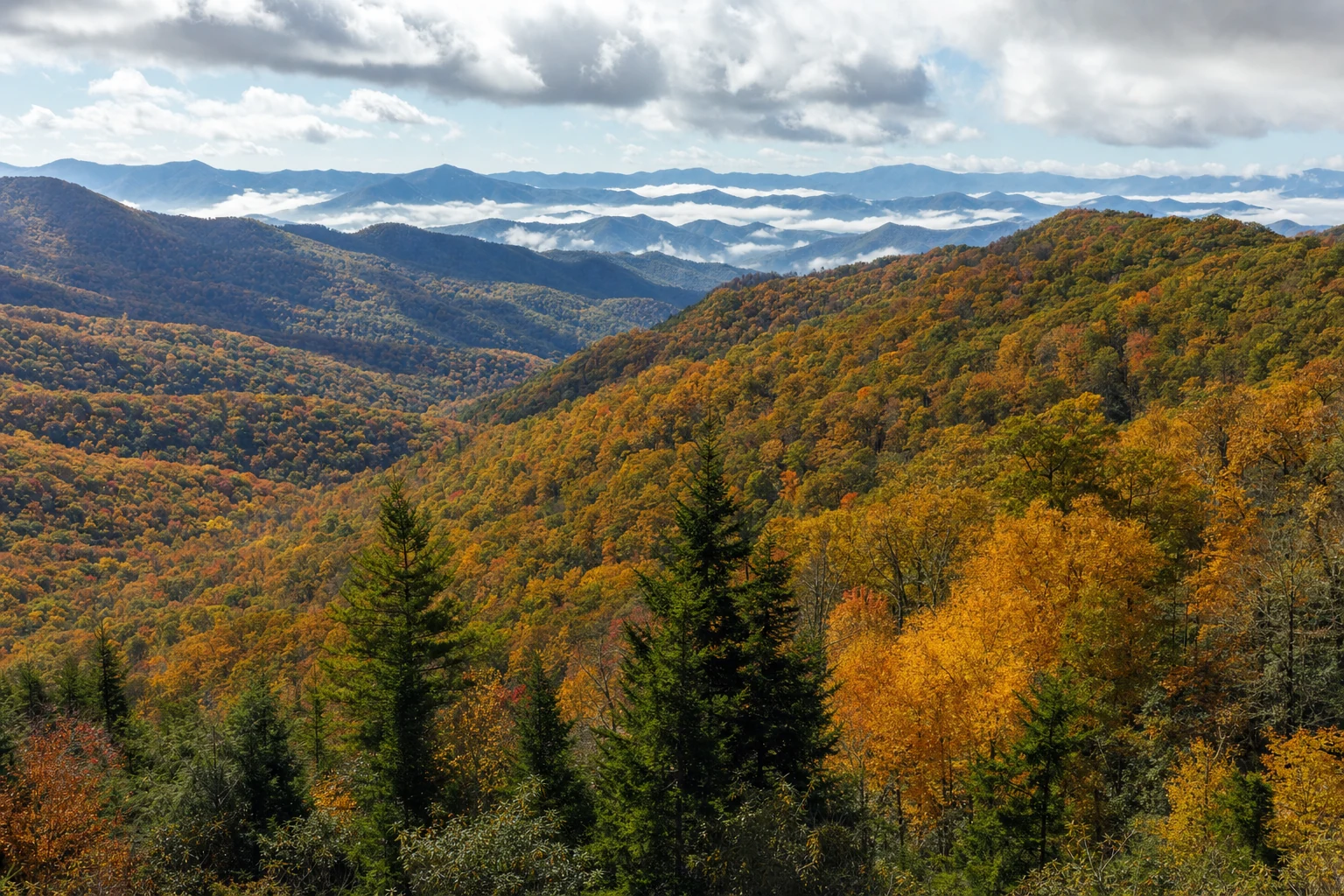
Fall is when this part of the park is most worth the trip, with the Oconaluftee valley's hardwoods turning through October. The farm structures read especially well against that backdrop. Spring is the other strong season: lower visitor volume than fall, and the valley floor greens up quickly once the last frost passes.
Summer gets busy; arriving before 10 a.m. keeps the parking lot manageable. The lot at Oconaluftee is larger than most in the park but still fills on summer weekends. Winter drops visitor counts considerably and strips the trees enough to open sightlines that summer closes entirely. Road closures at this elevation, near the park's lower southern entrance, are far less common than at high-elevation sites.
Getting There
The Mountain Farm Museum is accessed from the park's southern entrance on U.S. 441, north of Cherokee, NC. A Park It Forward parking tag is required for any stay over 15 minutes inside Great Smoky Mountains National Park: $5 per day, $15 per week, or $40 annually, purchasable at recreation.gov or at kiosks in the park. From the Tennessee side, Newfound Gap Road crosses through the park and connects to the Oconaluftee entrance on the far end; budget extra time in summer when traffic backs up on that crossing.
Nearby
The Mingus Mill, a turbine-powered gristmill also within the park near the Cherokee entrance, sits close to the Mountain Farm Museum and is typically open for demonstration from spring through fall. The Oconaluftee River Trail begins at the visitor center parking lot and follows the river north; it's flat, accessible, and runs through the primary range of the park's reintroduced elk herd, so early morning and late afternoon visits often produce sightings. Cherokee, NC, is just outside the park's southern boundary with restaurants, the Museum of the Cherokee People, and a full range of lodging.