
About Ephraim Bales Place:
Roughly two miles into the Roaring Fork Motor Nature Trail, the Ephraim Bales Place is one of the few historic homesteads in Great Smoky Mountains National Park where you can walk inside the buildings. The cabin, barn, corn crib, and smokehouse have stood since around 1890, when Ephraim Bales established this farm, and together they give you something more concrete than most park interpretive signs manage: a real sense of scale for what subsistence farming in this terrain actually required.
What the Site Is
The Bales complex is four structures, not one. The log cabin itself is the anchor — sturdy construction, open for exploration during daylight hours — but the outbuildings are what put the agriculture in context. A corn crib and smokehouse sit nearby, both essential to preserving food through winter; the barn served the livestock and draft animals that worked these fields. These aren't replica structures or park reconstructions. They date to around 1890, and the National Park Service has maintained them for open access rather than rope-off observation.
The surrounding fields are mowed deliberately. Reforestation is what the Smokies do naturally; leave ground alone here and saplings colonize it within a few years. So the park actively maintains the open pastoral character to preserve what the land looked like when the Bales family farmed it. Without that intervention, you'd be standing in a thicket instead of open ground, and the context of the buildings would be lost entirely.
The Man Behind the Homestead
Ephraim Bales was a farmer and blacksmith who settled this part of Roaring Fork in the late 19th century. Both trades made sense for the location. The farm produced food; the blacksmith work would have served both his own operation and neighbors across the ridge. The rugged terrain here, with its steep slopes and stream crossings, kept homesteads relatively isolated, which made a working blacksmith a genuine asset to the surrounding community.
The compound reflects the logic of mountain subsistence farming. The cabin's construction is solid and deliberate — these weren't structures thrown up quickly. The barn indicates livestock keeping; the smokehouse tells you how the family got through the months when nothing fresh grew. Together the site reads less like a museum exhibit and more like a functional compound that someone worked out carefully over years of hard winters.
The Bales homestead also offers a useful contrast to the Noah "Bud" Ogle Place, the other major homestead on the Roaring Fork loop. Both date to the same historical period, but the design choices differ enough to make visiting both worthwhile if you want to understand how individual families adapted to the same fundamental challenge.
Roaring Fork Motor Nature Trail
The Bales Place sits along a 5.5-mile one-way paved loop that's one of the more unusual drives in the park. The road is seasonal, generally accessible from early spring through late fall, and closes in winter when ice makes the narrow winding route unsafe. Pull-offs are frequent and not heavily contested outside peak-season weekends; the one-way layout keeps traffic moving without the usual back-and-forth congestion. Expect to spend at least an hour on the full loop if you're stopping at multiple sites, and closer to two if you're photographing.
The road follows Roaring Fork stream for much of its length through old-growth forest. This is a drive you do deliberately, not something you rush through to reach a trailhead.
Photography at the Bales Place
The homestead works differently as a photographic subject than the stream cascades along the same road. Open fields around the cabin give you room to compose from a distance, which the hemmed-in waterfall spots don't allow. Overcast light suits the cabin best; direct midday sun creates hard shadows across the log walls and interior. The golden-hour window in late afternoon pays off well in fall, when the surrounding tree line turns.
The corn crib and smokehouse work as standalone subjects; both are compact enough to fill a frame without wide-angle distortion. If you want the contrast between managed open fields and the forest edge behind the structures, early-morning mist gives you that transition cleanly.
For waterfall work elsewhere on the same Roaring Fork loop, carry a neutral density filter. The stream cascades reward longer exposures — roughly half a second to two seconds — and even an overcast day can be bright enough to blow out a slow shutter without one. A tripod is not optional for this kind of work.
Best Time to Visit
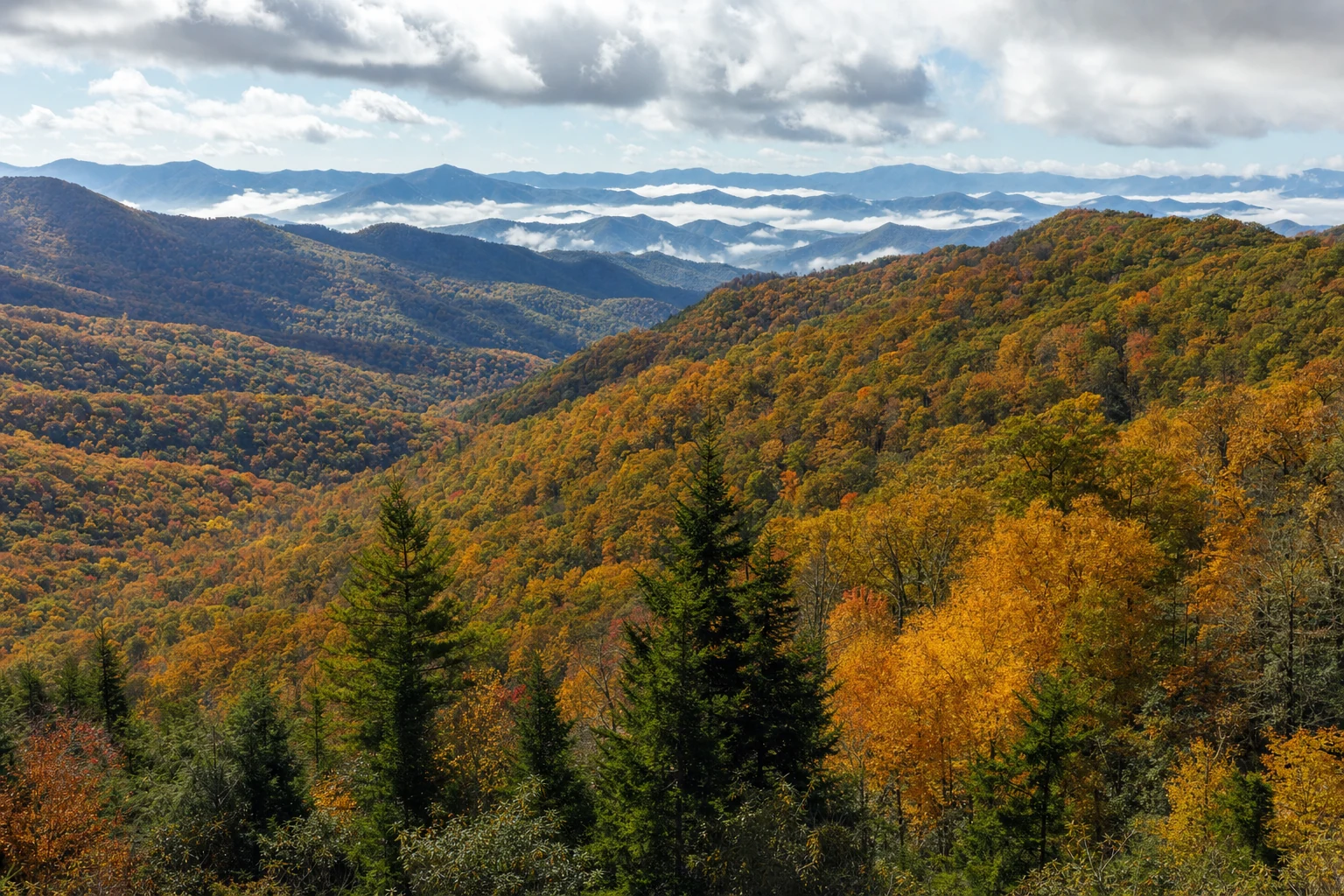
Fall is the clearest argument for timing your visit here. Mid-October typically peaks for foliage at the mid-elevations where Roaring Fork runs, and the tree line surrounding the Bales homestead turns hard: yellows, oranges, and the deep reds of sourwood. The road is still open in October, which isn't guaranteed by November.
Spring brings a different reward. The waterfalls along Roaring Fork run hardest after winter snowmelt and spring rain, so if you're treating the Bales homestead as one stop on the full trail loop, spring pairs high water with the wildflower bloom across the forest floor. Summer draws the most visitors; arriving early in the morning reduces congestion on the one-way road significantly.
Winter closes the Motor Nature Trail. This isn't a soft suggestion; ice makes portions of the road genuinely dangerous, and the park enforces the closure. Check road status the morning you plan to go — conditions get updated at Sugarlands Visitor Center and through the park's road conditions page.
Getting There and Parking
The Roaring Fork Motor Nature Trail entrance is reached from Airport Road in Gatlinburg. From downtown, follow signs toward the park and pick up Airport Road heading uphill; the trailhead entrance is near the Noah Ogle Nature Trail parking area. Once on the Motor Nature Trail, it's a one-way loop and you can't turn back, so plan on completing the full 5.5 miles from the start.
A Park It Forward parking tag is required for stays over 15 minutes anywhere in Great Smoky Mountains National Park. The daily rate is $5, weekly is $15, and the annual pass runs $40; you can buy at park entrance kiosks or in advance at recreation.gov. The pull-off for the Bales Place is signed and accommodates several vehicles. On peak fall-foliage weekends, parking at the various stops along Roaring Fork can fill up mid-morning, but the one-way flow keeps cars moving rather than stacking up.