
About Jesse Cole Cabin:
Now I'll write the guide with all constraints in mind.
---
Jesse Cole Cabin sits in the Hazel Creek drainage, one of the most remote corners of Great Smoky Mountains National Park, and getting there asks considerably more of you than most historic sites in the Smokies. Built around 1880, it's one of the few surviving structures from what was once a functioning community in this valley, long before the park absorbed the land. The building isn't open to enter; you're coming to see the exterior.
A Valley That Used to Be Full of People
Hazel Creek didn't empty on its own. Families farmed this valley, logged the surrounding slopes, and built a life here across generations, until the National Park Service acquired the land through the mid-twentieth century and the community dissolved. What remained behind was mostly forest reclaiming its ground, and a small collection of structures — Jesse Cole Cabin among them — that outlasted the people who built them.
The cabin's age puts it squarely in the post-Civil War expansion era of the southern Appalachians, when small creek settlements were pushing deeper into the mountains. Log cabins from that period weren't built for permanence in any romantic sense; they were functional structures, raised with available timber and the expectation that they'd be maintained indefinitely by whoever was living in them. That they're still standing a century and a half later says something about the construction, and also about the NPS's commitment to preserving what's left in the backcountry rather than letting the forest finish the job.
Getting to Hazel Creek
This is the piece of planning that catches people off guard. Hazel Creek has no roadside pull-off, no parking lot visible on Google Maps, no quick detour from Newfound Gap Road. Access runs one of two ways: a long backcountry hike in through the park's trail network, or a boat crossing of Fontana Lake followed by a shorter approach hike from the southern shore.
For most visitors, the boat route is the more practical option. Fontana Lake forms the park's southwestern boundary, and hikers regularly cross it to reach the Hazel Creek trailhead on the far side. You'll need your own boat or access to one from boat launch points in the Fontana area. If you're planning to hike the full distance in and out, be realistic about mileage and elevation before you leave; this is backcountry hiking, not a maintained tourist trail with distance markers every quarter mile.
Backcountry camping permits are required for overnight stays in the Hazel Creek area and are available through recreation.gov. Reserve well ahead during spring and fall, when sites fill quickly. A Park It Forward parking tag is required for any vehicle parked inside the park for more than 15 minutes: $5 daily, $15 weekly, or $40 for an annual pass, purchased at recreation.gov or park kiosks.
What You're Going to See
The cabin is exterior-viewing only. There are no interpretive panels at the site, no staffed visitor facilities, no guided programming; the remoteness of Hazel Creek makes all of that impractical. What you get is the structure itself: a hand-built log cabin from the 1880s sitting in a valley where the forest has had roughly a century to grow back around it.
That context shapes the visit more than any single feature of the building. Hazel Creek runs nearby, the canopy closes overhead, and the area has the quality of somewhere genuinely left alone, which is increasingly rare in a park that sees several million visitors annually. The cabin doesn't announce itself as significant. You have to bring the knowledge of what was here, and what isn't anymore, to make it mean something.
When to Go
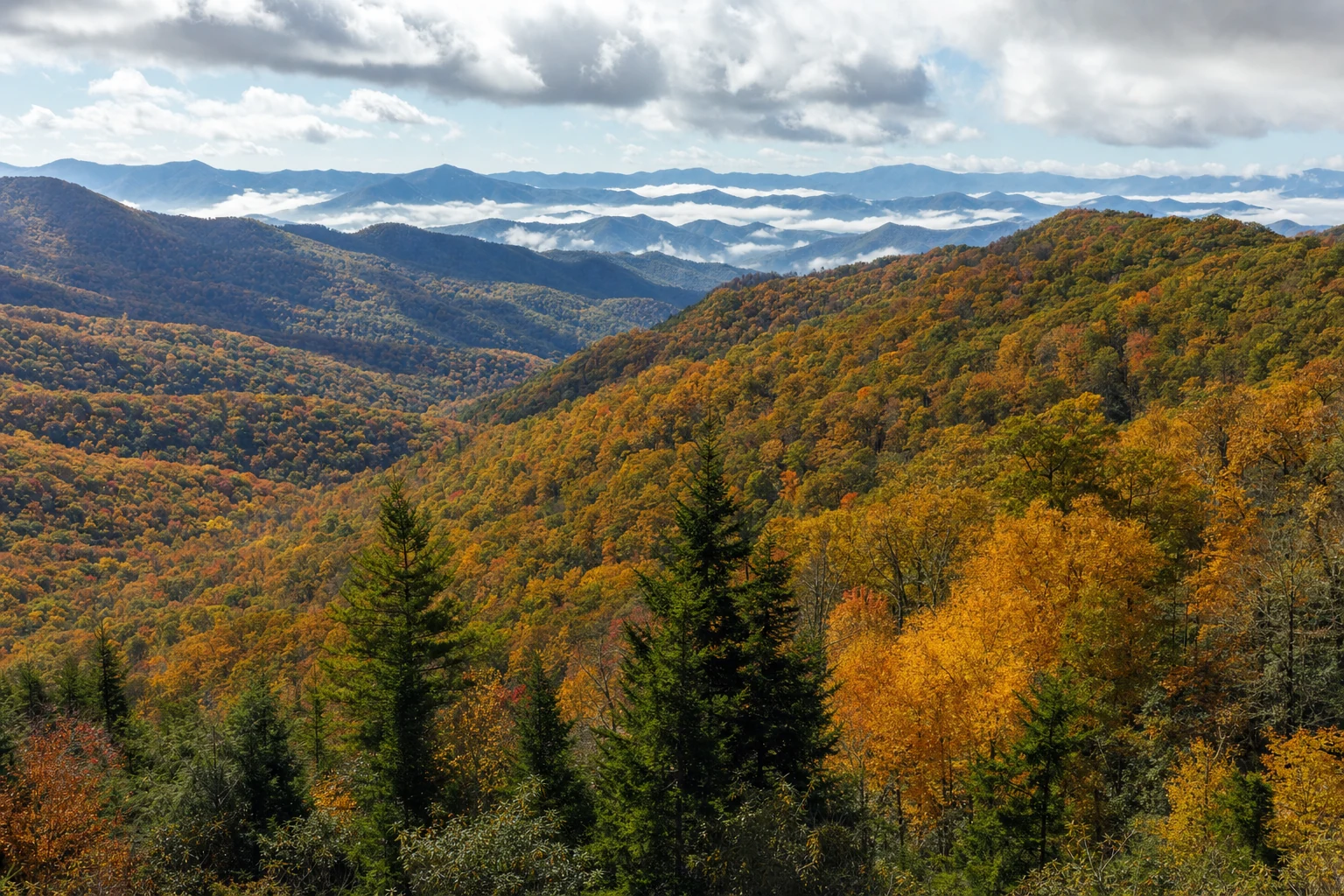
Spring and fall are the practical peaks. The Hazel Creek valley in spring carries wildflowers along the creek banks, and the streams run fuller and louder after winter rain and snowmelt, though crossings can be higher than expected. Fall, particularly from mid-October into early November, turns the canopy above the valley and brings cooler temperatures that make long hiking days far more manageable.
Summer works but runs warmer at lower elevations, and backcountry permits for Hazel Creek book faster. Winter is possible for experienced hikers with proper cold-weather gear; the bare canopy opens views that don't exist the rest of the year, and you'll likely have the area entirely to yourself. Check road and trail conditions through the park's official status page before any winter trip.
Before You Go
Cell service in Hazel Creek is unreliable. Download offline topo maps before you leave; apps like Gaia GPS store them on-device, and a paper backup adds almost no weight. The park updates trail and road conditions on its website, and it's worth checking the day before departure, especially after heavy rain or any late-season storm.
Water from Hazel Creek and its tributaries isn't safe to drink without treatment. Bring a filter, tablets, or UV purification for any extended trip. And think seriously about whether to pair the cabin visit with a longer stay in the Hazel Creek area rather than making it a single-target day trip — the approach distance makes a rushed visit a poor return on the effort. There's enough of the old valley to reward an overnight, if you're inclined.
The Jesse Cole Cabin is not a site you'll check off on a quick loop through the park. You earn it by planning the access, committing the time, and showing up somewhere that most Smokies visitors never reach. For the right kind of traveler, that's the whole point.