
About Messer Barn:
Now I'll write the page copy, grounded strictly in the known facts and research excerpts, following all anti-slop constraints.
---
The Messer Barn sits at the far end of Cataloochee Valley, one of the most deliberately remote places in Great Smoky Mountains National Park. Getting there takes commitment: a long, winding approach road that discourages impulsive detours, which is partly why the valley has retained the quiet that makes its surviving structures feel genuinely undisturbed. Built around 1900 by the Messer family, the barn represents a particular chapter in Appalachian agricultural life, before the park acquired this land and the families who farmed it had to go.
What You're Looking At
The barn is a cantilever design, an architectural approach common across the Appalachian region during this period. In this style, the upper portion of the structure extends beyond the lower walls, providing overhead shelter for animals and equipment at ground level while the upper floor handles hay and feed storage. The result is a barn that looks slightly top-heavy, distinctive in profile, and rather better engineered than its weathered exterior might suggest. Its scale is large relative to the valley's other surviving buildings; the Messer family ran a serious farming operation here, not a kitchen garden.
You can't go inside. The building is preserved for exterior viewing only, and that's not a bureaucratic technicality — the interior is old, and preservation means keeping people out of it. Most visitors don't feel shortchanged. The barn reads clearly from the outside, and the setting around it does as much interpretive work as any guided tour could.
The Valley Context
The Messer Barn doesn't stand alone. Cataloochee holds one of the more complete collections of preserved Appalachian homestead structures in the park system, and the barn makes most sense seen alongside what surrounds it. Palmer Chapel, a white frame church from 1898, still gets used for occasional services. The Caldwell House, a two-story frame dwelling built around 1903, represents a tier of local prosperity that wasn't universal here. Beech Grove School, a one-room schoolhouse from 1901, served the valley's children during the same years the Messer family was farming this land. Several other cabins and houses — the Palmer House, the Woody Cabin, the Steve Woody House — fill out the picture of how people actually lived when this was working farmland rather than national park.
These structures collectively span a short window of construction between 1898 and 1903, and they cover a range of economic conditions: chapel, schoolhouse, prosperous farmhouse, humble cabin, working barn. The Messer Barn is the agricultural anchor of that group. It's where the practical business of feeding people and animals happened, which makes it as central to understanding life in Cataloochee as any of the residences.
Planning Your Visit
The road into Cataloochee is not one you take without checking conditions first. It's narrow, unpaved in stretches, and designed to limit traffic. That limitation is deliberate; it keeps the valley from being overrun, and arriving after the drive makes the quiet feel earned. Check the park's road status before you go, especially between November and early April when weather can close the approach.
A Park It Forward parking tag is required for stays over 15 minutes anywhere in Great Smoky Mountains National Park. Daily tags run $5, weekly $15, annual $40, available at recreation.gov or park entrance kiosks. Cataloochee has designated parking near the historic structures, so you won't need to improvise. Plan at least two hours if you want to walk the valley and see multiple buildings at an unhurried pace; three hours is more realistic if you want to photograph properly or read the interpretive materials.
Cell signal in the valley is unreliable. Download the park map beforehand, and don't count on navigation apps once you're inside.
Best Time to Come
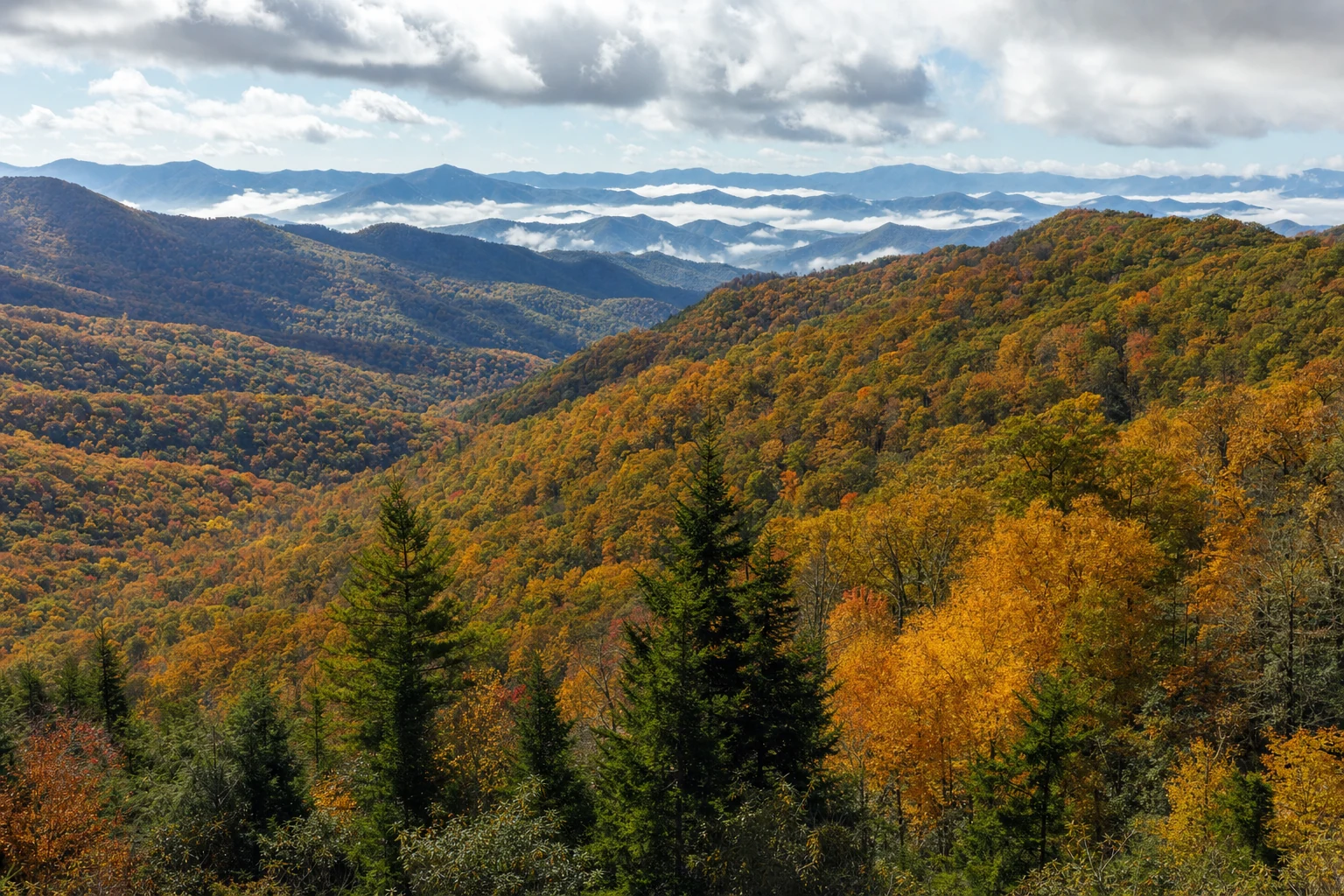
Late September through mid-October is when the valley floor goes gold and the surrounding ridgelines follow. The light in October afternoon catches the barn's weathered wood in a way that explains why photographers treat Cataloochee as a destination rather than an afterthought. Crowds are real during peak foliage, but the access road limits them; you're unlikely to feel swarmed even on a busy October weekend.
Spring is worth considering too. Wildflowers come up through April and May along the valley floor, and the barn reads differently against bare-branched trees than it does in full summer canopy. You see more of the structure and more of the surrounding landscape at once. Summer is the least visually interesting season for the barn, though the valley is quiet on weekday mornings and the drive in is lush.
Winter visits are for people who actively want solitude. Cold keeps most visitors away; the valley empties out entirely; the barn stands against a stripped-down landscape that's stark in a way summer doesn't allow. Road closures after ice or snow are possible, so check conditions before making the drive.
Who This Visit Suits
Not every traveler to the Smokies is drawn to preserved barns, and there's no point pretending otherwise. The Messer Barn is worth a specific trip if you're interested in vernacular architecture, Appalachian agrarian history, or the particular atmosphere of a landscape that was once densely inhabited and is now almost entirely quiet. It also works well as part of a Cataloochee half-day or full-day itinerary rather than as a standalone stop; the other historic structures in the valley are close enough to visit in a single outing.
For photographers, the cantilever silhouette is genuinely distinctive and comes out well in late-afternoon light. The framing of the barn against the surrounding tree lines, with open field grass in the foreground, is the kind of composition that doesn't require much effort to make work.
What to Bring
Wear shoes with some grip; the ground around the historic structures can be soft after rain. Bring water, since there's no concession or visitor center in the valley itself and the nearest services are back out the access road. If you're visiting in spring or fall, expect fog on the valley floor in the morning hours; it typically burns off by mid-morning, and the light that follows is worth the wait.