
About Noah Ogle Place (Ogle Cabin):
The Noah Ogle Place sits along the Roaring Fork Motor Nature Trail, about as close to a working 19th-century Appalachian farm as you'll find inside a national park. The homestead includes a log cabin, a barn, and a tub mill (a primitive water-powered grist mill), all built around 1880 by Noah "Bud" Ogle and his family. You can walk through the cabin and examine each outbuilding up close, which puts it several cuts above the roped-off historic structures common to most parks and history museums.
The Ogle Family and Their Farm
The Ogles were one of the founding families of what became Gatlinburg. Before Great Smoky Mountains National Park existed, before the resort strip and the traffic, people like Noah "Bud" Ogle were farming these coves, milling their own grain, and raising livestock in country the federal government would eventually acquire during the park's formation in the early 20th century. What they left behind is a complete picture of how mountain families sustained themselves in relative isolation: growing crops, keeping animals, grinding their own corn, and building everything from timber cut on the property.
The cabin is a standard Appalachian log construction, notched at the corners in the style that characterizes most surviving structures in this part of the park. Step inside and you're looking at the same proportions and layout the Ogle family would have used: a single main room, low ceiling, minimal natural light. It's not glamorous. That's the point. The Smokies' historic structures are striking precisely because they're ordinary, built to survive winters and to work, not to impress anyone.
The Tub Mill
The tub mill is the most unusual element of the property, and worth slowing down for. Unlike the larger overshot and undershot wheel mills found elsewhere in the park, a tub mill uses a horizontal water wheel set directly below the millstone. The whole mechanism is small enough to fit in a shed barely larger than a storage closet. Mountain families used these to grind corn into meal for their own household, not for commercial production or trade.
The Ogle tub mill sits alongside a small stream, fed by a wooden flume that channels water onto the horizontal wheel. Even if it isn't running when you visit, the mechanics are readable without explanation: water comes in, spins the wheel, the stone turns, corn goes in the top, meal comes out the side. It required almost no maintenance compared to a full-sized community mill, which made it practical for a single family farming a remote mountain cove. If you've visited the larger Mingus Mill near the Oconaluftee Visitor Center on the Cherokee side of the park, the Ogle tub mill is its opposite in scale and intention; one is a community resource, the other is pure subsistence.
Walking the Site
Plan on 30 to 45 minutes to cover everything at a relaxed pace. The cabin, barn, and mill are spread over a compact area, and the path between structures is easy walking. The area gets muddy after rain, so boots or waterproof shoes are worth wearing rather than trail runners or casual sneakers.
No interpretive rangers are stationed here permanently, but the on-site signage explains each structure in enough detail to be genuinely useful. The tub mill mechanics are described well enough that you'll leave understanding how the machine actually worked, not just that it existed. The cabin stays open for self-guided walkthroughs during daylight hours.
Bring children if you have them. Nothing here is behind glass or rope, which makes it engaging for kids in a way that standard museum displays rarely manage. The tub mill especially tends to prompt real questions about how people lived before grocery stores, about what "self-sufficient" actually meant when you were three days from the nearest town by foot.
Roaring Fork Motor Nature Trail
The Ogle homestead is one of several stops along the Roaring Fork Motor Nature Trail, a one-way loop road that peels off from downtown Gatlinburg and winds through dense second-growth forest. The road runs single-lane in sections and is not suitable for RVs or trailers; check park signage before turning onto it with a larger vehicle.
Other stops along the route include additional historic structures and several trailheads, so the Ogle place fits naturally into a half-day loop rather than a dedicated standalone trip. If you're planning to hike as well, the Trillium Gap Trail to Grotto Falls begins nearby. It's one of the park's most-walked paths, and one of the only trails anywhere in GSMNP that passes directly behind a waterfall. Pairing the homestead with that hike gives you a solid morning covering both the cultural and natural history of the Roaring Fork corridor.
The road closes in winter due to icy conditions. Check the NPS park roads status page before driving out between December and March.
When to Visit
Spring, roughly late March through May, tends to offer the strongest combination of factors: accessible road, wildflower bloom, and smaller crowds than summer or fall. The Roaring Fork area gets strong wildflower coverage in spring; trout lilies, spring beauties, and trillium are common along the roadside and forest floor. Arrive before 10 a.m. on weekends to have a realistic shot at parking at the Ogle homestead pull-off.
Summer is the busiest period in the park overall. Expect full lots by mid-morning on weekends from June through August. The forest canopy is fully leafed out by then, which makes the light inside the cabin dim and keeps the site cool even on warm afternoons.
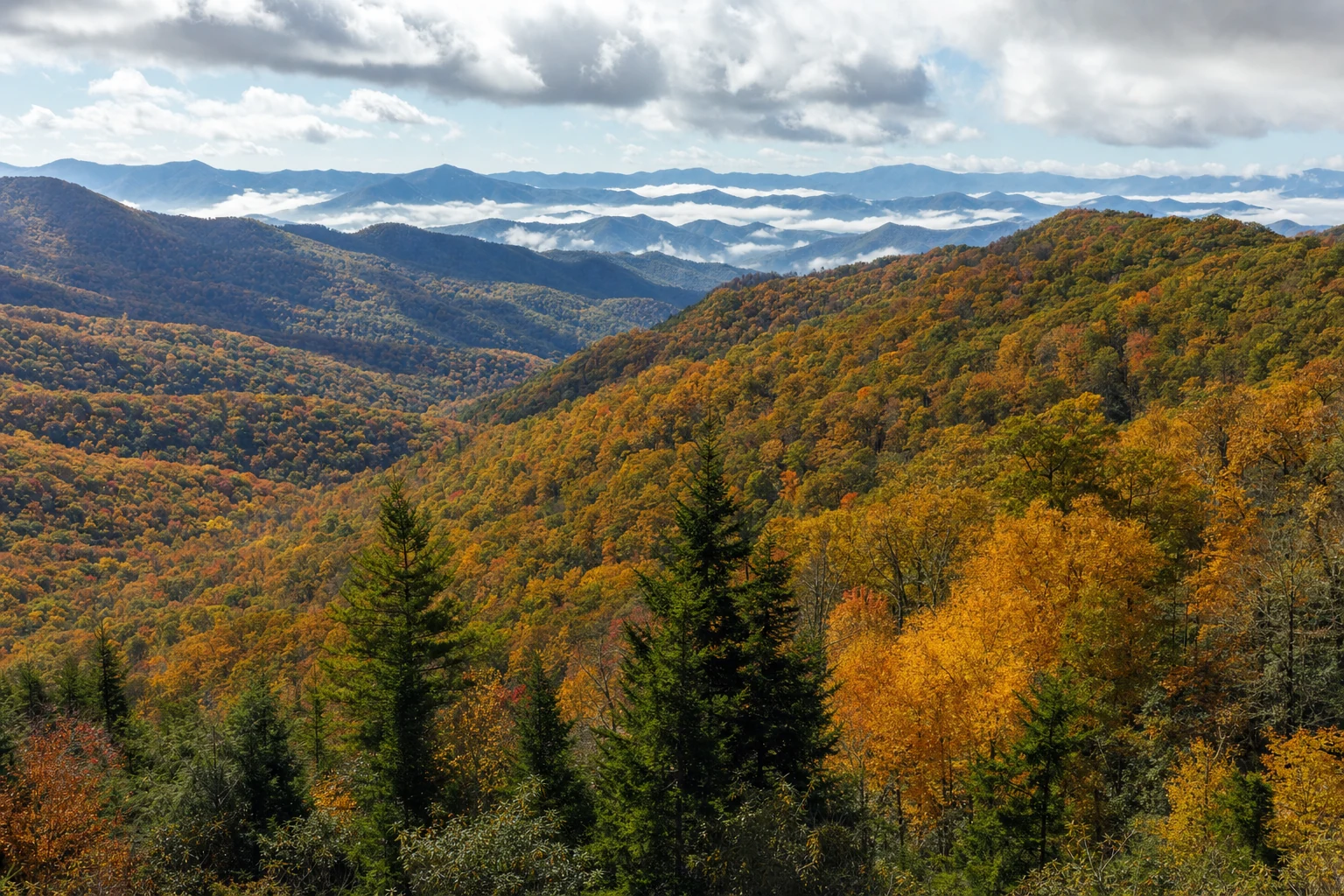
Fall draws the largest overall crowds to this part of Tennessee, with leaf color typically peaking around mid-October. If foliage is the draw, plan for early-morning visits and budget extra time for traffic on the Roaring Fork loop itself, particularly on weekends.
Getting There and Parking
From downtown Gatlinburg, follow Cherokee Orchard Road south; the turn for the Roaring Fork Motor Nature Trail is clearly marked. The road is one-way, so approach from the correct direction or you'll have to backtrack to the start of the loop.
A Park-It-Forward parking tag is required for any stop inside Great Smoky Mountains National Park lasting more than 15 minutes. The daily rate is $5, the weekly pass is $15, and the annual pass runs $40. Purchase at recreation.gov before you arrive, or at self-pay kiosks at the major park entrances. The tag hangs from your rearview mirror; rangers check regularly on busy days.
There's no reliable cell service along most of the Roaring Fork loop. Download any maps or NPS road-status information before leaving Gatlinburg.