
About Palmer House:
The Palmer House sits in Cataloochee Valley as one of the oldest surviving structures in Great Smoky Mountains National Park, a hand-built log cabin from around 1890 that you can actually step inside. Cataloochee is about as far from the park's crowded main corridors as you can get while still inside GSMNP, reached via a winding unpaved road off the Cove Creek area east of Maggie Valley. The reward for the drive: open meadows where a reintroduced elk herd now grazes, and a concentration of preserved 19th-century buildings that once belonged to one of the largest mountain settlements in what is now the park.
The Cabin and What It Shows You
Log construction of the type used for the Palmer House was the standard building approach in these mountains in the late 1800s. Notched logs, daubed chinking, small windows placed for function rather than light — it represents an earlier tradition than the two-story frame Caldwell House built across the same valley roughly a decade later. That contrast is worth paying attention to as you walk the valley. Standing inside the Palmer cabin and then moving over to the Caldwell House, you get a concrete feel for how quickly outside materials and growing prosperity were reshaping mountain architecture even before 1910. The physical difference between the two buildings is a short walk apart, but it tells a long story about what was changing in rural Appalachia.
The cabin is open during daylight hours and you can walk through it. No interpretive staff is stationed at the building, so it helps to arrive with some background on what you're looking at.
The Settlement That Was Here
Cataloochee once held more than a thousand people. At its early 20th-century peak, the community had churches, schools, mills, and a post office; it was a functioning Appalachian town tucked into a mountain valley with its own rhythms and institutions. When the federal government acquired the land for the park in the 1930s, families relocated out and the NPS preserved a selection of structures rather than clearing the valley.
Walking the valley now means passing the Palmer Chapel (a white-frame church from 1898), the Beech Grove School (dating to 1901, a single room with desks and a woodstove), the Caldwell House, the Messer Barn with its distinctive cantilever framing, the Steve Woody House, and the smaller Woody Cabin — alongside the Palmer House itself. These buildings survived because they were structurally sound enough and historically significant enough to justify ongoing maintenance. The schoolhouse is particularly worth time: everything a small rural community needed for its children's education, compressed into one room. Self-guided walking covers all of them at an easy pace in roughly an hour and a half.
The Elk
Any practical guide to Cataloochee has to deal honestly with the elk, because for most visitors, that's the primary reason to make the trip. Elk were absent from the Southern Appalachians for over a century before the NPS reintroduced them here starting in 2001. The herd has grown since, and the animals are a reliable presence in the valley's open fields.
Dawn and dusk are when you'll find them active, grazing in loose groups in the meadows near the valley's historic core. A bull in September during the rut is a genuinely large and striking animal; a full rack moving through morning fog in a mountain meadow is not something most visitors forget quickly. Park regulations require a minimum 150-foot buffer from all wildlife. Rangers are typically present during peak viewing hours and will enforce that. The elk during rut are unpredictable enough that the distance rule is worth taking seriously rather than treating it as a soft suggestion.
If elk are the goal, early fall is when to come. The rut runs through September and October, which also coincides with the valley's foliage color, compressing several strong reasons to visit into the same narrow window.
Getting There
Cataloochee Road leaves from near the Cove Creek Road area east of Maggie Valley. Most of the drive into the valley is unpaved and narrow, with sections of switchbacks that require patience. Plan for roughly 45 minutes from the highway, more if you're behind a driver unfamiliar with one-lane mountain roads. This access challenge is a significant part of why the valley stays much less visited than comparable park destinations like Cades Cove.
A Park It Forward parking tag is required for any stay over 15 minutes inside Great Smoky Mountains National Park. Daily passes cost $5, weekly $15, and annual $40 — available through recreation.gov before your trip or at kiosks near the main park entrances. America the Beautiful pass holders don't need a separate tag.
Trails Worth Adding
For more time outdoors beyond the historic structures, two trails serve different purposes: the Boogerman Trail loops through old-growth forest with large tulip poplars and hemlocks, suited to anyone drawn to big trees and a quiet canopy; the Cataloochee Divide Trail climbs to a ridge with long views across into Tennessee. Each works as a self-contained half-day option and they don't need to be done together. The Boogerman suits people after old-growth atmosphere; the Divide Trail is for anyone who wants elevation and a payoff view.
When to Visit
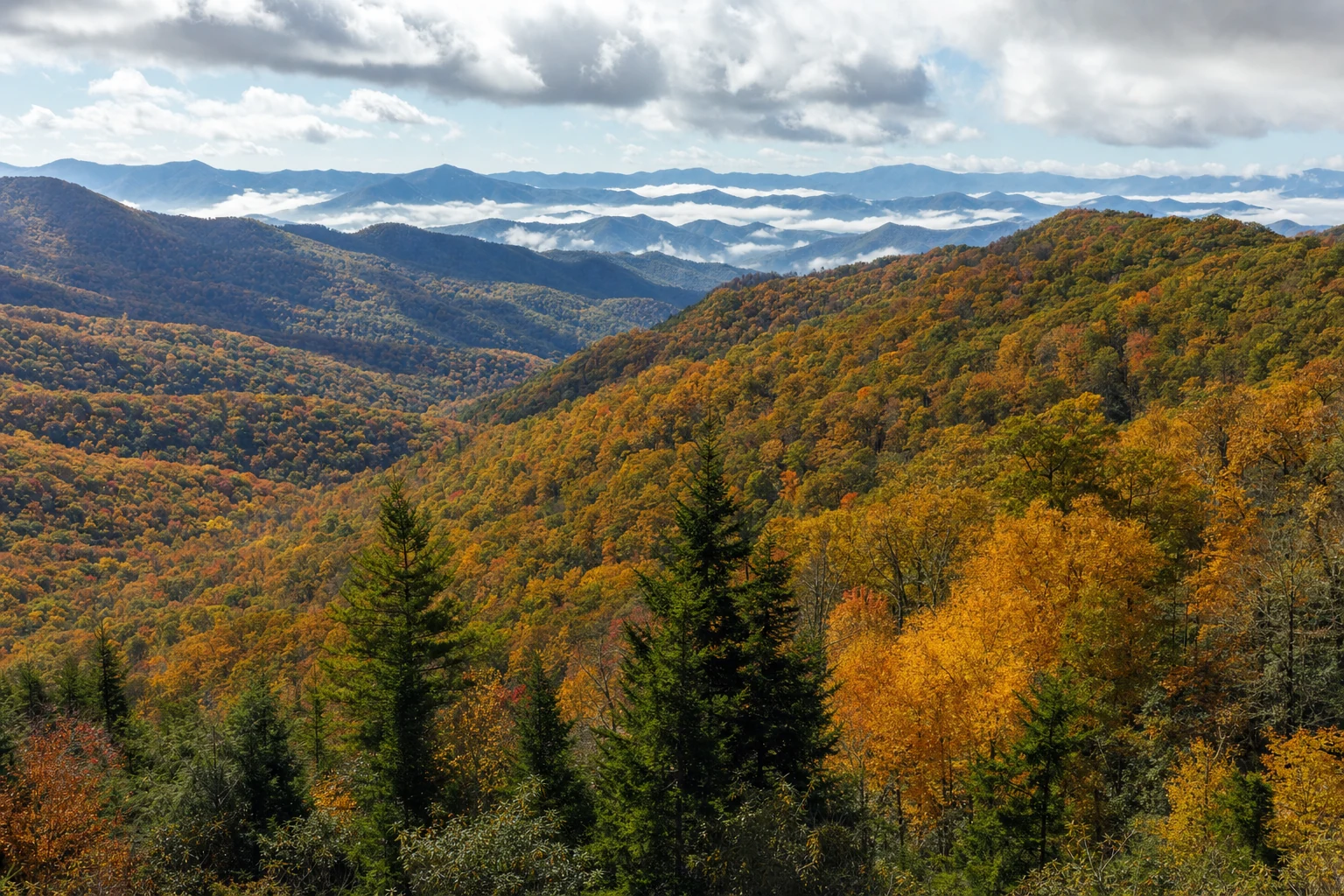
Spring brings wildflowers across the valley floor and active birdlife in the surrounding forest. Summer is manageable here precisely because the access keeps Cataloochee quieter than most of the park even during peak season, though arriving before mid-morning on weekends still makes sense. Fall is the most compelling time to go: elk activity, foliage, and cooler temperatures all come together in October, and the valley looks best in the low-angle light of early morning.
Winter visits are conditional. The road into Cataloochee can close after snowfall or ice, and the NPS sometimes gates it entirely in poor conditions. Check the park's official road status the morning of your trip, not the night before.