
About Springhouse:
The springhouse at the Mountain Farm Museum is easy to walk past — it's small, unpainted, and tucked within a larger collection of 19th-century structures along the Oconaluftee corridor of Great Smoky Mountains National Park. But it represents one of the most essential technologies of pre-modern Appalachian farming: a building constructed directly over a natural spring to exploit the earth's year-round cold for preserving food. Built in the late 19th century, it survives as a viewable exterior exhibit, part of the Mountain Farm Museum's living history collection.
What a Springhouse Actually Did
Long before mechanical refrigeration, mountain families relied on the geology beneath their feet. A springhouse was built so that the floor sat over — or immediately adjacent to — a cold spring, keeping interior temperatures cool even in July. Dairy products were the primary beneficiaries: crocks of butter, milk, and cream could be set in the running water or on stone shelves above it, staying cold enough to last days rather than hours. Other perishables followed — eggs, cured meats, seasonal vegetables. The spring also served as a household water source.
The design was stripped-down and functional: log or stone walls, a simple roof to keep out sun and rain, a dirt or stone floor, and ventilation gaps to let the cool air circulate. There was no decoration, no excess. Every element served the cold. That the structure at the Mountain Farm Museum survives at all is partly because it was so solidly built — these buildings had to withstand floods, decades of moisture, and the casual wear of daily farm life.
The Mountain Farm Museum Context
The springhouse sits within the Mountain Farm Museum, a living history complex assembled from original structures relocated from various locations throughout the park and presented together as a coherent 19th-century Appalachian homestead. The museum sits at the Oconaluftee area of GSMNP — the park's North Carolina entrance, accessible from the Cherokee side via Newfound Gap Road.
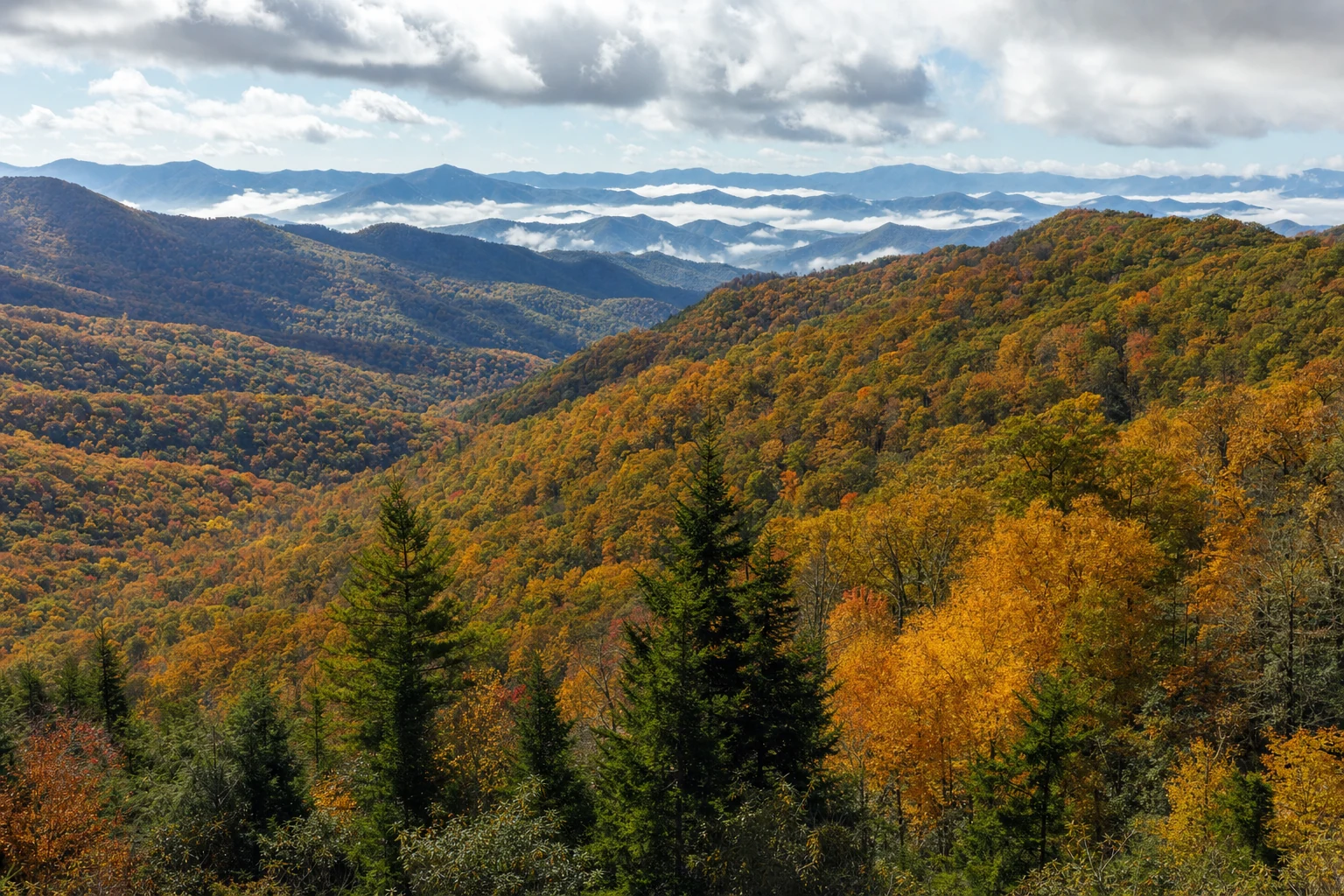
Visitors approaching from Gatlinburg drive Newfound Gap Road through the high elevations of the park before descending to the Oconaluftee Visitor Center and the farm museum complex. That drive itself — particularly in fall or on a clear summer morning — is worth building the day around. The museum grounds are open during park hours, and the visitor center provides interpretive material that puts the individual structures in context.
The springhouse is one of multiple outbuildings on the property. Seeing it as part of the whole complex — alongside the farmhouse, barn, smokehouse, and other structures — gives you the full picture of how interconnected these buildings were. Each served a specific function; together they formed a self-sufficient system.
The Springhouse Up Close
The building is viewable from the exterior only — do not attempt to enter. This is a standard designation across the non-cabin structures at the Mountain Farm Museum, and the boundary is clear on the ground.
What you can observe from outside: the construction method, the positioning relative to the natural topography, and the scale. These were not large buildings — a family needed enough space to store perishables, not to live in — and the Mountain Farm Museum springhouse reflects that. The log or stone walls, the low roofline, and the lack of windows (or very small ones) all served the purpose of keeping interior temperatures as stable as possible.
Look at the site as a whole rather than just the structure. The placement — typically near a water source, at slightly lower ground than the main cabin — was deliberate. Water flows downhill, and a well-sited springhouse took advantage of gravity to keep water moving through and cold air pooling inside. If you've already visited the Elijah Oliver Place in Cades Cove or the Alfred Reagan complex in the Roaring Fork area, you've seen similar structures in different contexts; comparing them is a useful way to understand the range of Appalachian building practice.
Getting There
The Mountain Farm Museum is located at the Oconaluftee Visitor Center, on the southern end of Newfound Gap Road (US-441) inside the park on the North Carolina side. Visitors from Gatlinburg will drive south through the park over Newfound Gap, a trip that covers roughly 30 miles of mountain road. Allow at least 45 minutes from downtown Gatlinburg under normal conditions; more in summer peak season when traffic backs up through the Sugarlands entrance.
A Park It Forward parking tag is required for any stay over 15 minutes anywhere inside Great Smoky Mountains National Park. Tags run $5 daily, $15 weekly, or $40 annually, and can be purchased at recreation.gov or at park kiosks before you pull in. Purchase it before you arrive — the Oconaluftee lot can fill quickly on summer and fall weekends.
There is no admission fee for the Mountain Farm Museum or the grounds. The visitor center itself offers restrooms, exhibits, and staff who can answer specific questions about the structures on-site.
Seasonal Considerations
Each season changes what you get from this visit. Spring brings wildflowers across the Oconaluftee valley and higher water flow, which affects how visibly active the spring-fed features on the farm appear. If you're visiting specifically to understand how springhouses functioned, early spring — when cold-water storage would have been supplemented by the tail end of winter temperatures — is a useful mental frame.
Summer is the busiest season in the park. The Oconaluftee area draws significant traffic from the Cherokee entrance, and the visitor center lot can fill by mid-morning on weekends. Arriving before 9 a.m. gives you the farm grounds largely to yourself.
Fall is peak season for foliage — mid-October is typical for peak color at these elevations — and the Mountain Farm Museum in autumn light is a genuinely different experience. The farm structures read differently against bare-branch hardwoods than they do surrounded by summer green. Crowds are at their annual peak in October.
Winter thins the crowds substantially, but Newfound Gap Road closes when ice and snow make it unsafe. Check the park's road status page before making the drive from Gatlinburg, particularly if there has been any precipitation in the preceding 24 hours. On a clear winter day with the road open, the Oconaluftee area offers solitude and clear sight lines across the valley that summer foliage obscures.
Pairing This Visit
The springhouse makes most sense as one stop in a longer exploration of GSMNP's historic structures rather than a standalone destination. Within the Mountain Farm Museum grounds, the other outbuildings and the main farmhouse offer a complete picture of how a late 19th-century mountain homestead functioned as a system.
Beyond Oconaluftee, the Cades Cove loop road on the Tennessee side provides the densest concentration of surviving homestead complexes in the park. The Elijah Oliver Place there includes a springhouse alongside a cantilevered barn and smokehouse — a useful comparison to what you've seen at Mountain Farm Museum. The Alfred Reagan Place off the Roaring Fork Motor Nature Trail similarly pairs a springhouse with a working grist mill and painted barn.
If you want to see a springhouse in a more remote, trail-accessed context, the Walker Sisters cabin at Little Brier Gap — reached via a moderate hike from Metcalf Bottoms — includes a springhouse as part of a homestead complex that was occupied well into the 20th century. That site requires more effort but rewards it with a different kind of historical immersion than the accessible, interpreted setting at Mountain Farm Museum.