
About Steve Woody House:
The Steve Woody House sits toward the upper reaches of Cataloochee Valley, a long corridor of farmland that settlers worked for generations before the creation of Great Smoky Mountains National Park absorbed it. Built around 1880, this log cabin belonged to the Woody family, whose name appears on multiple structures throughout the valley and whose roots ran deep in the community that once thrived here. Unlike many historic buildings that survive only as sealed, roped-off exteriors, this one's open during daylight hours; you can step inside and actually read the space.
The Woody Family's Place in the Valley
Cataloochee was never a single-family settlement. By the late 1800s it held dozens of households, a school, a church, and a community shaped by the geography around it: steep ridges pressing in from multiple sides, the river threading through the bottom, and limited road access that kept the valley relatively self-contained. The Woody family occupied a significant place in that community, and the house that carries their name reflects what domestic life looked like for established farming families in the southern Appalachians during that era.
The cabin was built around 1880 using methods common to the region: log construction, simple framing, craftsmanship that prioritized durability over ornamentation. When the National Park Service took stewardship of Cataloochee, they preserved these structures not as curiosities but as documentation. The Steve Woody House is one of several surviving buildings that together make the valley one of the most intact 19th-century settlement sites you can actually walk through in the eastern national parks.
What to Expect Inside
The cabin is open during daylight hours. You don't need to arrange access in advance; just show up and walk in. The interior is spare, the way these spaces actually were — no furniture staging, no theatrical recreation, just the structure itself: the walls, the floor, the ceiling, proportions that tell you something real about how people lived and worked in a space this size.
Informational plaques near the building provide historical context, and reading them before or after looking around adds something to the experience. The light inside shifts considerably depending on time of day; if photography matters to you, mid-morning to early afternoon gives the most useful natural light through the windows and door.
The Broader Cataloochee Historic District
The Steve Woody House doesn't stand alone. Cataloochee Valley holds a cluster of preserved structures from roughly the same period, and visiting several of them together gives you a much fuller picture of what this community actually looked like. Plan enough time to walk between sites rather than rushing back to your car after one stop.
The most frequently photographed is Palmer Chapel, a white-frame church built in 1898 that still occasionally holds services. The Caldwell House, built around 1903, is a two-story frame structure representing a more prosperous homestead in the valley; its architecture is noticeably different from the log cabins nearby. Beech Grove School, dating to 1901, is a one-room schoolhouse that lands more powerfully in person than it sounds on paper — a real classroom that real children used, intact enough to make that concrete. There's also the Messer Barn, a large cantilever barn whose roofline catches the eye from a distance; the cantilever style was common in this part of Appalachia, and this example is among the better-preserved ones in the park.
The valley floor is relatively flat between these sites, and distances are manageable on foot.
Getting There
Cataloochee Valley is accessed via a narrow road off US-276 near Maggie Valley. The approach is one lane through significant stretches, and the park service recommends against pulling large RVs or trailers down it. Standard passenger vehicles and most SUVs handle it without trouble in dry conditions, but the road warrants slower speeds and attention. Some mapping apps route visitors on an unnecessarily long path; check the NPS Cataloochee page directly for the current recommended approach before you leave.
A Park It Forward parking tag is required for stays over 15 minutes anywhere inside Great Smoky Mountains National Park, including here. Daily tags run $5, weekly $15, and the annual pass is $40. Purchase through recreation.gov before your visit or at kiosks near park entrances. Having the tag before you arrive saves the step of looking for a kiosk once you're already on the valley road.
Cell service is limited to nonexistent once you're in the valley. Download maps or directions before you go. The valley has restroom facilities near the main parking areas, appropriate to a remote park site.
Best Time to Visit
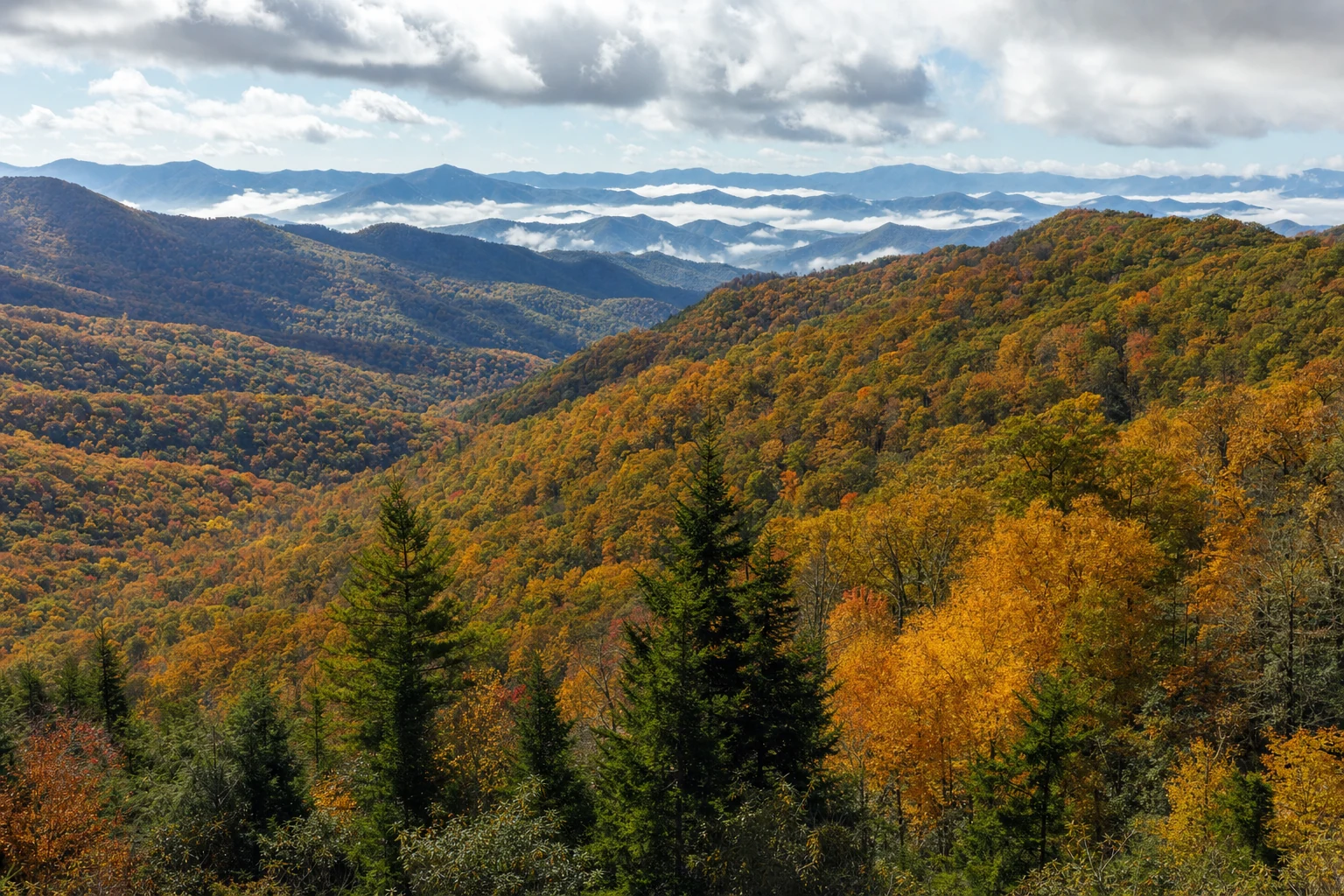
Fall is the honest answer. Mid-October typically brings peak color to the ridgelines above the valley, and the old farm fields and building rooflines set against turning hardwoods make for exactly the scene you'd expect. The trade-off is that Cataloochee draws more visitors in October than any other month, and parking at the more popular sites fills early. Arriving before 9 a.m. solves most of that problem.
Spring is quieter, with wildflowers appearing on the hillsides from mid-April into May. Summer is the most consistently accessible, though afternoon heat makes a long walk between sites less pleasant than an early-morning version of the same route. Winter brings the fewest visitors; the bare trees clarify the valley's layout in a way summer's canopy obscures, and you can understand the geography and the ridge structure more clearly. Road conditions matter more in winter — check NPS road status before making the drive, since conditions at higher elevations can change fast.
Who It Suits
Visitors with an interest in Appalachian history or vernacular architecture will get the most from the Steve Woody House specifically, though the surrounding valley makes it worth the trip for a broader range of people. The walk between buildings is easy enough that it works for families with kids who can manage a mile or two; the one-room schoolhouse and the Messer Barn tend to hold children's attention better than most park overlooks. Anyone who's spent time in other parts of GSMNP and wants to see something genuinely different from the trail-to-waterfall format will find Cataloochee a worthwhile detour. The remoteness is part of the point: the valley feels more like a field visit to an outdoor history museum than a standard park stop, and the Steve Woody House is one of the reasons for that.