
About Tremont Institute Dining Hall (former CCC Mess Hall):
Civilian Conservation Corps labor shaped much of what visitors encounter inside Great Smoky Mountains National Park today, and the dining hall at Tremont is one of the more intact reminders of how that work actually ran. Built in 1930 as a mess hall for CCC crews, the structure now sits within the grounds of an environmental education center in the Tremont area, where the forest has reclaimed the ridgelines above and the Middle Prong of the Little River runs close enough to hear year-round. You can't go inside — the building is viewable from the exterior only, with interior access reserved for participants in the center's programs — but the exterior itself tells a clear story about park-building in the New Deal era.
The Building and Its Origins
The Civilian Conservation Corps brought thousands of young men to the Smokies in the early 1930s as the federal government moved to establish the park. They built roads, trails, bridges, and the utility buildings that kept camps running, and this dining hall was one of those utility buildings: it fed the workers on a schedule that ran morning to night, anchoring camp life in a way that a tent or bunkhouse couldn't.
CCC construction in this region was built to function, not to last as a tourist attraction, which makes surviving structures like this one genuinely unusual. Most camp buildings from that era are gone. This one survived because it found a second use when the education center eventually occupied the Tremont grounds; practical buildings tend to outlast decorative ones. The exterior reflects that original logic: functional proportions, utilitarian construction, no ornament beyond what the work required.
What You'll Actually See
The building sits within a larger campus associated with current education programs at the Tremont site. You're looking at it from outside, so the experience is measured in minutes rather than hours; a walk around the perimeter, taking in the scale and construction details, doesn't take long. What the exterior gives you is a sense of proportion — how much space a working mess hall needed to feed an entire CCC camp crew, day after day for years.
The site rewards more of your time than the building alone commands. The Tremont area follows the Middle Prong, and the surrounding forest is the kind of Appalachian mixed hardwood that reveals itself on foot rather than from a car window. The dining hall is a fixed point in a landscape that's otherwise entirely about movement: water, light through canopy, wildlife cycling through the understory. Stopping at the building gives you an excuse to stay in one place long enough to take it all in, which is an underrated way to experience this part of the park.
Best Time to Visit
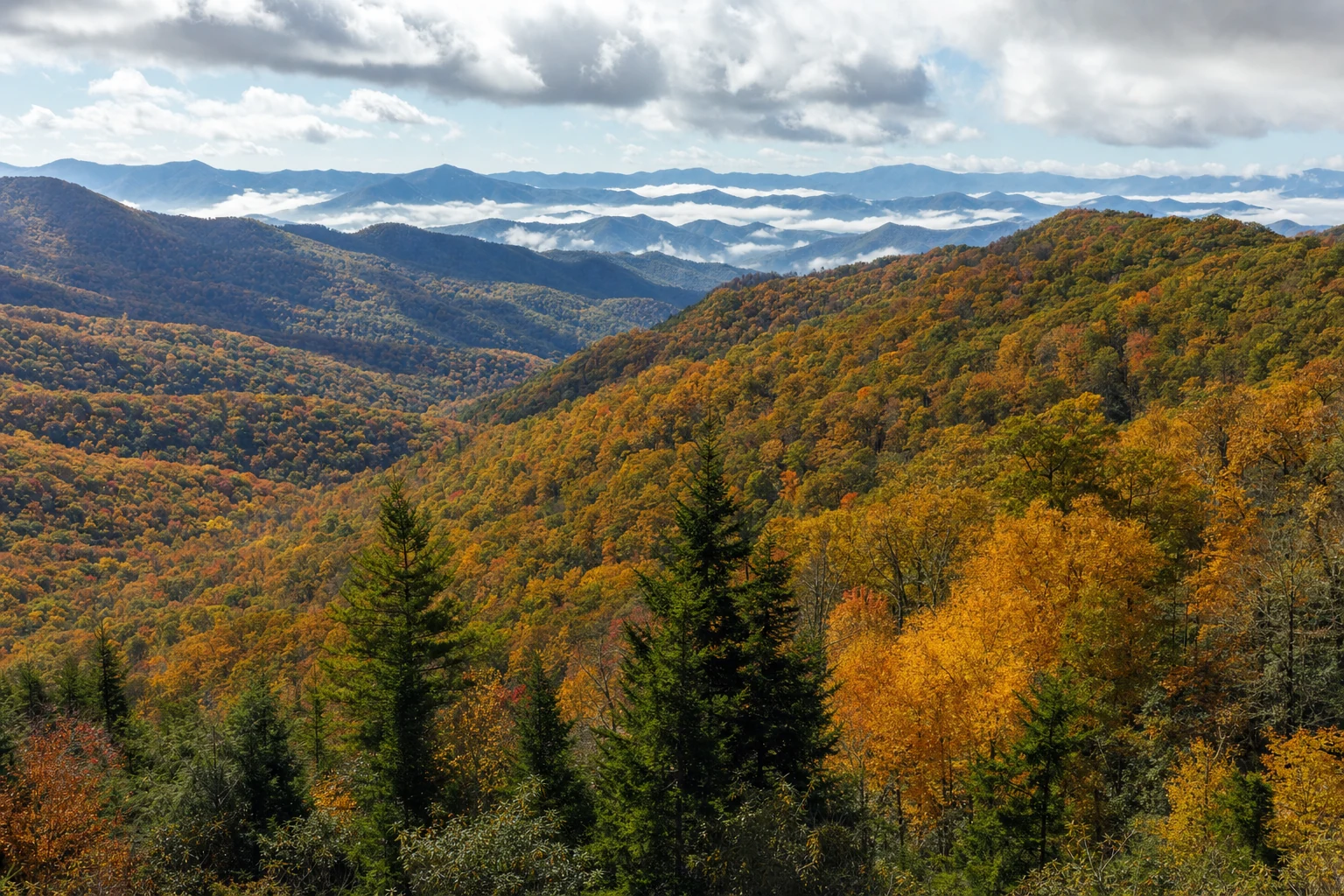
Tremont is accessible year-round, and the season you choose changes what you're actually experiencing. Spring peaks between April and early May for wildflower bloom; the streams run high and loud from snowmelt, and the light through new-growth canopy is exceptional. Summer brings park-wide crowds, and the road to Tremont can back up; arriving before 9 a.m. or after 4 p.m. sidesteps most of the pressure. Fall color at this elevation typically peaks in mid-October, with the ridges above going amber and rust before the valley floor follows. Winter quiets everything sharply. The road stays open in most conditions, the building looks exactly as spare as it was built to look, and you'll likely have the grounds to yourself.
Check park road status before any winter drive. Conditions can change quickly in the Smokies, and high-elevation roads close without much notice when ice comes in.
Getting There
The Tremont area lies on the western side of GSMNP, most directly reached from the Townsend entrance via US-321. From Gatlinburg, the route runs through Sugarlands and along Little River Road; it's a longer drive than it looks on a map because the road follows the river drainage rather than cutting across any ridge. Give yourself extra time coming from the Gatlinburg side.
A Park It Forward parking tag is required for any park stay longer than 15 minutes. Tags run $5 per day, $15 per week, or $40 for an annual pass, available at recreation.gov or at park entrance kiosks. Rangers check. Cell coverage gets unreliable once you're inside the park, so download maps and directions before you leave a town with reliable service.
Know Before You Go
The dining hall's interior is not accessible to general visitors. Access is reserved for participants in the education center's programs. Don't plan your trip around getting inside; plan around seeing the exterior and spending real time in the surrounding area.
The road into Tremont is paved but narrow, without good turnaround options until you reach the education center grounds. If you're towing a trailer or driving a large vehicle, check conditions before committing to the road — it doesn't accommodate improvisation well. There's no fee to enter the park, but the parking tag applies here the same as anywhere else in GSMNP.
Pairing This Stop
Tremont has enough in its immediate vicinity to fill a half-day comfortably. The Middle Prong Trail and Lynn Camp Prong Trail both start near the education center and reach genuine backcountry without a demanding approach; either one gives you a ground-level sense of the watershed the CCC was working in when they built the camp. The surrounding forest was heavily logged before the park was established and then left to regenerate — tree sizes and species distribution record that history if you're paying attention.
If CCC-era park construction is your main focus, GSMNP has other preserved structures from the same period. Cades Cove, reachable from Tremont via the park road, has structures from both the pre-park settlement era and the conservation period that followed. A day that moves from Tremont to Cades Cove covers more than a century of human activity in this corner of the Smokies, and the dining hall is one chapter in a story the landscape is still telling.