
About Woody Cabin:
Now I'll write the page copy, applying the anti-slop rules strictly.
---
Cataloochee Valley's historic structures don't compete on grandeur. The Woody Cabin, built around 1880, is a log cabin at its most functional: the kind of dwelling a mountain family put up to survive cold winters and work the land, not to leave an impression. Set within one of the most remote accessible valleys in Great Smoky Mountains National Park, it's open to visitors during daylight hours and reads as the most unvarnished account of ordinary Appalachian mountain life still standing in the park.
The Cabin Itself
The Woody family owned several structures in the valley, and this is among the simpler ones. Log construction, modest footprint, nothing sized beyond necessity. You can step inside, and once you're in, the contrast with the valley's more substantial homes becomes immediately legible — the two-story Caldwell House and the well-preserved Steve Woody House nearby are clearly the residences of families who had more. This cabin shows what the other end of that spectrum looked like.
The c. 1880 construction date puts it in the early generation of Cataloochee settlement, before the valley's small farming economy reached its modest peak. Families like the Woodys worked land that stayed genuinely isolated through most of the nineteenth century, building what they could from what the surrounding forest provided. The cabin holds that story without embellishment. The scale of the interior makes clear how little space a family actually required, and how much of daily life happened outside it.
Cataloochee Valley: Why the Whole Valley Matters
No single building here makes sense without understanding what the valley once was. Cataloochee sustained a working Appalachian farming community for generations, complete with schools, churches, and dozens of households spread across the valley floor. When the National Park Service acquired the land in the 1930s, nearly all of it disappeared. What survives — and the park has maintained it carefully — is an open-air record of that community: buildings you can walk into, read the interpretive markers on, and piece together without a tour guide.
The Woody Cabin is one stop on a longer circuit. Palmer Chapel, built in 1898, still occasionally holds services and draws photographers to its white frame exterior. Beech Grove School, dating to 1901, is a one-room structure that gives you the full picture of early rural education in a single glance. The Caldwell House, built around 1903, represents a more prosperous household. The Messer Barn draws consistent attention for its cantilever construction, a regional technique that lets the upper structure overhang the lower without external support columns — common to this part of Appalachia and striking once you know to look for it. Spending a few hours moving through all of them gives you a far more complete picture than any one structure can offer on its own.
Getting There
Cataloochee is the part of the itinerary where most visitors realize the road is not what they expected. From Maggie Valley, you'll head toward the valley entrance via a narrow, winding route that includes an unpaved stretch near the end. Standard passenger vehicles handle it fine in good conditions, but the road is slow, tight in places, and runs without guardrails along the creek. Budget extra time and don't attempt it after dark.
Once inside the park, a Park It Forward parking tag is required for any stop over 15 minutes. Daily tags run $5, weekly $15, and annual $40, available through recreation.gov or at kiosks near the main park entrances. Rangers do check, and Cataloochee is staffed during busy seasons. The valley has no services whatsoever — no food, no cell signal, no water. Bring everything you need before you turn off the highway.
When to Go
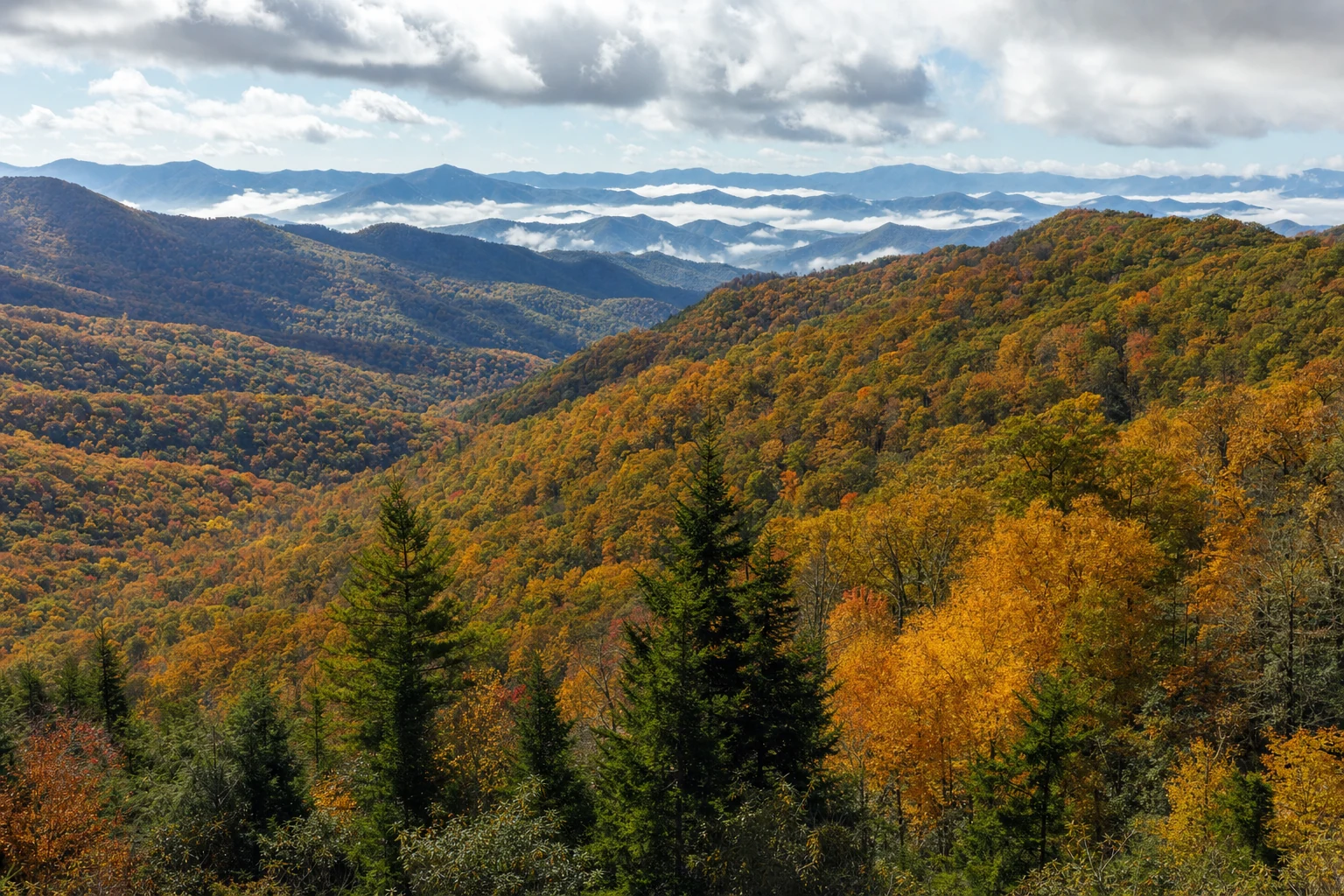
Fall draws the most visitors, and the valley earns it. At Cataloochee's elevation, the foliage turns sharply in mid-October, and the open meadows along the valley floor give you unobstructed sightlines to the color on the ridges above. Weekends in peak fall can mean a full parking area by mid-morning; a weekday visit or an early start makes a real difference.
Spring brings wildflowers along the creek and running water loud enough to hear from the road. Summer stays cooler than the lowland towns but sees crowds on weekends. Winter strips the leaves back and opens up long views across the valley that the growing season hides, though road conditions become the variable — check the NPS road status page before driving in during or after a cold snap, since ice on that narrow approach road is genuinely dangerous.
What the Visit Actually Looks Like
The Woody Cabin isn't a half-day destination on its own. Plan for it as the anchor of a full Cataloochee loop: an hour or two working through the cabin, the school, the chapel, the barn, and the other preserved structures, with time to walk the meadows in between. Wear shoes that can handle wet ground; the valley floor stays muddy well into spring, and the paths between structures are unpaved.
Entry to all the historic structures is free once you're inside the park. No tickets, no reservations, no timed entry. The Park It Forward vehicle tag is the only cost to plan for. If you're driving in from the Cherokee entrance on the park's southern side, the approach is somewhat different than coming from Maggie Valley — either way, confirm road status before you go, particularly outside of summer.