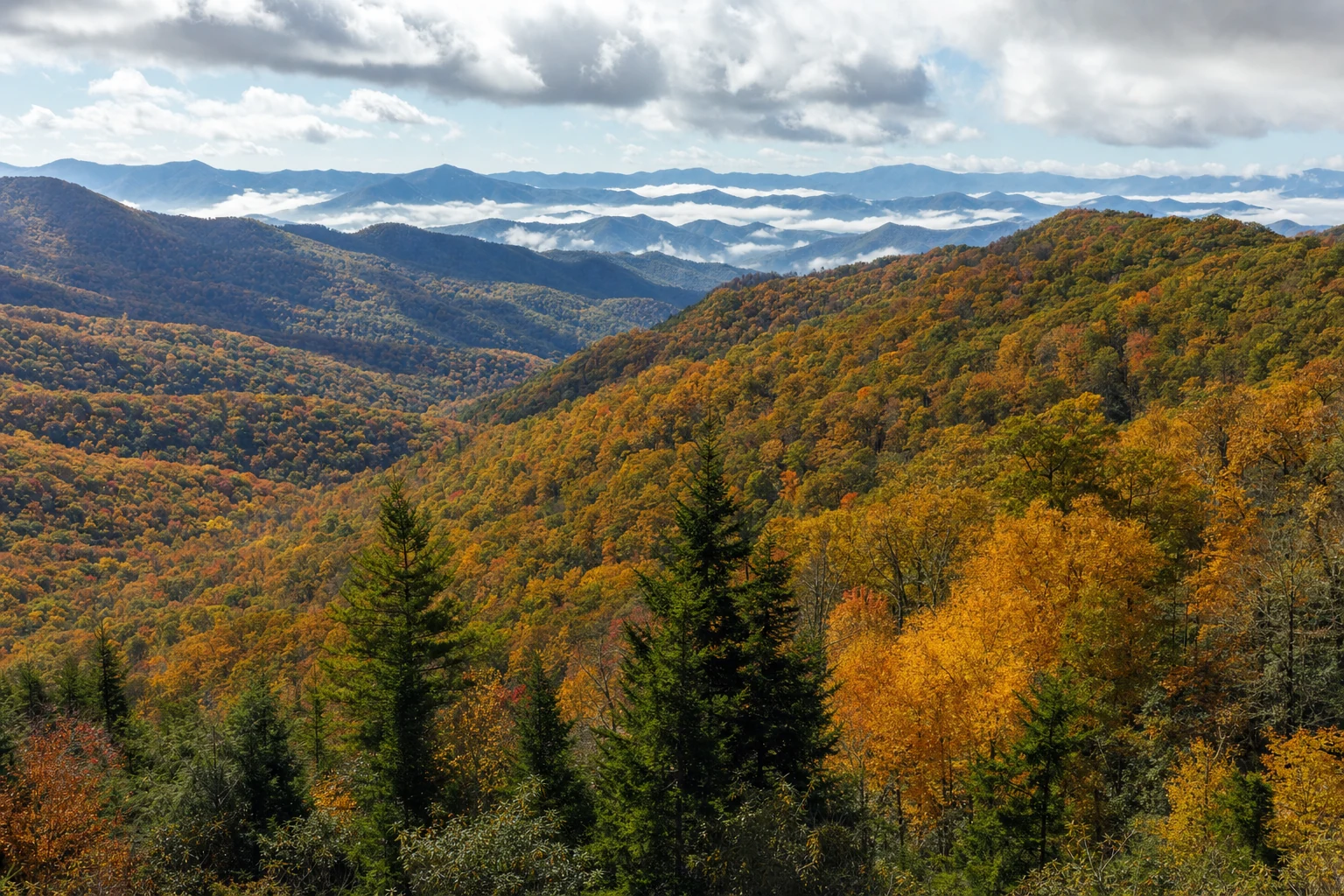

About Chilhowee Lake Overlook
Chilhowee Lake sits in the low country west of the main Smokies ridgeline, backed by forested hills that roll down from Chilhowee Mountain. This overlook, around milepost 15 along the park's western corridor, puts you directly above the water and the softened terrain surrounding it. Less dramatic than the high-elevation panoramas at Newfound Gap or Clingmans Dome, yes — but with a different quality entirely: open, calm, and consistently uncrowded.
What you're looking at
The lake is a reservoir, which means its edges are relatively flat and open rather than the dense riparian canopy that crowds most Smokies waterways. That openness is what makes the stop worth more than a windshield glance. On a clear mid-day, the water surface reflects the sky and the wooded ridges behind it in a way that rewards actually stepping out and letting your eyes settle. The surrounding hills are rounded and low compared to the park's interior peaks; the scene reads as transition country, the threshold between the deep mountain terrain to the east and the Tennessee Valley lowlands spreading out to the west. In fall, the hillsides pick up color that frames the water nicely — the usual reds and yellows against a dark lake surface.
The pullout is small, enough for a handful of cars, and crowds tend to be light. This overlook doesn't appear on most tourist maps and doesn't sit on the standard Smokies checklist, which keeps foot traffic to a minimum even in summer. If you arrive and it's full, the road shoulder isn't a realistic parking option — come back in 15 minutes and you'll likely find a spot.
When to go
Mid-day is genuinely the right call here, which runs counter to the usual advice about chasing golden-hour light. Overhead sun flattens shadows on forest scenes, but it does the opposite to still water: it drives reflections. From late morning through early afternoon on a calm day, the lake surface can read almost mirror-flat, doubling the sky and ridgeline above it. Early morning works if there's mist, though the reflections won't be as sharp.
Seasonally, late spring and early fall offer the clearest conditions. Summer brings dense green on the hillsides and typically clears by mid-morning after any overnight haze burns off; fall adds foliage color. Winter is genuinely unpredictable — the road may close during ice events, and the park doesn't maintain a predictable reopening schedule for lower-priority overlooks when conditions deteriorate. Check road status before making the drive.
Getting there
The overlook sits along the park's western approaches at roughly the milepost 15 mark. From Gatlinburg, you'll head west on US-321 or pick up the Foothills Parkway corridor depending on your route. The Foothills Parkway (western section) runs along Chilhowee Mountain through this area and provides access to several overlooks in sequence; Chilhowee Lake Overlook appears mid-route as the road descends toward the western lowlands. The parkway itself stays lightly traveled because it doesn't connect to the park's main interior roads, which means you won't hit the US-441 crawl that can add an hour to peak-season park drives.
There's no entrance gate or toll at the overlook itself, but if you spend more than 15 minutes within park boundaries — which you almost certainly will if you're combining this stop with anything else nearby — you'll need a Park It Forward parking tag. Daily tags run $5, weekly $15, annual $40; you can buy one at park entrance kiosks or through recreation.gov before you arrive. If you've already paid for the day at another park location, you're covered for the rest of it.
What to bring
No restrooms, no interpretive signage, no amenities. The pullout is just a pullout. Bring water, especially in summer: the lower elevation and open sun can make the exposed roadside noticeably warmer than the shaded interior trails higher up. If you shoot with a camera, a polarizing filter earns its place here specifically — it lets you dial out glare on the water and pull actual depth out of the reflection rather than just shooting at a washed-out surface.
Cell coverage at this elevation is generally reliable, more so than at the high-elevation overlooks. If you're checking road conditions or navigating, that's useful.
Pairing this stop
Chilhowee Lake Overlook works best as part of a western-section Foothills Parkway drive rather than as a standalone destination. The parkway through this corridor strings together overlooks with different view angles — valley, foothills, ridge, water — and you can cover most of them in a half-day without retracing your route. Abrams Falls trailhead sits in this part of the park as well, accessible via Cades Cove to the east; the combination of a waterfall hike and a lake-view stop makes for a coherent day out rather than two unrelated drives with a long gap between them.
If you're based in Gatlinburg and doing the western corridor for the first time, plan the Foothills Parkway drive as a morning outing before tourist-area congestion builds on US-441. The parkway doesn't intersect with the main park traffic, which is one of its genuine practical advantages — you can move at your own pace without someone tailgating you to a pullout.
Before you go
- Parking: Small pullout, roughly four to six cars. Weekends in peak season may mean occasional competition for a spot, though nothing like the congestion at Alum Cave or Laurel Falls.
- Road closures: Check the park road status before driving, particularly November through March. Ice forms quickly at higher elevations on the parkway and closures can happen without extended notice.
- Park It Forward tag: Required for stays over 15 minutes in the park. Daily $5, available at park kiosks and recreation.gov.
- Timing: Mid-day for water reflections; late morning works too. Avoid the overlook on overcast days if reflections are the main draw — the lake loses most of its interest under flat gray light.