
About Forney Ridge Parking Area (for Kuwohi Tower)
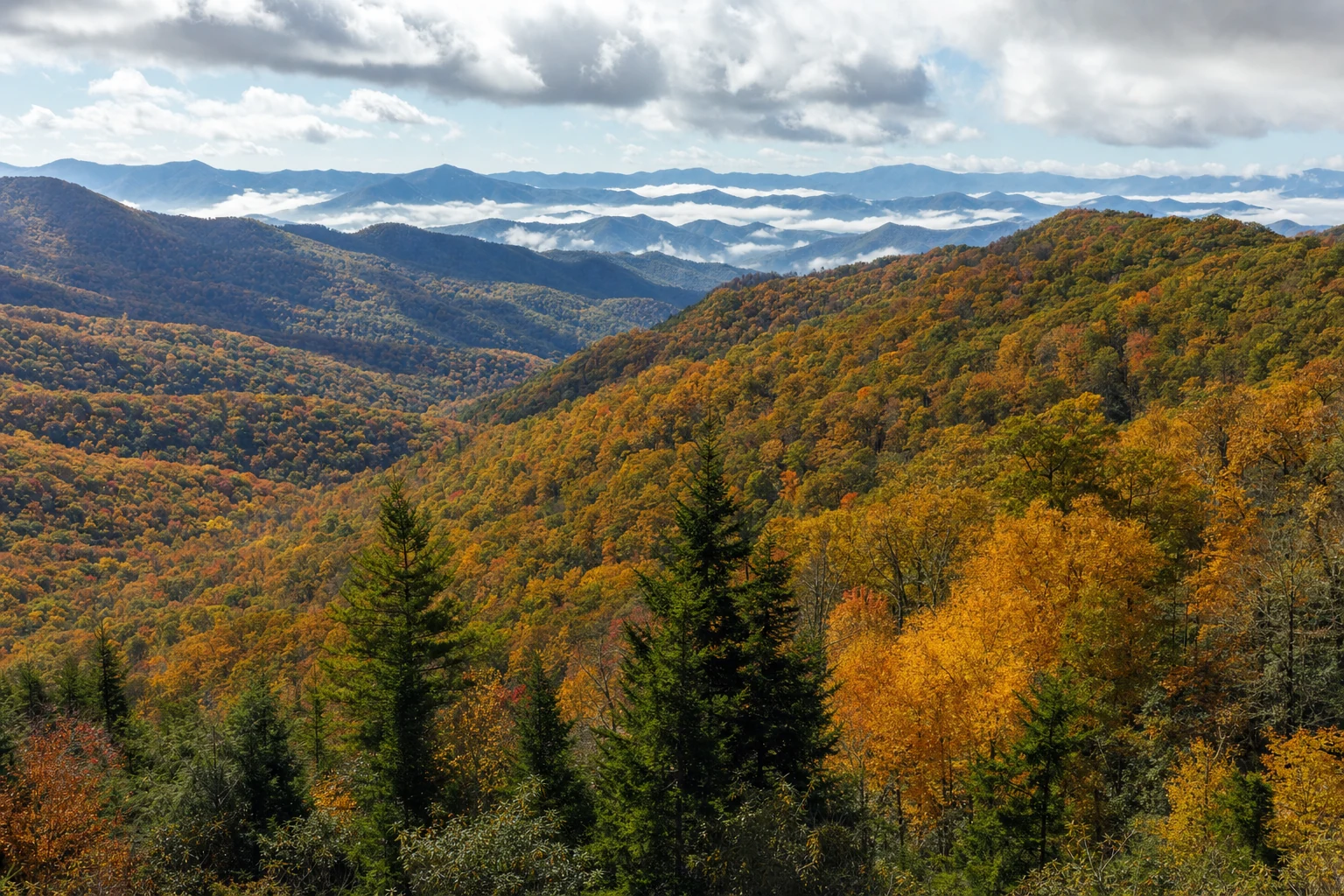
The Forney Ridge Parking Area sits at the top of Kuwohi Road — among the highest paved roads in the eastern United States — and it's far more than just a place to leave your car. Even standing in the lot, you're looking out over a sweep of high Appalachian ridges that, on clear days or foggy mornings, appears to go on without end. The main draw is Kuwohi itself, the highest point in Great Smoky Mountains National Park and the highest point on the entire Appalachian Trail, reached by a short but strenuous paved climb from the lot. What makes Forney Ridge worth understanding before you arrive is how completely the lot can fill up — and how different the experience is depending on when you get there.
What the parking area offers on its own
Most visitors treat Forney Ridge as a staging area, but the lot itself sits at genuine high elevation and delivers panoramic views of the surrounding peaks before you take a single step toward the tower. On mornings when a temperature inversion has settled cloud cover into the valleys below, you can look out from the parking area and see a white sea beneath you, ridgelines rising through it like low islands. The views are "often above the clouds" — a phrase that sounds like promotional copy until you've actually experienced it at 6 a.m. on a September morning when the lowlands are invisible and the sky above you is perfectly clear.
The area is associated with Kuwohi (formerly Clingmans Dome), the Cherokee name the National Park Service officially restored to the mountain. Road signs and older maps may still display "Clingmans Dome Road" and "Clingmans Dome." Both names refer to the same destination, and if you're using an older GPS unit or printed guide, that's what to look for.
The walk to the tower
From the parking area, the path to the observation tower is short but climbs steadily and steeply. The surface is paved, so footing is secure, but the elevation means even fit hikers feel it in their lungs. The tower at the top is a concrete spiral ramp that winds up to an enclosed observation deck offering views in every direction — on clear days the ridges visible from the top span multiple states. When visibility is low, the tower can sit completely inside a cloud, which is either meditative or frustrating depending on how you've framed the visit.
The path begins at the upper end of the parking lot. Restrooms are available at the trailhead. If mobility is a consideration, the grade is steep and sustained — brief, but not flat — and that's worth factoring honestly into your planning.
Timing: sunrise is the main event
The most sought-after experience at Forney Ridge is sunrise with a cloud inversion, and it earns the reputation. On mornings when warm, humid air sits in the valleys below cooler summit air, the lowlands fill with cloud while the peak stays clear. You stand above a white sea with the sunrise painting it in orange and pink, the far ridges lit from the side. This happens with enough regularity during late summer and fall that photographers plan entire trips around specific forecasts.
To catch it, you need to arrive before dawn. That means accounting for the drive up Kuwohi Road from Newfound Gap, which takes time even in good conditions, plus finding a space in a lot that fills early. Arriving in full darkness with headlamps is common among people who've done this before and know what the experience is worth. Sleeping in and driving up at 8 a.m. hoping to see a cloud inversion is a reliable way to find a full lot and a clearing sky.
Sunset light
Sunset at Forney Ridge is less dramatic than sunrise in the cloud-inversion sense, but the colors across the high ridges can be remarkable. The Smokies' characteristic blue atmospheric haze — caused by terpenes released by the dense tree cover — deepens at dusk, and the warm light plays differently at this elevation than it does from the valley. Sunset crowds tend to be lighter than sunrise crowds, and the drive back down Kuwohi Road in fading light, with spruce-fir forest closing in on either side, is its own quiet experience.
If you're pairing a sunset visit with an evening in Gatlinburg or Pigeon Forge, account for the drive back through Newfound Gap before factoring in dinner reservations. The road takes longer than it looks on a map.
Crowds and parking strategy
Crowd level at Forney Ridge is high — genuinely, consistently high — and the parking lot, despite being one of the largest in the park, fills completely. This isn't a worst-case scenario. Arriving at 9 or 10 a.m. on a clear summer weekend and finding no available space is a normal outcome, not an unlucky one.
The practical strategies are limited but clear:
- Arrive before sunrise. This gives you the best light, the most dramatic conditions, and a guaranteed space.
- Target weekdays. Traffic drops considerably Monday through Thursday outside holiday weeks.
- Visit in shoulder seasons. Late September and October bring heavy foliage traffic, but May and early June — before summer volume peaks — can be considerably more manageable.
- Have a backup plan. If you arrive and the lot is full, the small unnamed pullouts along Kuwohi Road offer high-elevation spruce-fir forest and occasional distant views, though not the summit panorama.
Getting there and the Park It Forward tag
Kuwohi Road branches off Newfound Gap Road (US-441) at Newfound Gap, which sits on the Tennessee–North Carolina state line. From Gatlinburg, follow US-441 south through Sugarlands and up through the Chimneys area to Newfound Gap, then turn onto Kuwohi Road. From the North Carolina side, approach Newfound Gap from Oconaluftee near Cherokee. The junction is clearly signed.
A Park It Forward parking tag is required for any stay over 15 minutes anywhere inside Great Smoky Mountains National Park. Tags are available at recreation.gov or at fee stations within the park: $5 daily, $15 weekly, $40 annually. The annual tag pays for itself quickly across multiple visits. The park charges no separate entrance fee — the parking tag is your only out-of-pocket cost for access.
One critical logistical note: Kuwohi Road closes each winter when ice and snow make it impassable, typically from late November through late March, though the exact window varies by year and conditions. Check the park's road status page before making the drive. Showing up to a closed gate after an hour on the road is avoidable with a two-minute check the morning you go.
Know before you go
Weather at summit elevation is genuinely different from what's happening in Gatlinburg or Pigeon Forge below. Temperature drops with elevation, and what reads as a warm spring day in town can be cold, wet, and windy at Forney Ridge. Pack a layer — a fleece or wind shell — regardless of the lower-elevation forecast.
High-elevation fog is common and can move in quickly, dropping visibility from miles to yards in a matter of minutes. The tower can be completely socked in on a day when Gatlinburg is perfectly clear. Waiting 20 or 30 minutes sometimes opens a clearing; sometimes it doesn't. That unpredictability is part of what makes the summit compelling, and it's not a reason to avoid the visit — just a reason to hold expectations loosely and let the mountain offer what it will.
Cell service is limited to nonexistent at the summit. Download offline maps and any park information before leaving town. There is no food service or water available at the summit, so carry what you'll need for the visit.