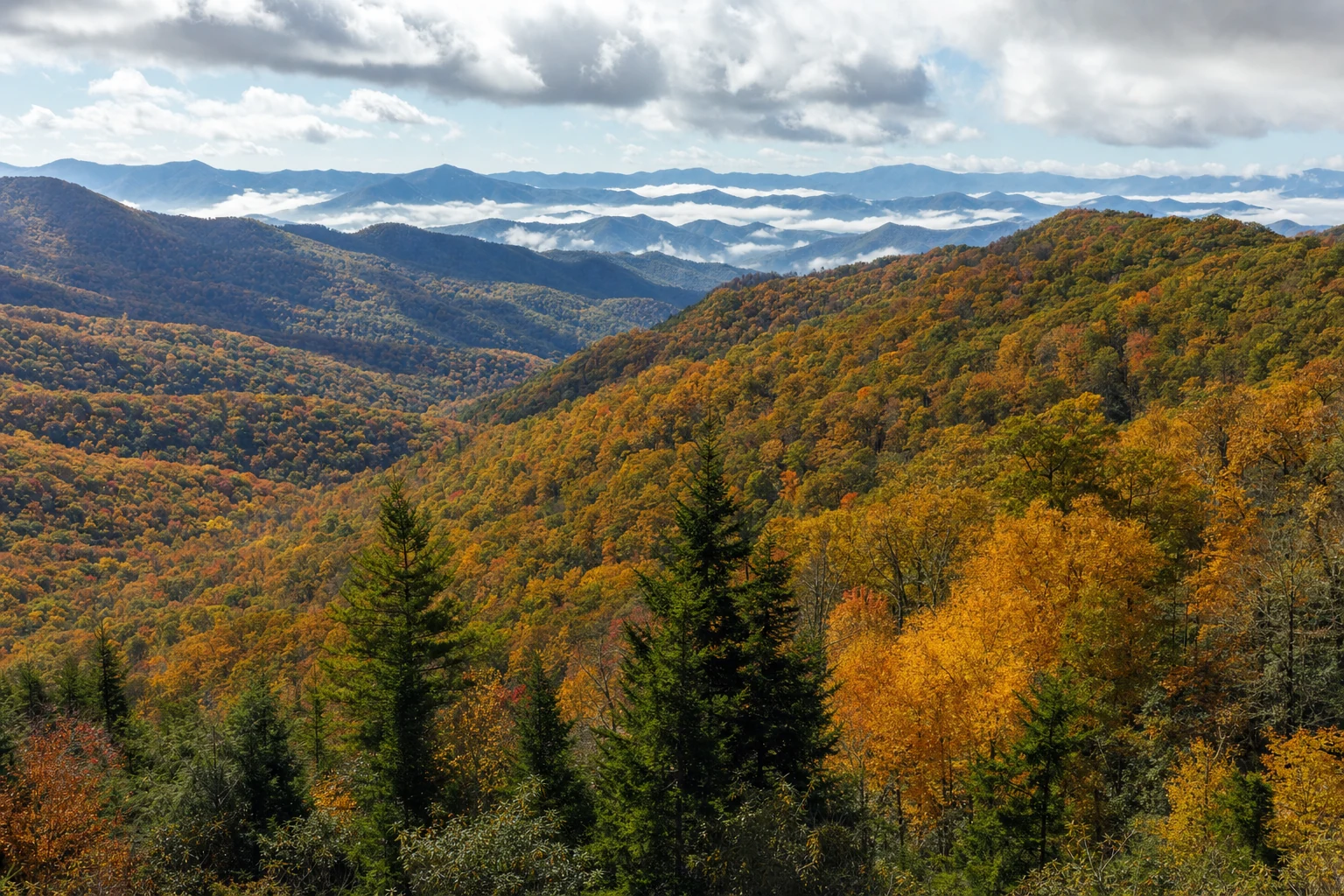

About Happy Valley Overlook
Good, I have the full banned list. Now I'll write the article applying all constraints.
---
Down below the pullout, Happy Valley spreads across the valley floor in uneven rectangles of farmland, and behind it the mountain ridges stack up in layers of blue-green that get softer and more indistinct the further they recede. This is the Foothills Parkway's eastern section at around mile marker 8, a small pullout that most people drive past, which suits the overlook well. The view earns its reputation on clear mornings; arrive late on a humid summer afternoon and you may not see much beyond the first ridge.
What the view actually shows
The character here is pastoral and wide, not dramatic in the way that high-elevation park viewpoints tend to be. You're looking across the foothills at the geography of the region laid out horizontally: agricultural land at the base of the mountains, privately owned fields and cleared terrain, and then the forested slopes of Great Smoky Mountains National Park rising behind them. Happy Valley below was working farmland, and in places still is, which gives the patchwork of fields you see from the overlook a grounded, specific quality that the abstract mountain panoramas elsewhere in the park don't have.
The transition between those two zones is visible and legible from up here. Where private land ends and the protected wilderness begins isn't just a legal boundary; it reads plainly in the landscape, in the way the vegetation shifts and the land stops being organized into rows and parcels. That quality makes this overlook interesting in a way that's easy to miss if you're measuring it against summit views. It's not trying to be Clingmans Dome. What it offers instead is a clear sight line across the full bottom-to-top range of the Smokies, from valley floor to distant ridge, at a scale you can take in all at once.
Morning light, and why it matters here
The best light for Happy Valley Overlook is morning, and that recommendation has a practical basis beyond photography preferences. Haze builds over low-elevation terrain as the day heats up, and in summer it builds fast; by early afternoon the valley can be opaque enough that the back ridges simply disappear. Come before 9 a.m. and the scene reads clearly. Come at 2 p.m. in July and you're likely looking at a solid wall of atmospheric blur where the mountains should be.
For photographers, the implication is direct: the morning angle puts workable light across the valley floor, giving the farmland texture and depth. Midday light flattens everything out. There's no complex calculation here, just a consistent rule that holds across seasons.
October deserves its own mention. When the valley floor turns in fall, the agricultural patchwork picks up warm color while the upper park slopes stay dark with evergreens, and the contrast between those two zones is the most visually interesting version of this view. The window is short, roughly two to three weeks depending on how quickly temperatures drop, and the Foothills Parkway does get noticeably more traffic during peak fall color. Arriving early remains good advice; the difference between 7:30 a.m. and 10 a.m. on a Saturday in October is real.
Winter access depends on road conditions. High-elevation sections of the Foothills Parkway close when ice forms, and the overlook may be unreachable for days at a stretch. Check the National Park Service's road status page before heading out; they update it continuously.
Getting there
The Foothills Parkway's eastern section runs along the park's northern boundary from Look Rock, near Walland on Highway 321, eastward toward the US-321 corridor. Happy Valley Overlook is around mile marker 8 on that stretch. There are no turn-by-turn complications once you're on the Parkway; it's a two-lane road with no commercial development and far less traffic than Newfound Gap Road.
Access from Gatlinburg means heading toward US-321 and following it to wherever you pick up the Parkway. The drive is uncomplicated and the road itself is the experience, so budget time to stop rather than driving straight through.
The pullout is small: space for several cars, nothing more. No overflow, no shoulder to queue in if it's occupied. Low crowd levels here make that a minor issue most of the time, but early arrival eliminates it entirely.
Parking and entry
Parking anywhere inside Great Smoky Mountains National Park for more than 15 minutes requires a Park It Forward tag. The fee structure is $5 for a daily tag, $15 weekly, $40 annual; purchase through recreation.gov or at kiosks inside the park. If your day also includes stops inside the park at Cades Cove, Alum Cave, or anywhere else with a parking area, a daily tag covers all of them.
The program replaced the previous free-parking arrangement and applies throughout park boundaries, so it's worth buying the tag before your first stop rather than scrambling for a kiosk mid-trip.
The overlooks nearby, and how to use them
This stretch of the Foothills Parkway works best as a sequence rather than a single-stop destination. Miller's Cove Overlook, nearby on the same road, offers a comparable pastoral view focused on the historic Miller's Cove area and the farming communities at the base of the mountains. The two aren't dramatically different from each other, but they read slightly differently: the frame shifts, the valley floor below changes, and together they give you a more complete picture of the terrain than either one alone.
Further east, the Little River Overlook near mile marker 12 adds a different element: the Little River snaking through the valley, with forested slopes above it. The subject there is more linear, more about the river corridor than the open valley, which makes it a useful counterpoint to the broader views at Happy Valley.
None of these pullouts get heavy traffic. You can drive the full eastern section of the Parkway, stop at several overlooks, and not encounter the parking pressure or pedestrian congestion that defines the main park experience in summer. That's the real argument for building a morning drive along the Foothills Parkway into a Gatlinburg-area trip: it's one of the least-visited parts of the park's edge, the views are genuinely good, and you can take your time.
Who benefits most from this stop
Photographers working the morning light along the Parkway will get consistent value from Happy Valley Overlook. Travelers doing a scenic loop from Gatlinburg who want to see the park without committing to the Clingmans Dome road will find the Foothills Parkway sequence gives them that. Visitors who've already hit the main overlooks and want to see the Smokies from a different angle, lower, quieter, and more agricultural, will find something here that the interior park drives don't offer.
Expect a pullout, a view, and no amenities: no restrooms, no rangers, no interpretive signage. It's a place to stop, look, and move on or stay as long as the view holds your attention.