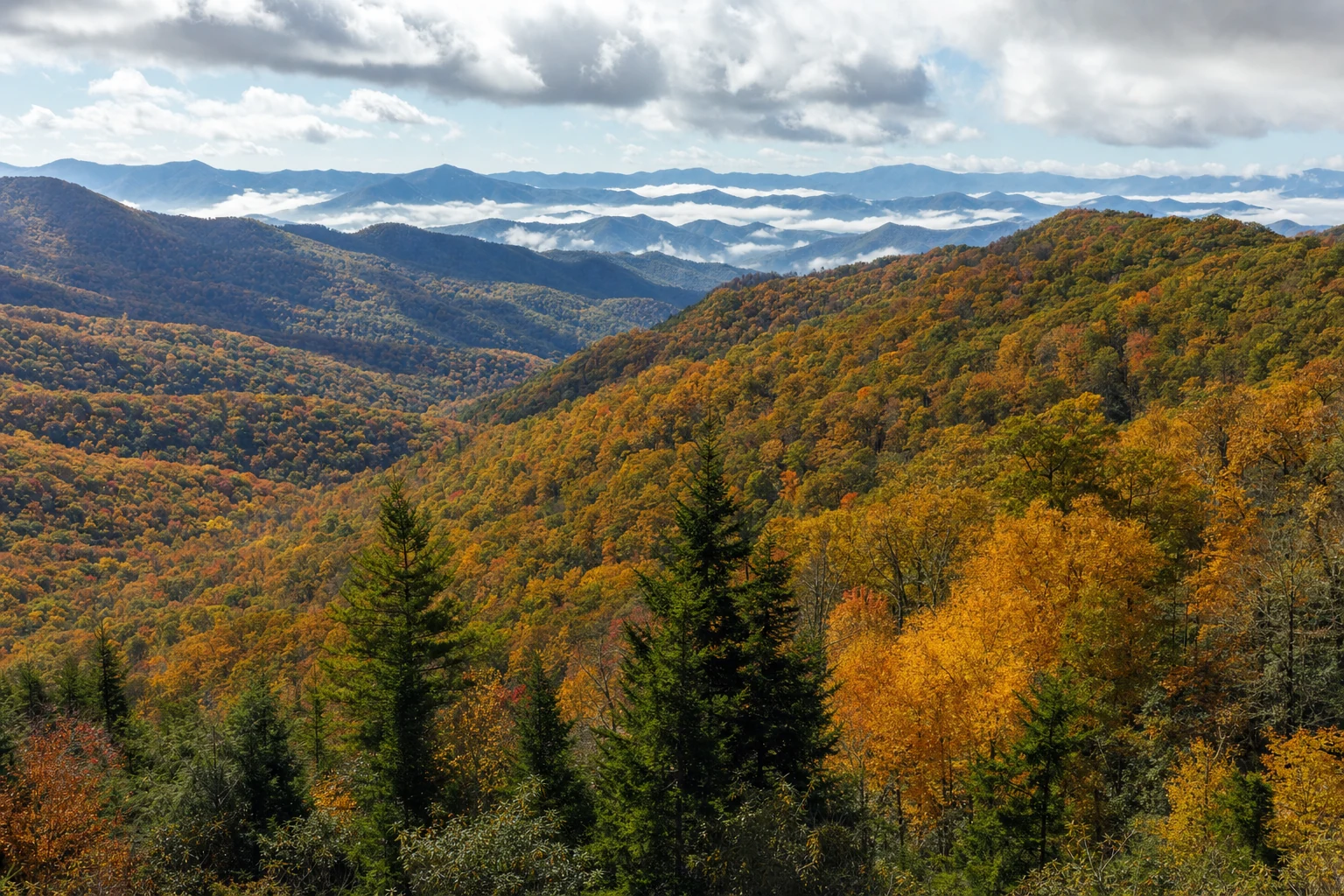

About Hooper Bald Overlook (NC Side)
The banned-words reference file isn't at that path, so I'll work from the skill's documented rules and the prompt's explicit banned list. Writing the copy now.
---
Most Smokies-area scenic overlooks give you a window through the trees: guardrails at the edge, canopy pressing overhead, trunks on either side boxing in the sight lines. Hooper Bald works on a different premise. The overlook sits on an open mountain bald where the vegetation drops away near the summit and the horizon opens in every direction, giving you a genuinely unobstructed panorama that most ridge pullouts can only approximate from a single angle. It's one of the key stops on the North Carolina side of the Cherohala Skyway, and if you're planning a loop from the Gatlinburg area, this is the overlook worth building your timing around.
What the view actually is
From the bald, you're looking out over stacked Appalachian ridges, each range fading from green to blue-gray as it recedes into the distance. High-elevation air tends to be cooler and cleaner than what you get lower on the drive, which matters for how far you can see on a good day. On a sharp fall morning, the long-range views are clear enough to pick out individual ridgelines well into the distance; on a humid summer afternoon, haze settles into the valley gaps and softens everything into something more atmospheric, less precise. Neither condition is wrong — they're just different experiences of the same place.
The bald setting is the defining variable here, and it's worth understanding what it means. Southern Appalachian balds are naturally treeless patches that persist near summit elevations for reasons ecologists still debate. What that produces for a visitor is simple: nothing cuts off the sky above you, and no canopy limits your peripheral range. At a standard forest-edge overlook, you work around the trees — finding the right slot, managing what the frame crops. Here, you turn 360 degrees and ridgelines keep appearing. That distinction is real, and it puts Hooper Bald in a different category than most of the Skyway's other named stops.
When to visit
Sunrise and sunset are the right calls. On an open bald, golden-hour light hits the ridge faces laterally, pulling depth out of every crease and valley in a way that midday overhead sun flattens entirely. The parking lot is moderate-sized, so arriving before dawn is realistic without the competition you'd face at a major park trailhead. If you want the full color progression from silhouette to lit landscape, plan for first light.
Fall is the Cherohala Skyway's peak season, and Hooper Bald earns its place in that window. The elevation here means color arrives earlier than in the valleys below; the surrounding forest follows across the subsequent weeks. You're not locked into a single peak-color weekend — there's a longer window than most people plan for. Mid-October on a clear morning, before afternoon haze accumulates, tends to produce the clearest long-distance views. Weekend traffic picks up significantly during the fall rush; arrive early or shift to a weekday if crowds matter to you.
Summer visits are feasible, with one pattern to plan around: afternoon thunderstorms build over the ridges on most days, typically developing from mid-morning onward. Get there early and you'll usually beat them. Winter access hinges on road conditions — the altitude that makes the views exceptional also puts this section of the Skyway in the zone where ice forces closures without much lead time. The road doesn't see winter maintenance. Check conditions before you commit to a long drive; the upper sections can be gated while lower-elevation roads look completely clear.
Getting there
Hooper Bald Overlook sits on the North Carolina side of the Cherohala Skyway, a scenic two-lane road that crosses the Appalachian ridge between Tellico Plains, TN and Robbinsville, NC. Visitors coming from Gatlinburg typically approach via the GSMNP corridor south toward Robbinsville, then pick up NC-143 heading west as it begins the climb into Nantahala National Forest. The road gains elevation steadily; Hooper Bald is in the upper portion of the NC side, past Santeetlah Overlook and a handful of smaller pullouts.
There's no entrance fee. The Cherohala Skyway runs through national forest land on both sides — this isn't a national park admission situation. What the drive costs is time, and that's the thing to account for. Build at least half a day into a meaningful Skyway loop from Gatlinburg; more if you're stopping seriously at multiple overlooks instead of just rolling through.
Cell service fades substantially on the upper Skyway. Download offline maps before you start and note your planned stops in advance. There are no services of any kind on the Skyway itself; fuel and food need to happen in Robbinsville or Tellico Plains before the road climbs.
Pairing with other overlooks
Hooper Bald makes more sense as part of a sequence than as a stand-alone destination. Santeetlah Overlook, lower on the NC descent toward Robbinsville, looks out over Lake Santeetlah through a forest-and-mountain composition that's visually opposite to the open-bald panorama at Hooper Bald; running both on the same drive is worth it specifically because they don't repeat each other. Toward the TN/NC border, Unicoi Crest sits near the Skyway's highest elevation and delivers long-range views in multiple directions — include it if you're running the full route.
Between the named stops, informal pullouts appear wherever the road crests a ridge. Don't write them off. Some offer views as strong as the designated overlooks, just without a formal lot. If you see a reasonable shoulder and the view opens up, it's worth stopping.
What to know before you go
The overlook has no facilities: no restrooms, no water, nothing to buy. The parking lot is moderate-sized and handles a normal day's traffic without difficulty, but peak fall Saturdays with clear skies can fill it earlier in the morning than you'd expect.
High-elevation Skyway sections close when ice forms, and Hooper Bald's position on the route puts it squarely in that zone. The NC Department of Transportation posts current road conditions, and checking before a long drive is two minutes well spent. Late-season spring storms can produce the same situation. When the road is clear, though, the overlook requires no hiking — you pull off, walk the short distance to the open bald, and the view is immediate. That accessibility makes it viable for visitors who can't commit to a long trail, which is part of why it draws the crowd volume it does on good-weather days.
---