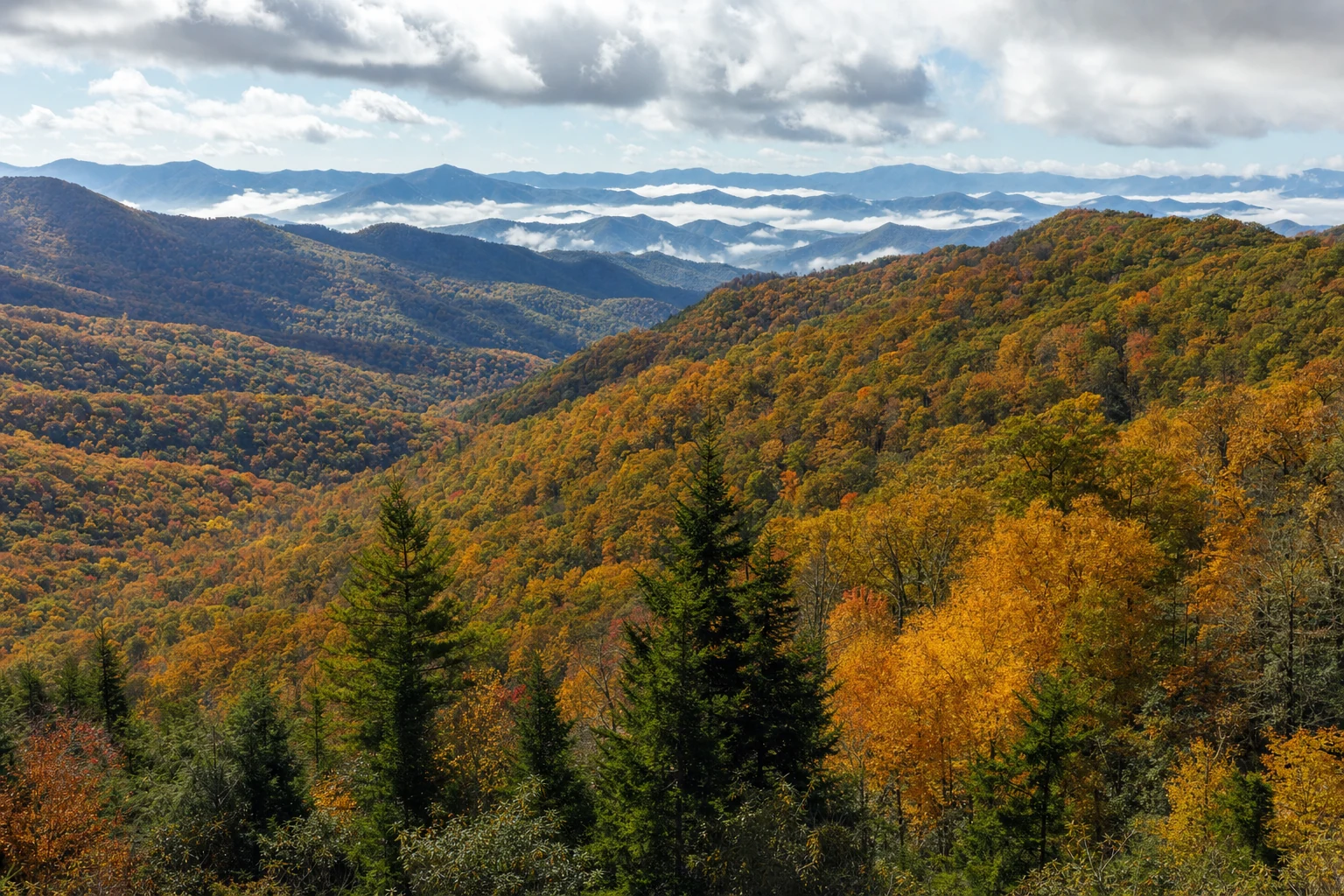

About Look Rock Overlook (MP 43)
Look Rock at milepost 43 is one of the few Foothills Parkway stops where the main feature isn't visible from your car window. A short trail leads up from the large parking area to a historic fire tower, and the tower is the point. Once you're at the top, the panorama earns its reputation: the main Smokies ridgeline to the south, the Tennessee Valley spreading wide to the north, and on a clear day, the Cumberland Plateau in the far distance. Most overlooks give you a slice of view; this one gives you all of it simultaneously.
The Fire Tower
The trail from the parking area is short, and most visitors who stop here reach the tower without difficulty. What the tower provides that the parking area itself cannot is clearance above the tree line, which is the entire reason the 360-degree view is possible. From ground level, the surrounding forest would reduce your sightlines to a narrow corridor in one direction, same as most other stops on the parkway. The tower lifts you above that problem.
From the platform, the view organizes into distinct layers. The Smokies ridgeline runs across the southern horizon in rolling waves of forested peaks. To the north, the Tennessee Valley opens wide — agricultural, expansive, surprisingly different in character from the dense mountain terrain you drove through to get here. Look far enough north or northwest on a clear day and the Cumberland Plateau comes into view. The total horizontal reach of that panorama is among the longest sight lines accessible from any easy stop in this part of the park system.
Reading the Light
The standard advice holds up at Look Rock more than at most places: sunrise for mist in the valleys, sunset for dramatic colors. What makes it worth taking seriously here specifically is the orientation of the view. Morning fog pools in the Tennessee Valley and drifts between the Smokies peaks before it burns off, and from the tower platform you watch it from above rather than from within it. That's a different experience than standing inside the fog at road level.
Sunset works differently. The light moves across that much terrain slowly, and the color progression takes longer to develop and longer to fade than it does from a constrained viewpoint. Arriving before the actual sunset time rather than at it usually produces better results. Once the sun drops behind the ridge, the show is largely over.
Overcast days are worth considering too. Fog at elevation can reduce visibility significantly, but when it breaks partially, alternating bands of clarity and cloud across the ridgeline often make for more interesting photography than a clear blue sky does. This is a spot where flat light and drama aren't mutually exclusive.
Crowds and Timing
Look Rock draws moderate to high visitor volume, with late afternoon and sunset hours seeing the most traffic. The parking lot is large by Foothills Parkway standards, so finding a spot is rarely the problem. The tower platform itself is a different matter — it's small, and at peak times there's a wait to get to the railing. If that bothers you, early morning is the straightforward solution. Midweek mornings in the shoulder seasons, early May or mid-October, are about as quiet as this stop gets.
The crowd here skews toward photographers, which shapes the dynamic at golden hour. Tripods at the railings, people holding position for the light — it's friendly enough, but it's not peaceful. The 7am crowd on a Tuesday in April is a completely different scene.
Getting There
Look Rock sits on the Foothills Parkway, which runs along the northwestern edge of Great Smoky Mountains National Park. From the Wears Valley side, US-321 connects to the Foothills Parkway entrance, and milepost 43 is a straightforward drive along the parkway from there with no navigational complications. The parkway is a scenic road with a clear beginning and end, and the Look Rock parking area is well-marked.
From Gatlinburg, the Sugarlands Visitor Center is the natural starting point before heading toward the park's western reaches. From Cherokee or the Oconaluftee entrance, Look Rock is a longer drive and typically warrants a dedicated trip rather than a casual add-on.
A Park-It-Forward parking tag is required for any stay over 15 minutes inside Great Smoky Mountains National Park. Tags run $5 for a single day, $15 for a week, or $40 for an annual pass, available through recreation.gov or at park entrance kiosks. For sunset visits specifically, the parking lot fills fastest in the final two hours before dark, so arriving with extra time is worth planning for.
Road Conditions
The Foothills Parkway is not maintained to winter interstate standards. When temperatures drop and ice forms, sections close, and the Look Rock area is at elevation, which means it ices faster than the valley roads below. Before driving up between November and March, check the park's current road conditions — closures can happen quickly and with limited warning.
Summer brings a different consideration: afternoon thunderstorm season in the Smokies is real, and the fire tower is an exposed position at elevation. If clouds are building to the west, the sensible move is to get off the tower and back to the parking area. This isn't a rare scenario in July and August; plan your arrival time accordingly.
Pairing With Other Stops
The Foothills Parkway West section that includes Look Rock offers several other overlooks within easy driving distance, each with a distinct character. Chilhowee Mountain Overlook at milepost 39 looks out over Chilhowee Lake and the surrounding mountains rather than the broad Tennessee Valley, making it a genuinely different experience in close proximity. The Little River Gorge Overlook at milepost 35 is different still — you're looking down into a deep, forested canyon carved by the Little River, which is the visual opposite of the open panorama at Look Rock. Pairing the two on the same drive makes the contrast between them land harder than either stop does on its own.
For a full Foothills Parkway West experience, the drive from the eastern terminus near Walland to the western end takes under an hour with no stops. Most people stop several times. Look Rock is the anchor of the route; the other overlooks fill in the surrounding picture on the way up or down.