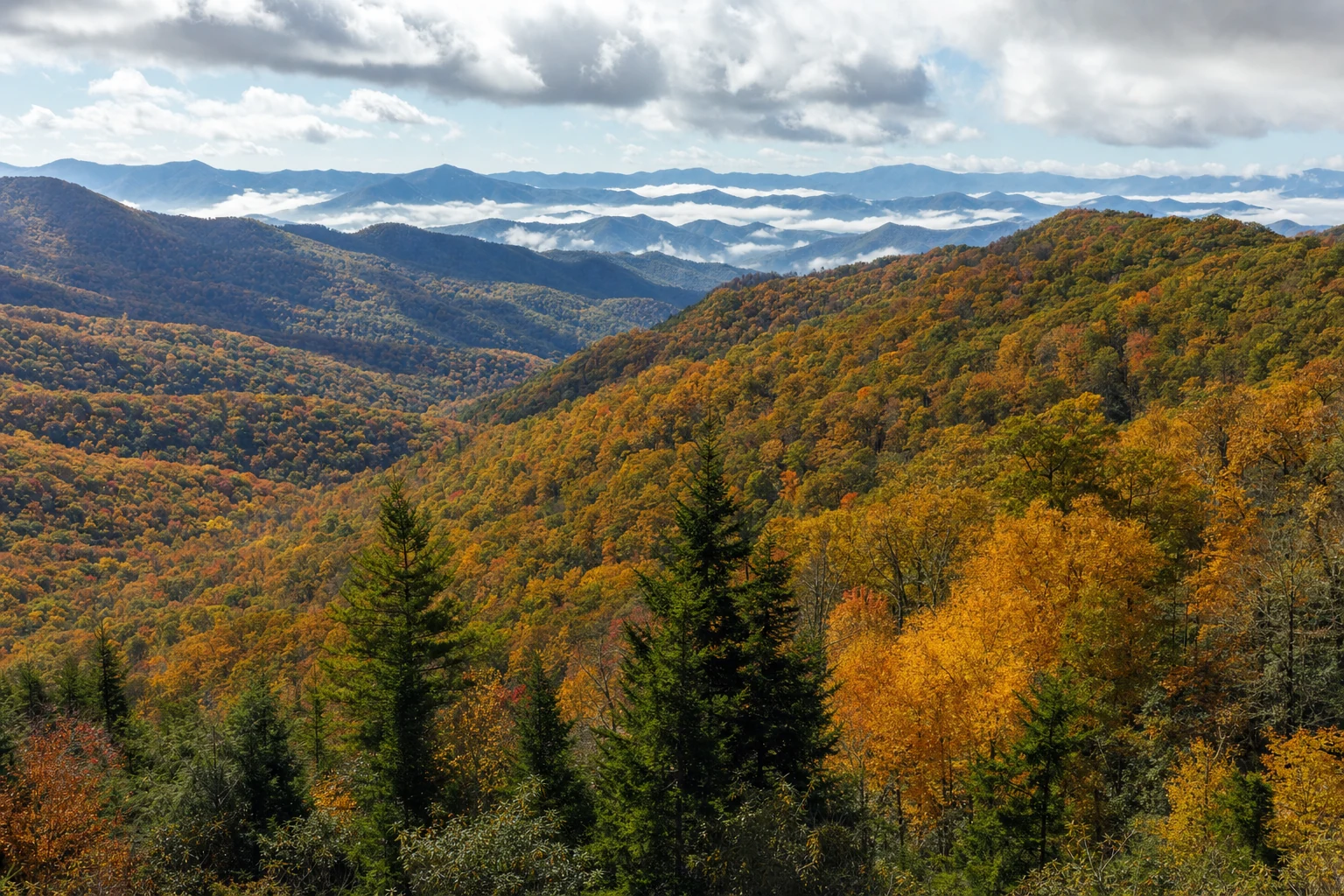

About Mill Creek Pullout
Mill Creek Pullout is a small roadside stop in Great Smoky Mountains National Park that trades panoramic scale for something closer and quieter. The view isn't a distant ridgeline; you're looking into the creek corridor itself, where water runs through old-growth forest covering both banks. On the list of GSMNP overlooks, it sits at the low-drama end — that's not a criticism.
What the view actually shows
The two main elements here are the creek and the forest, and both reward more attention than the initial glance might suggest. Mill Creek is a mountain stream with the character you'd expect from a drainage flowing through intact forest for generations: clear water moving over a stone-strewn bed, the sound carrying up to the road even from the pullout. The surrounding trees are old-growth, which in the Smokies means genuinely large trunks, a closed canopy, and an understory layered with rhododendron and hemlock. It doesn't look like the managed parks and second-growth woodlands most visitors are used to.
The absence of a distant vista is actually what defines this stop. You're not scanning a horizon; you're looking at a specific small section of a working mountain drainage inside one of the most biodiverse temperate forests in the eastern United States. That framing shift changes how the spot reads.
Crowd level is low. Partly this is because the pullout lacks the obvious drama of a high ridge view, and partly it's because the parking is genuinely small — room for only a handful of vehicles. On a busy summer weekend you may need to circle back.
Why mid-day is actually the right call
Most photography advice for the Smokies defaults to golden hour: soft angled light, long shadows, warm tones across open ridgelines. Mill Creek Pullout operates by different rules. The canopy here is dense enough that low-angle sunrise or sunset light gets blocked before it reaches the water, and what you end up with is clipped highlights competing with murky shadows in the same frame.
Mid-day overhead light clears the canopy and hits the creek surface at an angle that shows the water's texture and movement without obscuring the streambed underneath. On overcast days the advantage shifts somewhat — flat diffuse light doesn't animate moving water the same way — but overcast conditions bring out the forest greens in a way that direct sun can't match. Either way, there's no reason to set an alarm for predawn to visit this stop.
For visitors who aren't photographing: none of this changes the experience; the creek is worth watching at any hour.
Getting there
The pullout sits inside GSMNP on the Tennessee side, accessible from the Gatlinburg entrance. From downtown Gatlinburg, you enter the park at the Sugarlands Visitor Center and follow the park road network from there. Sugarlands is the natural staging point for any drive deeper into the Tennessee side, and the visitor center has rangers on duty, restrooms, and current road condition information before you commit to the route.
Parking at the pullout itself is the kind of stop where you pull off, spend 15 to 20 minutes, and continue on. Plan around that rather than treating it as a place to linger for hours; you'll arrive with the right expectations and leave at the right time.
Park access and fees
A Park It Forward parking tag is required for any stop over 15 minutes inside Great Smoky Mountains National Park. Tags are available at recreation.gov, at park entrance kiosks, and at the Sugarlands Visitor Center. The daily rate is $5, weekly $15, annual $40. If you're spending more than one day in the park, the weekly tag saves money quickly — daily passes stack up fast.
GSMNP itself charges no entry fee, which separates it from most major national parks, but the parking tag requirement applies throughout. Don't skip it; rangers do check, and the fines considerably exceed the cost of a tag.
Seasonal notes
Park roads on the Tennessee side can close when ice forms in winter, sometimes with little advance notice. Conditions in the Smokies change faster than the surrounding lowland weather suggests, and a road that's clear in the morning isn't guaranteed open by afternoon. Before visiting from November through March, check the park road status through official park resources or call the information line.
Spring and fall are peak season for GSMNP overall, but small pullouts like this one don't see the same surge as Laurel Falls or the Clingmans Dome road. If you're visiting during fall color or the spring wildflower bloom and want some distance from the main crowds, the smaller creek and forest stops along the interior roads are genuinely less contested.
Summer brings the densest canopy cover and the fullest water flow; the contrast between the shaded forest floor and the lit creek surface is at its most pronounced from June through August. Despite the park's high overall visitor numbers in summer, this specific stop stays quiet by virtue of its size.
How to pair this stop
A pullout this size works best as part of a longer drive rather than a standalone destination. The road network on the Tennessee side of GSMNP connects a series of comparable stream and forest stops, most of them small and low-crowd, that give you a fuller picture of the park's interior away from the developed visitor areas.
Sugarlands Visitor Center is the logical anchor for building that route. Check in with the rangers for current conditions, pick up maps if needed, and follow whichever road leads toward the creek corridor. Most visitors to GSMNP stick to the highest-profile destinations; the interior roads and their smaller pullouts are quieter almost by default.
From Gatlinburg the drive into the park takes only a few minutes, so this is the kind of stop you can work into an afternoon without a full-day commitment. Add two or three similar creek and forest pullouts along the same route and you have a half-day loop that shows you what the Smokies look like when nobody else is looking.