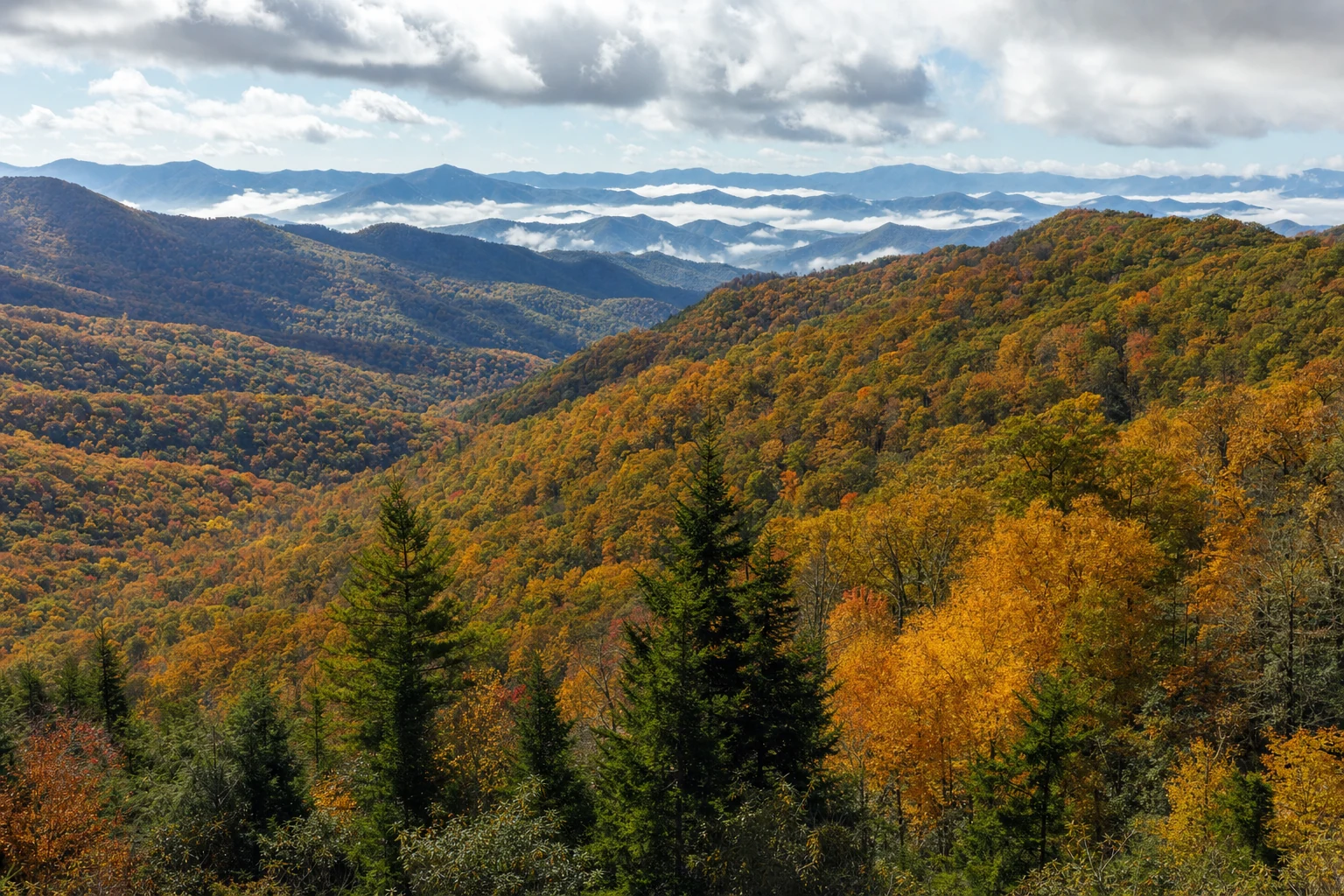

About Miller's Landing Overlook
Miller's Landing Overlook sits at roughly milepost 4.5, offering something genuinely different from most Smokies pullouts: an unobstructed view outward, across the Tennessee Valley floor and the patchwork of agricultural land stretching below, with mountain ridges rising in the distance behind you. The perspective faces away from the park interior rather than deeper into it, which changes the feel of the stop entirely.
What you'll see
The panorama here faces the Tennessee Valley rather than into the high mountain core. On a clear afternoon you can pick out agricultural fields spreading toward the valley floor, open lowland that disappears fast once you're climbing into the dense forest cover further into the park. The Smokies form the backdrop, ridge after ridge in overlapping layers, rather than filling the entire frame from close up. The composition is as much pastoral as mountainous, and that's what makes it worth the stop for visitors who've already seen a dozen forested pullouts on the same drive.
Haze is a real factor in this part of Tennessee, especially from June through August. The "smoky" effect that named the park comes from actual atmospheric moisture and organic compounds released by the trees; on humid summer afternoons, distant ridges can soften to near-invisibility. Late September through early November gives you the clearest air of the year, and you'll have fall color in the valley below to work with. Winter, on clear days after a cold front has passed, can be equally sharp and tends to be underappreciated for valley views.
Timing and light
Late afternoon is the right window. The light hits the valley floor directly in the two hours before sunset, warming the agricultural patchwork and casting shadows into the foothills. Photographers specifically favor this slot for valley-facing angles, and you'll notice most visitors with serious equipment arriving mid-to-late afternoon rather than at sunrise.
Morning isn't wrong, but it's the less rewarding choice. The valley angle simply catches better light later in the day. If you're building an itinerary, put Miller's Landing at the tail end of an afternoon loop rather than a morning start.
Getting there and parking
From Gatlinburg the overlook is accessible along the roads that trace the park boundary toward the Cosby corridor. It's a small pullout with room for roughly 5 to 8 vehicles; on busy summer weekends, particularly Saturday and Sunday afternoons, that fills faster than you'd expect. Arriving before 4 p.m., or waiting until closer to 5 when the midday crowd starts filtering back toward town, gives you a better shot at a space.
The Park It Forward parking fee applies throughout GSMNP: $5 per day, $15 per week, or $40 annually. Tags are available via recreation.gov before leaving home, or at park entrance kiosks. Stays over 15 minutes at any park pullout require one; there's no staffed booth at this specific overlook, so plan accordingly and don't count on paying cash on arrival.
Winter road conditions are worth a check. Ice events can close park roads with little warning between November and March, and the park's road status information updates regularly. A quick look the morning of your drive can save a wasted trip.
Photography
The valley-facing angle gives photographers something that most Smokies overlooks don't: foreground that isn't forest. Agricultural fields and open valley floor create depth and leading lines that work well with a longer focal length compressing the mountain ridges into the background. The sweet spot for light is the 30 to 45 minutes before sunset, when low-angle warmth catches texture in the fields and the natural haze in the Smokies atmosphere glows rather than simply obscures.
Partly cloudy afternoons tend to produce more interesting results than pure clear-sky days; light breaking through clouds adds texture and dimension to the sky above the mountains, which flat-light afternoons can't replicate. Winter afternoons after a cold front has cleared the haze out can produce unusually sharp views of ridgelines that stay invisible through most of the humid summer months.
Nearby overlooks worth pairing
The overlooks on this corridor are spaced closely enough that you can cover two or three on the same afternoon without major backtracking. A few worth folding into the same run:
- Cosby Entrance Overlook: Near the junction with US-321, low crowds, rolling foothills and distant ridges. Late afternoon light is favorable here too.
- Happy Valley Overlook: Around milepost 8, with pastoral valley scenes and a broader mountain backdrop. Morning tends to give clearer visibility across the valley at this one.
- Little River Overlook: Near milepost 12, where the view shifts to glimpses of Little River moving through forested slopes rather than open agricultural land.
None of these stops have facilities; water, snacks, and a full tank before leaving Gatlinburg are the practical baseline for any afternoon circuit.
Who this overlook suits
Miller's Landing won't anchor a full day on its own. It's a strong addition to an afternoon drive, particularly for photographers after a composition outside the standard forest-canopy frame. The valley perspective is genuinely different from the ridge-and-forest views you get at Newfound Gap or most points along the Clingmans Dome corridor. Crowd levels run low to moderate by Smokies standards, so you'll usually have the pullout to yourself or share it with just one or two other parties; there's none of the competition for position you'd find at the park's high-traffic overlooks on a summer weekend.