
About Numerous River Access Pullouts (Throughout Little River Road)
Little River Road runs about 18 miles through Great Smoky Mountains National Park, connecting Sugarlands Visitor Center near Gatlinburg to the Townsend entrance, and the river stays close to the pavement for nearly the entire distance. The pullouts along this corridor aren't formal overlooks with interpretive signs and paved aprons; they're small clearings, most fitting one to three cars, where the road shoulder widens just enough to stop and step out. That informality is the point.
What you're actually stopping for
The Little River isn't a slow, flat mountain creek. Depending on where you pull off and what season you visit, you might find fast rapids churning around granite boulders, still pools with visible riverbed, or narrow chutes loud enough to drown out conversation. Two stops a quarter-mile apart can look like different rivers. What they share is the canopy overhead: second-growth forest closes in from both banks, fragmenting sunlight into shifting dappled patches that move as the breeze moves. That light is genuinely useful for photography, particularly in mid-morning, when high-elevation overlooks are overexposed and flat.
The most common things people do at these pullouts: wade out onto mid-river rocks and sit; cast for trout; watch for salamanders in the shallow margins. None of that requires gear beyond shoes you don't mind getting wet, though a pair of water sandals or neoprene shoes makes a real difference on algae-coated boulders.
How to find them
There's no official list of every pullout, and you don't need one — you'll spot them as you drive. The road has no traffic lights and relatively few intersections, so slowing down when you see a clearing won't hold up a line of cars. The pullouts are distributed unevenly; some sections have them every few hundred yards, others have long stretches without a good stopping point.
A few named stops serve as useful anchors. The Sinks, around mile marker 12, is a geological feature where the Little River drops into a natural plunge basin surrounded by rock formations; it has its own parking area and is worth a dedicated stop. Meigs Creek Trailhead near mile marker 10.5 is quieter and smaller, with similar river access and lighter foot traffic. The Townsend Wye area near mile marker 18 offers a wide, calmer section of river that draws tubers in summer. These named spots are reference points, but the unmarked pullouts between them often provide equivalent or better access with fewer people around.
Parking and the Park-It-Forward tag
Every stop along Little River Road sits inside Great Smoky Mountains National Park. A Park-It-Forward parking tag is required for any stay over 15 minutes: daily ($5), weekly ($15), or annual ($40), purchased at recreation.gov before you go or at park entrance kiosks. Given that most people linger at river pullouts far longer than they planned, it's worth buying the tag in advance rather than watching the clock while standing in a creek.
Parking capacity at the informal pullouts is genuinely small; one to three cars is the realistic range. If a pullout is occupied when you reach it, keep driving — another will appear within a mile. Waiting and circling isn't really an option on this road.
When to go
Morning visits are cooler and quieter, which matters considerably in July and August. The dappled canopy light tends to work best in late morning, once the sun is high enough to penetrate the tree line but not so high that it flattens the water's surface. Midday in summer brings heat even at river elevation, and the water itself becomes the main draw; that's when wading traffic peaks.
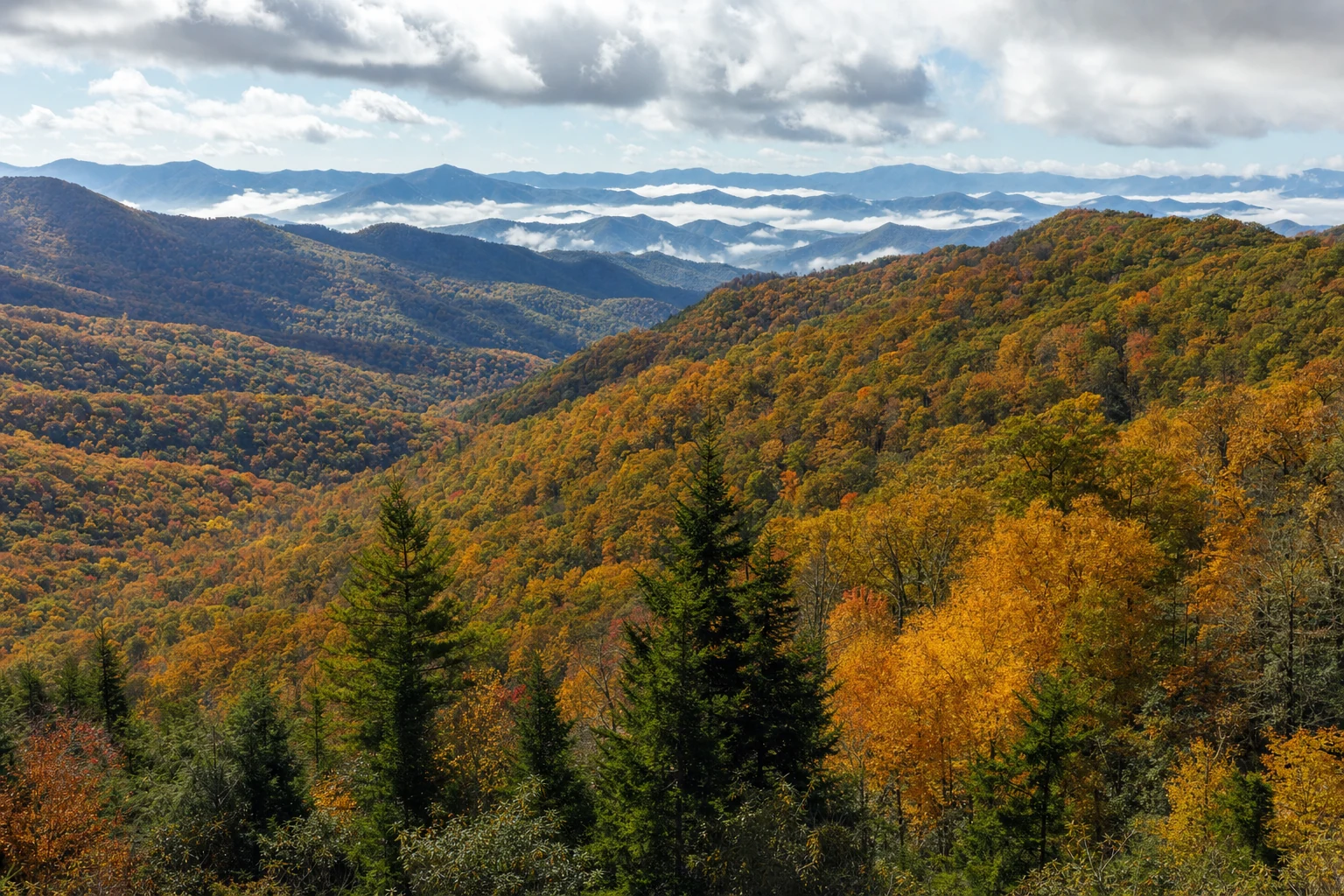
Fall deserves specific mention. The Little River corridor turns from mid-October through early November, and the combination of moving water and autumn foliage at these pullouts is better than most formal overlooks, partly because you're at river level rather than looking across a valley. Crowds moderate slightly from their summer high, though peak color weekends still bring real traffic.
Spring runoff from late February through April makes the river run fast and high; wading isn't safe during peak snowmelt, but the volume and sound of the river in that state is worth seeing from the bank. Late October through early March tends to be the low-traffic window, with some road closures possible in icy conditions — check park road status before heading out.
Who these pullouts suit
If you want an unobstructed panoramic view, this isn't it. The perspective here is close-up and enclosed: a few yards of river framed by forest, rapids breaking around a boulder you could step onto. That intimacy suits people who want to slow down and actually touch the park rather than photograph it from a distance.
Fly fishers work this corridor regularly; the Little River holds wild rainbow and brown trout, and the informal access points let you enter the water without a long approach hike. Families with younger kids find these stops practical for the same reasons: the riverbank is reachable in under a minute, there's no elevation change to manage, and shallow margins are safe for supervised wading while the main current stays visibly distinct.
Building a half-day around Little River Road
The road is most rewarding as a slow drive rather than a destination you rush to and from. Start at Sugarlands Visitor Center to pick up a park map, then work toward Townsend with no fixed schedule, pulling over when something catches your eye. Plan two to three hours minimum; four is more realistic if you wade or fish at multiple spots.
The Sinks is worth a dedicated stop for the geology alone. Meigs Creek Trailhead suits anyone who wants solitude over scenery. Laurel Falls Trailhead, near the Gatlinburg end, has a larger lot but fills before 8 a.m. on summer weekends — if it's full, keep driving rather than waiting. The road terminates at the Townsend junction, putting you within easy reach of Cades Cove if you want to extend the day into a longer park loop.