
About Oconaluftee Valley Overlook (NC Side)
Sitting at roughly mile marker 20.5 on Newfound Gap Road, this pullout is the first stop on the North Carolina descent worth getting out of the car for. After the road crosses the state line at Newfound Gap and begins threading down the southern slopes, the forest presses in close on both sides; this east-facing opening is where it finally parts enough to show you the full width of the Oconaluftee River valley. The lot is genuinely spacious — large enough for RVs and towed vehicles to pull in and turn around without the tight maneuvering that shorter overlooks demand.
What the view shows
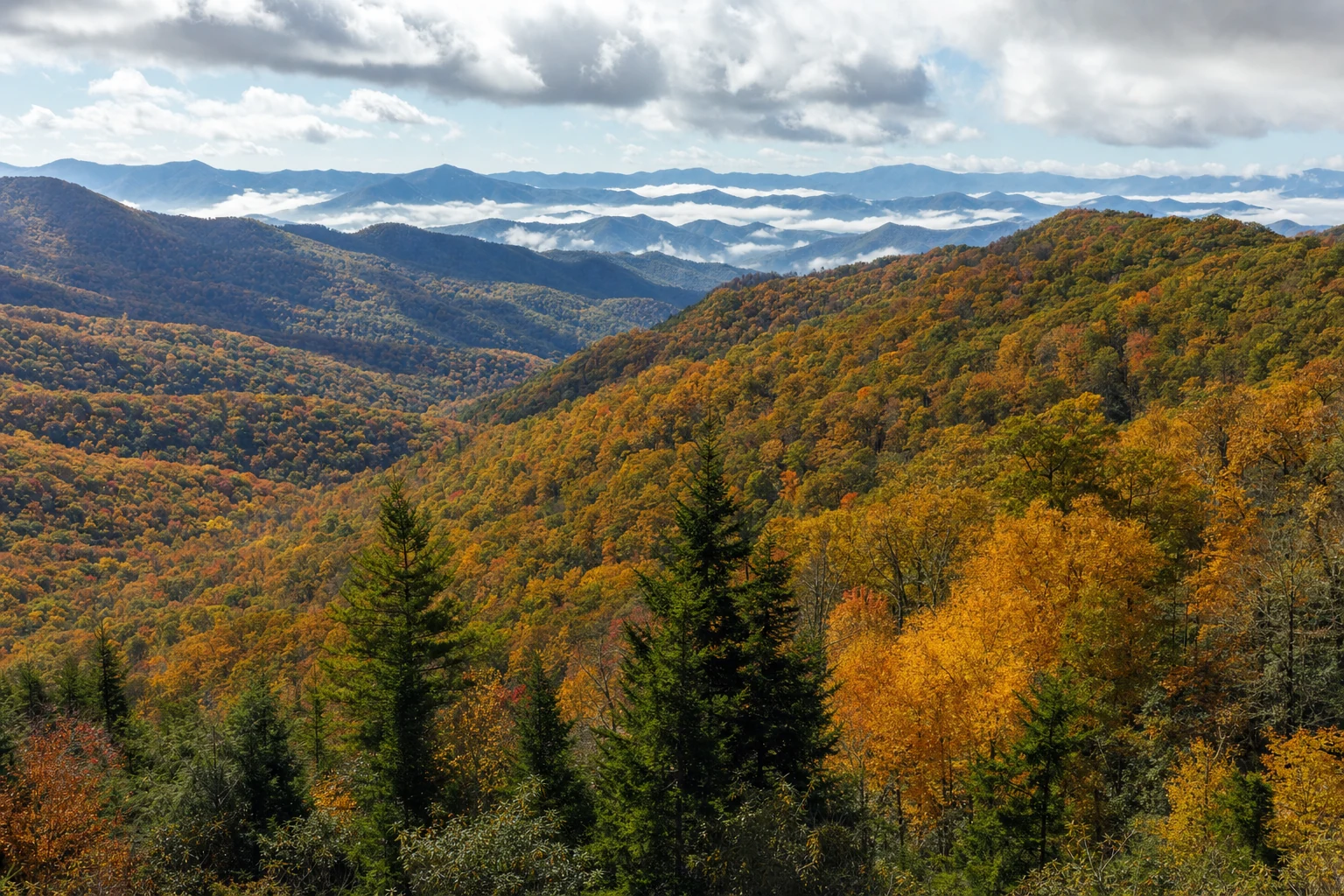
The Oconaluftee River cuts through a wide flood plain before winding south toward Cherokee, and from roughly 3,200 feet you can see across the full breadth of it: bottomland, forested slopes rising on either side, distant peaks closing off the far end of the frame. Most overlooks on the Tennessee side of Newfound Gap Road look out across ridgelines at roughly equal elevation. This one looks down, which reads differently. You're above the valley floor by enough that the river's course is visible as a distinct feature, not just a line you know is somewhere below the trees.
On clear mornings, especially after rain or during humid weather, the valley holds mist for an hour or two after sunrise while the higher ridgelines are already in full light. That layering — fog in the bottom, lit slopes above — is what most classic Smokies photography captures, and this overlook is one of the more reliable places to find it without leaving the road.
The valley has a long history before the park existed. The Eastern Band of Cherokee lived and farmed here for centuries, and the lower stretches of the valley outside the park boundary remain part of the Qualla Boundary, the federally recognized Cherokee lands adjoining Cherokee, NC. The park's upper corridor has been in continuous protection since 1934, which accounts for the forest density and structural complexity you're looking at.
Timing the light
Morning gives you the most to work with. As the sun clears the eastern ridge, it fills the valley floor while the far slopes are still warming up, producing good depth across the whole scene. By mid-morning the light gets flat, and haze builds throughout the day in summer; the Smokies are named for the blue-gray atmospheric effect the trees themselves produce, and on humid days that haze can cut visibility considerably before noon. Late afternoon shifts the conditions in a different direction: as the western ridgelines catch the low sun, the valley walls develop topographic definition that earlier light entirely obscures.
Fall color at 3,200 feet typically peaks in the second half of October, though it varies by a week or more year to year. The oaks and maples here color later than the high-elevation forests near Newfound Gap but earlier than the valley bottoms around Cherokee. On a single drive down Newfound Gap Road in mid-October you'll pass through the sequence in roughly that order, from bare upper canopy near the state line to full peak here to still-green bottomland south of the park boundary.
Getting there
The overlook is accessible only by driving Newfound Gap Road (US-441), the 33-mile paved route between Gatlinburg and Cherokee. Coming from Gatlinburg, pass through the Sugarlands area, climb through the Tennessee-side overlooks, cross the state line at Newfound Gap (just over 5,000 feet), and descend about six miles to the pullout on your left. Coming from Cherokee, it appears on your right as the road climbs; the uphill approach gives you a bit more time to spot it.
There's no kiosk at the overlook itself. A Park-It-Forward parking tag is required for any stop inside Great Smoky Mountains National Park longer than 15 minutes; daily tags cost $5, weekly $15, and annual $40, available at recreation.gov or at kiosks near the main park entrances. Buy one before you arrive.
High-elevation sections of Newfound Gap Road close during winter ice events, sometimes for hours and sometimes for days. The NC descent tends to stay icy longer because it stays shaded through the morning. Check the National Park Service road status before heading up between late November and March.
Crowd levels
Moderate, by Smokies standards. Newfound Gap draws very large numbers year-round, and nearby overlooks absorb some of that overflow, but at mile 20.5 things thin out noticeably, especially on weekdays. Fall foliage weekends are the exception: on a mid-October Saturday after 9 a.m., the lot fills and turnover is slow. Weekday mornings solve both the crowd problem and the light problem simultaneously.
If you're specifically chasing the valley mist effect, you don't need to arrive before dawn. Unlike Newfound Gap, there's no hike to do from here, so the lot never fills as dramatically at first light as the trailhead pullouts do. Before 8 a.m. on any fall weekend is a sensible target; most other times you'll have room to move around.
Nearby stops worth pairing
Newfound Gap, six miles north toward Gatlinburg, is the road's highest point, the Tennessee-North Carolina state line, and the location of both the Rockefeller Memorial and the Appalachian Trail crossing. Sunrise there is worth planning around if you're willing to drive up before daylight.
Mingus Mill, about three miles south near mile marker 23.5, is a working 19th-century grist mill powered by a turbine wheel. Free to visit, and the mill actually runs during warmer months. It draws far fewer visitors than its proximity to the main road would suggest.
Webb Overlook, a short distance south near mile marker 26, sits at around 3,000 feet and faces east like the Oconaluftee Valley Overlook. Similar view, slightly lower elevation, slightly different angle on the valley's curve. The two stops are close enough to combine without doubling back.
Oconaluftee Visitor Center, a few miles further south near the park boundary at Cherokee, has ranger staff, Cherokee history exhibits, and the Mountain Farm Museum, a collection of original Appalachian farm structures relocated to a single outdoor site. It's the natural stopping point if you're driving the NC corridor from end to end.