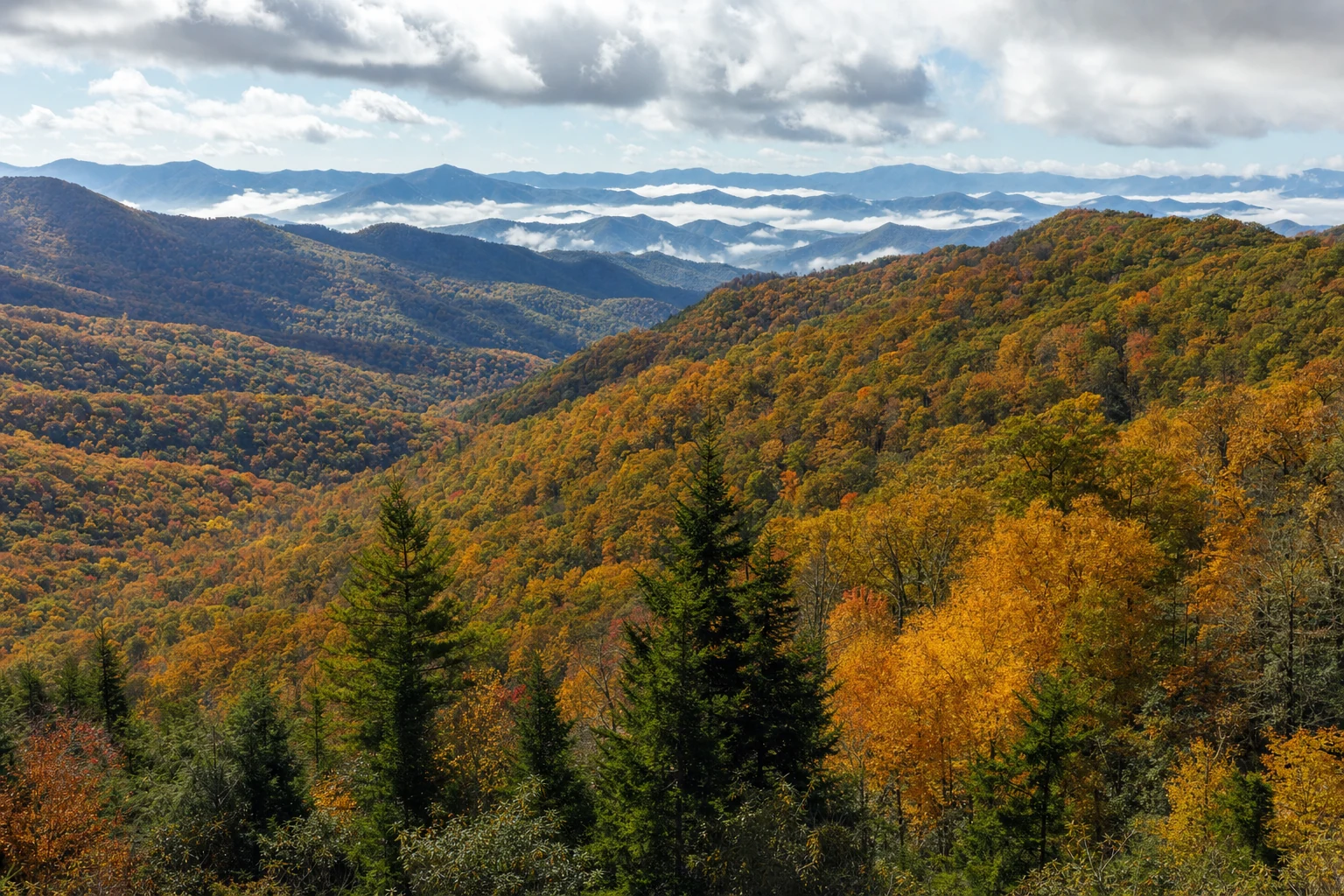

About Stratton Ridge Overlook (TN Side)
Stratton Ridge Overlook sits on the Tennessee side of the high-elevation scenic route through this corner of the Southern Appalachians, delivering views of rolling forested ridgelines and the more distant mountain ranges that pile up to the horizon. It draws a low crowd and uses only a small pullout, which makes it less of a destination in its own right and more of a quiet pause in a longer drive — the kind of stop where you can actually stand at the railing without a tour bus emptying out behind you.
What You'll See
The view here is wide but unhurried. Stratton Ridge itself anchors the foreground, its rounded contours covered in dense hardwood and conifer mix that shifts color dramatically in autumn. Beyond it, successive ridges recede into the distance, the furthest ones softening into pale blue-grey depending on humidity and time of day. It's a classic Southern Appalachian layered-ridge panorama rather than a dramatic drop-off or cliff edge — the kind of view that rewards a few minutes of quiet looking more than a quick phone shot and return to the car.
Because the crowd level is consistently low, you have time to actually study the topography. On clear days you can trace individual ridgelines well into the distance. When haze builds in the valleys — common in summer afternoons — those distant ranges take on a watercolor quality, though visibility drops accordingly.
When to Visit
Mid-day is the confirmed best light for Stratton Ridge Overlook. That may seem counterintuitive — photographers usually chase the golden hours — but the orientation and terrain here mean that the midday sun illuminates the full depth of the ridge system rather than casting parts of it in shadow. If you're visiting primarily to photograph the landscape, plan to arrive between late morning and early afternoon.
That said, the overlook works reasonably well throughout the day for general sightseeing. Early morning can bring low cloud or mist in the valleys, which creates atmospheric conditions even if the light isn't optimal for technical photography. Late afternoon is acceptable but not ideal — the light goes flat before it goes golden, and the haze tends to thicken.
Seasonal timing matters considerably. Fall foliage transforms the view entirely: the rolling hills become a mosaic of orange, red, and yellow that makes the mid-day light recommendation even more relevant, since direct overhead sun saturates autumn color better than angled early or late light. Aim for mid-October on the Tennessee side for peak color at this elevation, though that window shifts a week or two in either direction depending on the year.
Spring brings a different kind of interest — redbud and dogwood appear in the lower elevations, and the overall greening of the ridges happens in visible waves as the season climbs upslope.
Logistics and Parking
The pullout here is small. There's room for only a handful of vehicles, so if you arrive and find it occupied, circling or waiting is your only real option — there's no overflow lot. The practical move is to stop here as part of a planned sequence of overlooks rather than making a special trip specifically to this one. Given the low crowd levels typical of this stop, finding space is usually not a problem, but it's worth keeping in mind on peak fall weekends.
If you're visiting within Great Smoky Mountains National Park, a Park It Forward parking tag is required for any stop over 15 minutes. Tags are available at park kiosks and through recreation.gov — daily, weekly, and annual options are offered at $5, $15, and $40 respectively. Have one before you pull in rather than scrambling for it at the overlook.
High-elevation roads in this part of the park and the surrounding national forest can close in winter when ice accumulates. Before making the drive, check road status through the National Park Service or the relevant forest service district. A trip planned around this overlook specifically could be cut short if conditions push a closure.
Pairing With Other Stops
Because this overlook works best as part of a longer scenic drive rather than a standalone destination, it fits naturally into a sequence with other pullouts along the same route. The research on this corridor lists Turkey Creek Overlook immediately to the west — a stop that looks down into a deep forested valley rather than across ridgelines, giving visual contrast if you hit both. The Cherokee National Forest Overlook follows to the east, offering a broader forest canopy view. Further along, Unicoi Crest Overlook near the Tennessee-North Carolina border is the standout of the corridor: a large lot, exceptional long-range sightlines, and the kind of panoramic scope that justifies the drive on its own.
Planning to hit Stratton Ridge as one of four or five stops along this route gives you variety in viewpoint type — valleys versus ridges versus high balds — while Stratton Ridge itself contributes the quietest and most unhurried experience of the bunch.
Who This Overlook Suits
Stratton Ridge works particularly well for visitors who want a low-key addition to a scenic drive without fighting crowds for space. It's not a pull-out-all-the-stops destination, and it doesn't need to be. If you're driving the Tennessee side of this high-elevation route, it earns a stop of five to ten minutes: step out, read the ridgeline, let the distance register, then move on. Photographers on a mid-day schedule shooting fall color will get the most out of it. Everyone else benefits from the fact that there's almost never anyone else there.